The clutch is a small part on which to hang an ambition. Yet Mohal Lalbhai’s account of building an electric motorcycle comes with a memorable casualty list: roughly 250 clutches, burnt through in the first two years of development. The rider was supposed to make a familiar movement. Getting the machine to accept it took considerably more persuasion.
Lalbhai, the co-founder and Group CEO of Ahmedabad-based Matter, had committed to an electric motorcycle with manual gears. The AERA would let riders shift for themselves. That choice gives his story its peculiar charm. Here was a company working on the future of mobility, expending time and money to preserve something a motorcyclist already knew how to do.
There is a temptation to treat familiarity as an absence of invention. Lalbhai’s career suggests another possibility: sometimes the familiar is the brief. The battery can change. The source of torque can change. The person in the saddle still has expectations, and a foot that knows where the gear lever belongs.
A materials student meets a motorcycle problem
Before Matter, there was materials science at the University of Sheffield. Lalbhai’s early business career included founding Lalbhai Composite Solutions in Ahmedabad in 2014. He subsequently worked on research and development at Ethereal Machines in Bengaluru. Ethereal received a CES Best of Innovation Award in 2018. His route into motorcycles therefore ran through the practical business of making things.
Composites, manufacturing equipment and vehicle components belong to different markets, but they share a certain discipline. An appealing idea must eventually survive contact with materials. The drawing has to become an object. A physical product offers abundant opportunities for reality to express an opinion.
By 2018, Lalbhai was discussing electric mobility with the people who would become his fellow founders. Matter began in January 2019. His interest extended beyond selling a vehicle: the company would work on electric mobility and energy storage. A battery could serve a rider, a building or a larger power system. The motorcycle was one way into a broader energy problem.
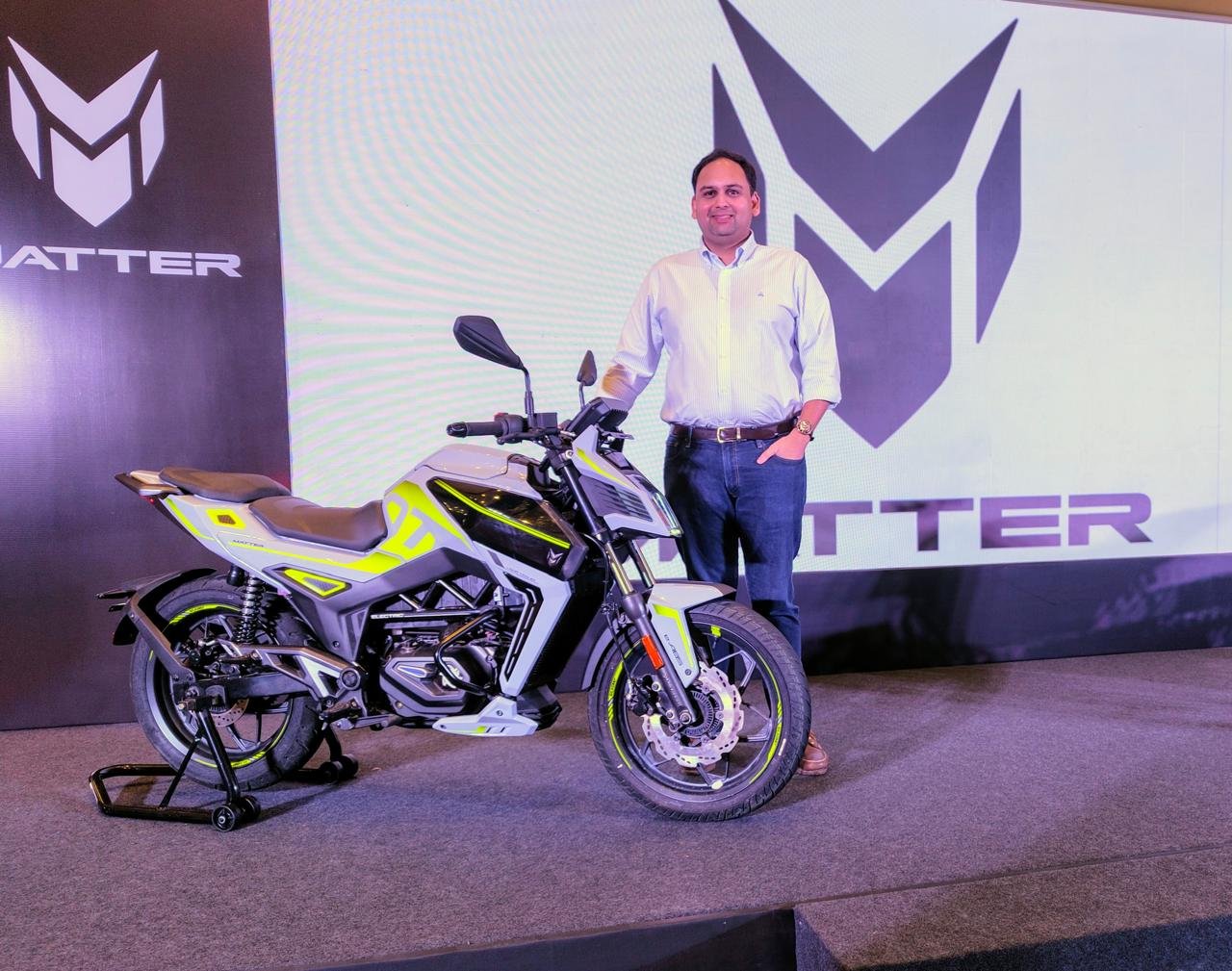
Four founders, two meanings of Matter
Companies often acquire an elaborate explanation for their names. Matter began with a pleasing disagreement. For Lalbhai, the word connected to materials and the small building blocks of the physical world. For co-founder Saran Babu, it carried the sense that experience and ownership matter. They arrived at the same word by different routes.
The founding group brought together Lalbhai, Arun Pratap Singh, Saran Babu and Kumar Prasad Telikepalli. Singh’s earlier experience included years selling YOBykes. The team had encountered electric vehicles before the current product cycle, including their shortcomings. That experience gave the new business a practical comparison: the petrol vehicle a customer could already buy.
In 2021, Lalbhai described price relative to performance as his guiding measure. Low running costs helped make the case for electric power, but the purchase still had to make sense. For a founder trained to consider what materials can do, the commercial question was equally concrete: what would the rider get for the money?
“In India, we look at service before product.”
Mohal Lalbhai, January 2024
Ahmedabad’s less glamorous advantage
Choosing Ahmedabad placed Matter near an industrial ecosystem. Lalbhai has pointed to Gujarat’s automotive suppliers and power-electronics capabilities as reasons to build there. A hardware company needs people who can make parts as much as people who can imagine them. Proximity changes the daily work of turning a specification into something repeatable.
Recruiting talent to Ahmedabad presented its own difficulty, he acknowledged. The location had to be explained to prospective employees. His description of hiring emphasised willingness to learn across disciplines; Babu’s architectural background offered one example of the range he valued. The company would need people prepared to cross professional boundaries along with geographical ones.
His stated preference for frugality fits this setting. The word can sound joyless until it is attached to a product a customer must afford. Waste in development and complexity in production eventually arrive somewhere on the bill. For Lalbhai, the promise of locally developed technology carried an obligation to make the economics work.
The rider’s foot gets a vote
The AERA’s four-speed gearbox is the most visible expression of the brief. Most electric two-wheelers use a single-speed arrangement. Matter chose manual shifting, retaining a clutch lever and the familiar location of the gear control. A customer encountering electric propulsion could still recognise the choreography.
Lalbhai has described two reasons for the transmission: controlling torque delivery and letting the motor operate efficiently across different conditions. Alongside those engineering arguments sits an emotional one. Riders who want to change gear associate the action with control. The move to electric power need not remove that involvement.
The development account supplies a useful corrective to the neatness of the finished product. An electric motor’s torque characteristics forced the team to reconsider the transmission’s materials, geometry and controls. The gearbox influenced the motor design, which in turn had to work with the electronics. A decision made for the rider spread through the machine.
Conceptual explanation of Matter’s approach. Not a performance chart.
The result also contains an electric twist: the motorcycle can stop without the rider pulling in the clutch. There is no engine idle to maintain. Familiarity, in this instance, comes with a small concession to convenience. Even a dedicated gear changer might appreciate the occasional favour.
A prototype leaves the drawing board
During 2019, Matter worked on the concept, assembled its team and talked with consumers and dealers. Lalbhai later dated the first prototype to June 2020. Further conversations with prospective users followed. Testing and refinement continued through 2021 and 2022, before the motorcycle was unveiled in November 2022.
That sequence matters because a finished vehicle can make its own history look inevitable. Each stage contained a different question: whether the components worked together, whether the product matched the intended customer, whether the team was ready to put it on the road. A prototype answers only some of them.
The AERA name and introductory pricing followed in March 2023. The motorcycle’s liquid-cooled battery pack, touchscreen and manual transmission made an unusual combination. Much of the engineering remained invisible to the person looking at it. Cooling systems are rarely the reason someone admires a motorcycle, although their behaviour can have considerable influence on the relationship.
- 2019Matter founded
- 2020First prototype
- 2022Motorcycle unveiled
- 2024Initial deliveries reported
The factory changes the conversation
The journey to customers took longer than the early plans. By November 2023, delivery dates had moved, and Lalbhai was discussing supply-chain difficulties. The account is a reminder that owning the design does not exempt a company from dependencies. A vehicle still requires parts to arrive, processes to settle and production to hold together.
In July 2024, Matter announced $35 million in Series B funding led by Helena. Manufacturing, the supplier network, marketing and retail were among the intended uses. The list reads like the machinery behind a launch. An investor can fund the ambition; the business must then organise the many ordinary activities that make it deliverable.
Initial AERA deliveries were reported from Ahmedabad in October 2024. In April 2025, the company inaugurated its manufacturing facility near the city and brought the motorcycle to Bengaluru. The plant’s announced annual capacity was 120,000 vehicles. Capacity describes what a facility is designed to accommodate; actual production must be earned through operations and demand.
Lalbhai’s attention to dealerships belongs in the same story. A buyer has to consider servicing as well as the ride home. His insistence on service before product gives the founder’s engineering ambitions a useful point of accountability. The person purchasing a motorcycle will eventually need somebody to answer a practical question.
The next brief lives inside the electronics
By January 2026, Lalbhai was discussing a different kind of consolidation: moving from multiple electronic control units towards a central computing core. His explanation connected simpler electronics with the ability to respond to rider inputs and operating conditions. The intended improvement included using energy more intelligently.
He also discussed reducing dependence on rare-earth materials and developing motorcycles with relevance beyond India. These are directions for the work ahead. They fit a career that began with materials and moved into the interactions between hardware, software and human behaviour. The gearbox remains visible; much of the next argument takes place inside the electronics.
The public role has widened with the company. Lalbhai speaks about manufacturing depth, reliability and the importance of Indian technology development. On LinkedIn, he returns to how a motorcycle feels on the road. The recurring concern is the rider’s experience of engineering, which has a way of making abstract claims rather concrete.
Four more motorcycles, and the work of repetition
In August 2026, Matter announced $25 million in growth capital from existing investors. Its plans included expanding manufacturing and distribution and introducing four new motorcycles over the following 12 to 24 months. The company reported 111 granted patents. Those are corporate assets and future plans, with the practical work still attached.
For Lalbhai, expansion means applying the original choices across more products and more places. The first motorcycle establishes a proposition. The next ones test whether the organisation can keep making it useful. Suppliers, retailers and service teams become participants in the founder’s promise, each with their own part to get right.
His story returns, finally, to the rider. Someone will climb aboard, put a foot near the gear lever and expect the motorcycle to respond. The years of materials work, testing, fundraising and factory preparation have to resolve into that ordinary movement. Lalbhai has spent a substantial part of his career making room for it.