A car window changes tint. The passenger notices the disappearing glare. The engineer notices something else: the layers that must remain clear, hold together and survive the demands of a vehicle. Inside that problem sits Mativ, a company whose most interesting work often disappears into somebody else’s product.
- Mativ sells films, filter media, adhesives and specialty papers.
- Its customers turn those materials into finished products.
- A merger gave it scale. Weak demand made cash generation urgent.
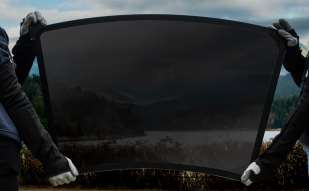
In March 2025, its Argotec brand and smart-window developer Miru presented a compound-curved electrochromic sunroof prototype measuring 1.5 by 1.6 metres. The window could change its tint; Argotec supplied the thermoplastic polyurethane interlayer film. For a materials company, this is an appealing position: contribute something essential to a product with an immediately understandable benefit.
A window is only as clever as its layers
The partnership moved beyond an exhibition specimen. In May 2025, Mativ announced a first commercial materials order from a major glass manufacturer. In January 2026, it announced an equity investment in Miru and closer coordination of manufacturing capacity. Each step addressed a different question: can it work, will somebody order it, and can the supply chain support production?

Those questions explain Mativ’s place in the market. It works between raw materials and finished goods, combining polymers, fibres and resins through processes including extrusion, coating and converting. Its contribution can be a material with a particular optical property, a layer that protects a wound, or media that helps separate contaminants from air or water.
Consider a less photogenic object: a dressing. In a Tapecon interview, Mativ’s Jon Burgoon describes a construction involving adhesive, an absorbent nonwoven layer, polyurethane film and a protective wound-contact layer. Changing thickness or material changes the result. A dressing intended for a moving joint presents different requirements from one designed around absorbency.
Another example comes from Argotec’s European medical-film expansion, completed in 2025. It included a 4,445-square-foot ISO-8 cleanroom for thin films used in wound care, ostomy products and medical-device packaging. Here, the problem extends beyond a film’s properties to the environment in which it is made and the reliability of regional supply. The customer needs repeatable production as well as a promising sample. That makes manufacturing capability part of the product being purchased.
The useful lesson for a product team is specific. Define the behaviour you need before choosing the material. Test the construction, then change the variables that disappoint. In the process described by Tapecon, Mativ helps select components and Tapecon makes a prototype. The reader can copy that sequence without owning an extrusion line.

The customer buys a result
Mativ’s portfolio can look peculiar until you consider the jobs its materials perform. Gessner supplies filtration solutions. Conwed makes industrial netting. ITASA coats and converts release liners. Scapa Healthcare develops and manufactures medical adhesive and skin-care solutions. Neenah serves specialty-paper and packaging buyers. Renfrew PRO has been making hockey tape since 1980. Somewhere between the sunroof and the hockey stick, the company’s range becomes rather memorable.
Customers include industrial manufacturers, medical-device businesses, converters and distributors. Consumer paper brands also reach retail buyers. Revenue comes from selling physical materials and products, with contract development and manufacturing in healthcare. The commercial proposition is practical: bring a difficult specification to people who understand the chemistry and the machinery needed to meet it.
That breadth is a competitive argument, rather than proof that Mativ wins every specification. Its annual report names rivals including Ahlstrom, Hollingsworth & Vose, 3M and Covestro in advanced materials, and Loparex and Mondi in selected other categories. The company says it competes on features, innovation, quality and service. The relevant comparison changes with the application. A buyer choosing a medical adhesive and a buyer specifying filter media may both deal with Mativ, but they are evaluating different technical promises and different alternatives.
Then the orders slowed
Mativ itself arrived through a corporate combination. SWM and Neenah completed their merger in July 2022, bringing together roughly $3 billion in annual sales at the time. They anticipated at least $65 million in annual cost synergies. Combining purchasing, reducing overlapping costs and sharing capabilities offered a straightforward industrial logic.
What broke first was the demand assumption. Describing 2023, management said customers’ inventory reductions became more prolonged and severe than expected, while inflation persisted. Customers could consume material already sitting on shelves instead of placing fresh orders. A supplier could retain useful technology and still watch its production volumes suffer.
The response was tangible. Mativ sold its tobacco-focused Engineered Papers business in November 2023 after announcing a $620 million transaction. Management said that business did not fit its long-term direction. Debt reduction took priority, and the annualized dividend was cut from $1.60 to $0.40 a share. The reset had a price for income-seeking shareholders.
“lower costs, improve cash flow and reduce leverage”
Kimberly E. Ritrievi, board chair, March 2025
By March 2025, the board wanted faster execution. Shruti Singhal replaced initial CEO Julie Schertell. The appointment announcement paired the leadership change with a comprehensive cost review, following more than $20 million in reductions to non-operating costs during 2024. The public explanation was urgency around profitability, cash and debt.
Useful is only half the equation
The financial results show why those distinctions matter. In 2025, reported sales rose just 0.3% to $1.987 billion. Free cash flow reached $93.8 million, up 139%. Yet the company reported a $337.4 million GAAP loss. Improved cash generation and an accounting loss can coexist; neither number should erase the other.
By the second quarter of 2026, Mativ reported $531.8 million in sales and $3.6 million in GAAP income. Adjusted EBITDA was $75 million. The improvement offered evidence of progress, although one quarter cannot establish how the business will perform through an entire cycle.
There are limits to the recipe. Customers must value the technical performance enough to pay for it. Their orders must arrive often enough to support manufacturing costs. Smart-window development still requires validation and production readiness. Mativ’s story is compelling because it contains both kinds of engineering: making the layer work, and making the business around it pay.