Consider the food pouch. We notice the printing, the spout, the promise of something convenient for dinner. Between its layers sits an adhesive with a less glamorous assignment: keep the structure together through processing and use. In retort packaging, that can mean surviving temperatures up to 135°C. Suddenly, “just glue” sounds like an ambitious job description.
- Fuller sells adhesives, sealants and coatings to manufacturers across more than 30 market segments.
- Its practical value comes from matching chemistry to a customer’s materials and production process.
- The strategy now favors specialized applications, supported by acquisitions and a smaller factory network.
A small ingredient with a large assignment
H.B. Fuller occupies a peculiar place in manufacturing. Its work is often concealed inside somebody else’s product. Full-Care adhesives help assemble disposable hygiene products. Flextra bonds flexible packaging. Kömmerling technologies serve insulating glass. Elsewhere in the portfolio are electronics materials, medical adhesives and coatings that help fasteners resist loosening.
These customers buy different kinds of reassurance. A packaging converter needs a bond that suits its films and processing conditions. A diaper manufacturer wants softness, fit and reliable assembly. A medical-device maker has its own demanding requirements. Calling all of this glue is convenient, rather as calling every vehicle a wheel is convenient.
The commercial arrangement is principally business to business: Fuller formulates and manufactures materials, sells them through customer relationships and distribution channels, and supports their application. Some products reach trade and retail buyers. ND Industries adds pre-applied fastener coating services. The important unit of value is the functioning application, which is why comparing adhesive prices alone can miss the economics.
The founder went up the ladder
The company began in Saint Paul in 1887 with Harvey Benjamin Fuller. Its early offerings included fish glue and wet paste. One detail from that period deserves more attention than the usual sepia origin story: Fuller invented adjustable scaffolding for customers hanging wallpaper.
Think about that decision. A manufacturer of paste could spend his attention on the paste. Fuller also addressed the awkward work required to use it. The scaffolding made wallpaper installation safer. There is a useful continuity between that invention and a modern adhesive supplier helping a customer test equipment settings. Both require looking beyond the material in the container.
“Connecting what matters.”
H.B. Fuller’s stated mission
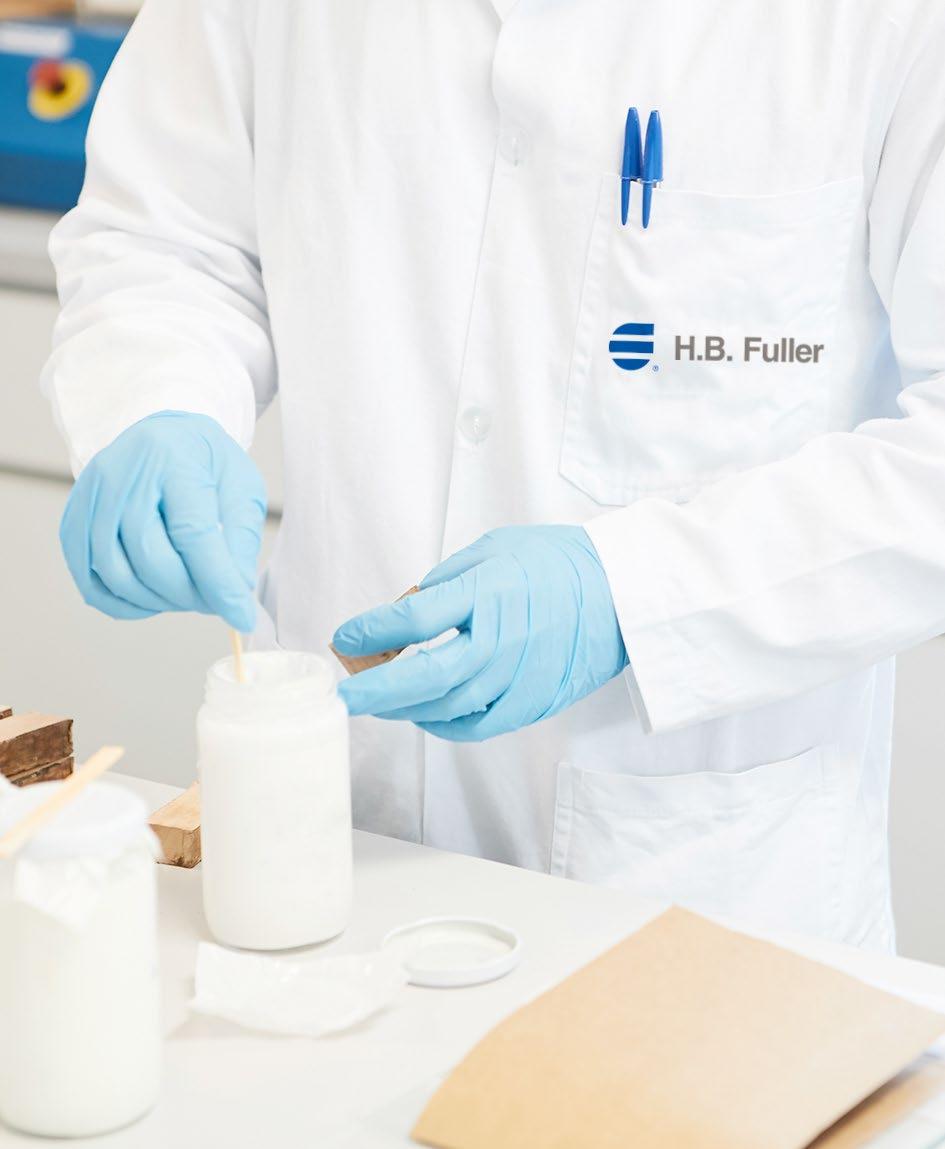
Today, that approach has physical addresses. Fuller’s technology centers connect its specialists with customers’ design and development teams. Its Lüneburg Adhesive Academy, opened in 2015, includes dedicated spaces for packaging, hygiene, beverage labeling and other applications. The Flextra offering includes operator training, regulatory work and trials on laminating equipment. A formulation has to graduate from a laboratory result to a repeatable factory process.
The pouch has another exam
Then comes the end of the product’s life. A package can perform beautifully on the shelf and still present problems in recycling. Adhesive selection becomes one more variable in a system that includes films, coatings, collection and processing.
In March 2024, Fuller announced that Flextra SBA 5250 + XA 3350 received RecyClass approval for compatibility with European industrial recycling of polypropylene flexibles. The same formulation was designed for demanding retort applications. That pairing is the interesting part: the bond must do its job during use while fitting a specified recycling process afterward.
*For the cited Flextra formulation. Diagram shows design requirements, not universal package certification.
Approval has boundaries. It does not establish that every package containing the adhesive will be collected or recycled everywhere. The complete structure and local infrastructure still count. Fuller’s separate work with Covestro illustrates another route: certified mass-balance attribution of alternative feedstock to a reactive hot melt, designed to replace an existing adhesive without equipment changes. That is a supply-chain accounting approach, with specific certification behind it.
Buying expertise costs real money
Fuller has bought its way into additional applications. The decisive example is Royal Adhesives & Sealants, acquired for $1.575 billion in 2017. Royal expanded engineering, durable assembly and construction capabilities, including insulating glass and commercial roofing. Fuller ended that fiscal year with $2.452 billion in total debt, compared with $799 million at the preceding quarter-end. Technical breadth came with a financing bill.
More recent acquisitions have extended medical and fastener technologies. The 2024 purchase of ND Industries brought locking and sealing materials, processing centers and the Vibra-Tite brand. This is a particular kind of expansion: acquire a technical capability and the customer relationships surrounding it, then give it a wider route to market.
Fuller competes with suppliers including Henkel, Bostik, Sika and 3M, depending on the application. Its case rests on formulation knowledge, service and breadth across adhesive markets. Buyers still need to qualify the actual product. Corporate scale cannot substitute for a bond that works on their substrates.

Fewer factories, harder choices
The recent business story includes subtraction. Fuller sold its North American flooring business and has described exiting lower-performing areas while directing capital toward higher-margin applications. In October 2025, its factory-network plan targeted a reduction from 82 plants to 55 over five years, with $75 million in annual run-rate savings by 2030. Those are targets, with consolidation work attached.
$3.47BNet revenue
down 2.7%
$152MNet income
reported under GAAP
17.9%Adjusted EBITDA margin
non-GAAP measure
Demand supplied a reality check. In fiscal 2025, organic revenue was flat: pricing improved 0.8%, while volume fell 0.8%. Adjusted EBITDA nevertheless rose. By the third quarter of 2026, revenue was up 5.2%; price increases again outweighed lower volumes. Sales growth and selling more material were different stories.
The lesson a manufacturer can borrow is practical: test a component against the whole job. Include production speed, waste, curing and end-of-life requirements in the comparison. That approach earns its keep when failures or process changes are expensive. Where a standard adhesive already meets the requirements cheaply and reliably, added specialization needs to justify its cost. The thin space between materials is valuable only when it solves a real problem.