At Voith, the drive-technology company, a transmission housing presented a stubborn problem: several large holes, tight tolerances, and existing machining equipment. Kennametal’s answer weighed 11.5 kilograms. Its branching, almost skeletal form looked more grown than assembled. The object was a cutting tool, made using additive manufacturing and then precision machining. In Kennametal’s account, it reduced machining time by 50% while meeting the required accuracy and surface finish.
- Kennametal makes the tools and wear parts that keep industrial production moving.
- Its sales pitch works best when buyers measure the cost of a finished part.
- Customer trials matter: a result from one machine is no promise for another.
There is a useful way to read that odd-looking object. A factory already owns a machine, pays people to run it, and has orders to fulfill. Make an operation shorter, and the same equipment can release capacity. Kennametal’s opportunity sits inside that interval. The customer buys something tangible; the interesting return arrives as time.
Eleven and a half kilograms of persuasion
The Voith project involved more than pressing “print.” Kennametal used generative design to address stiffness, balance, machining forces and coolant delivery. The cutting-insert pockets still required precision machining. The resulting shape served a demanding job; its resemblance to something from a natural-history cabinet was a consequence of engineering.
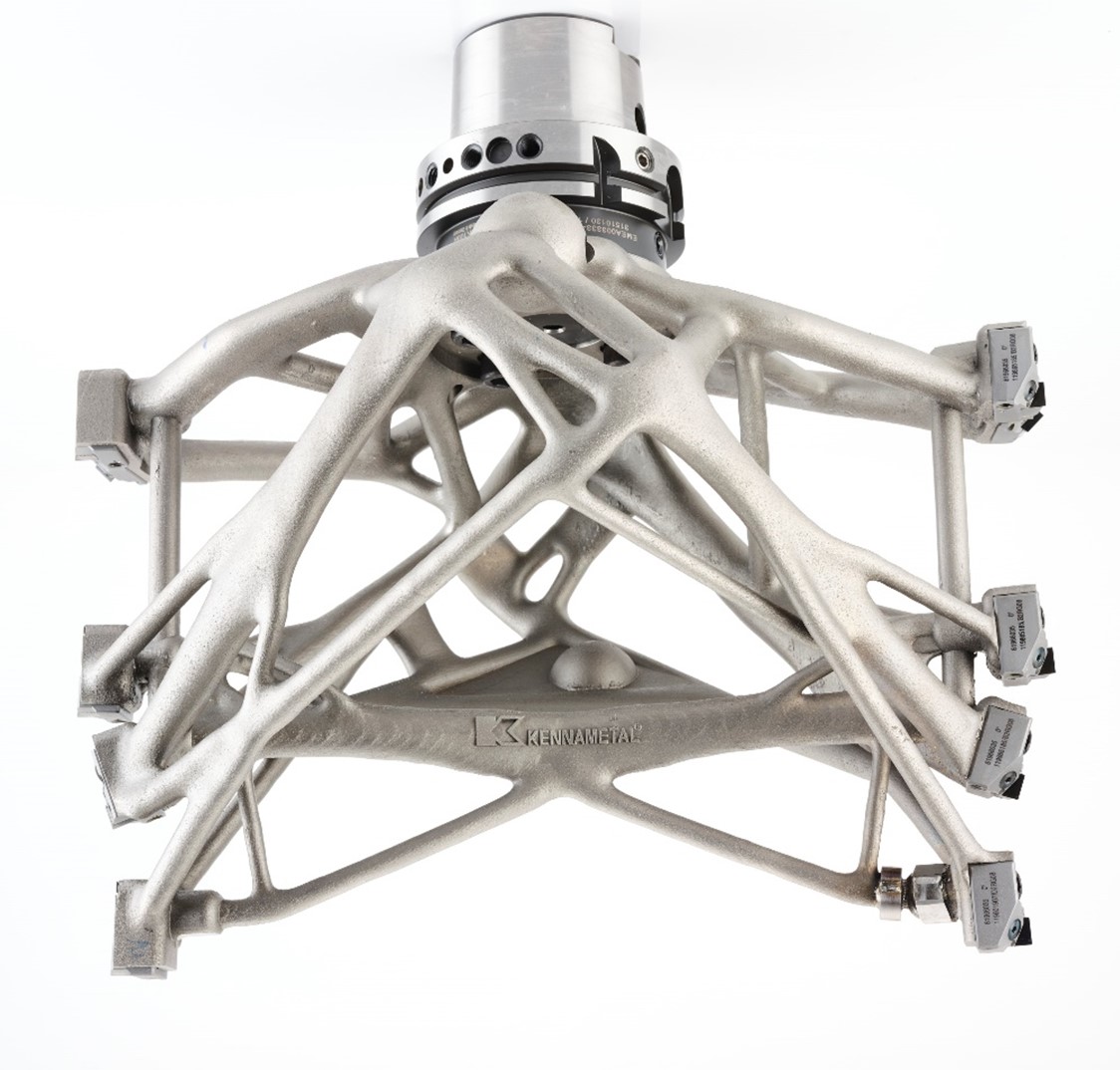
First came a prototype and trials at Kennametal’s demonstration center in Fürth, Germany. Voith then tested it on-site and in longer production runs. Further requirements went back into the design. That sequence matters. The evidence for adopting an unfamiliar tool accumulated in actual machining, where accuracy and finish had to survive alongside the faster cycle.
“Additive is one tool in our toolbox”
Werner Penkert, on the Voith project
The 50% result belongs to this application. It is a useful example of the method: identify a constraint, change the tool around it, and validate the whole operation before calling the problem solved.
The edge came first
Kennametal began with another troublesome encounter between a tool and its workpiece. Early tungsten-carbide tools could suffer chemical wear when cutting steel at higher speeds. Metallurgist Philip McKenna developed a tungsten-titanium carbide composition that resisted that problem. In 1938, he founded the business in Latrobe, Pennsylvania. It started with 12 employees and $30,000 in first-year revenue.
The material carried the Kennametal name before the company did. That is a pleasing piece of industrial history: the invention became the identity. Hardness alone was insufficient. The edge needed to remain useful while doing the work customers wanted done.
Today, that materials expertise reaches across two segments. Metal Cutting supplies tools for milling, turning, holemaking and other precision operations. Infrastructure makes engineered wear components, earthcutting tools and metallurgical powders for punishing environments. An aerospace component and a road-milling operation ask different questions of a material. Both punish an answer that wears out too soon.
The invoice misses the interesting part
Consider a medical-manufacturing example in Kennametal’s own brochure. A producer machining a cobalt-chrome knee component wanted less burr formation. A HARVI III solid carbide end mill, combined with a revised machining strategy, reportedly increased tool life by 80% and delivered nearly $80,000 in annual savings. Less subsequent work removing burrs contributed to the benefit.
Indexed tool life: previous process = 100
That last detail is the business in miniature. Count only the end mill’s purchase price, and the deburring work remains somewhere else in the accounts. Count the completed component, and the connection becomes visible. Another medical example reported a titanium humeral-stem cycle shortened by more than 40%, with tool life rising from eight pieces to 24.
The catalog includes HARVI end mills, modular drilling systems such as KenTIP FS and KSEM, turning inserts, and toolholders. Kennametal sells standard and custom products through direct and distribution channels. Replacement cutting components create repeat demand. Application engineers help select tools and develop the process that makes them earn their keep.
It competes with Sandvik’s cutting-tool brands, ISCAR and other manufacturers, including specialist toolmakers. Materials expertise, product performance and application support form its argument for winning a job. A buyer can test that argument on the machine. The appropriate comparison is what each proposed setup produces, at the required quality, for the total money spent.
That relationship also puts expertise on the shop floor. Kennametal’s stated values include safety and accountability, while its careers materials emphasize collaboration and customer focus. In tooling, those ideas have a concrete test: can the team explain a recommendation, run a useful trial and take responsibility for the result? The customer needs a process that operators can run repeatedly after the demonstration ends. A clever geometry is only part of that handoff.
The material sends its own bill
Kennametal’s own economics supply a caution. Fiscal 2026 sales reached approximately $2.357 billion, up 20%. Yet operating cash flow was negative $4 million. Higher tungsten prices increased inventory values, while advance payments to suppliers helped secure raw material. Revenue growth and cash generation told different stories.
The company also reported a substantial benefit from the timing of raw-material-related pricing against costs. Those results deserve care: a favorable pricing interval is different from a permanent improvement in manufacturing. Even a business devoted to removing production friction must finance the material waiting to become a tool.
Bring a stopwatch
Under CEO Sanjay Chowbey, who took the role in June 2024, recent announcements extend the same practical proposition. In September 2026, Kennametal became NASCAR’s Official Tooling Supplier after years of application work. It also introduced KAF82, a proprietary additive tungsten-carbide grade for custom hole-finishing tools. The company says two major automotive manufacturers already use tooling made with it.
For a shop considering Kennametal, the transferable lesson is straightforward. Establish a baseline. Record cycle time, tool changes, scrap and finishing work. Trial the proposed tool and strategy, then compare costs per acceptable part. A machine limited elsewhere may gain little from faster cutting; inadequate rigidity or a poor setup can defeat the tool. The persuasive number is the one your own production run can repeat.