Shruti Singhal works in the part of the economy that rarely gets a round of applause. Films, coatings, color concentrates, release liners: the vocabulary has the glamour of a warehouse inventory. Yet these materials help determine how other products look, behave and get made. Someone has to understand the chemistry. Someone also has to make the factory, the customer relationship and the balance sheet agree with one another.
On March 11, 2025, that someone became Mativ’s president and chief executive. Singhal moved from the company’s board into its operating leadership, succeeding Julie Schertell. The brief was unusually plain. Board chair Kimberly Ritrievi wanted faster execution, lower costs, better cash flow and less leverage. A company that sells materials to other manufacturers had an immediate manufacturing problem of its own: turning capability into consistent financial performance.
The appointment brought together two strands of his career. There was the chemical engineer, trained to consider what a material can do. And there was the executive who had moved through coatings, cables, polymers and color concentrates, learning how technical promise meets commercial reality. At Mativ, both strands would have to hold.
An engineer acquires a second language
Singhal has a bachelor’s degree in chemical engineering and a master’s in the same subject from Drexel University. He also completed the Global Marketing Management Program at Wharton. The combination fits a career spent near the border between making something work and persuading a customer that it solves a worthwhile problem. A specification may win the laboratory argument; a customer still has to place the order.
His employers have included Henkel, Cognis, Rohm and Haas, Dow, Ashland, Solenis and General Cable. His responsibilities ranged across North America and Europe. At Rohm and Haas and Dow, his work included North American coatings marketing and business leadership. Other assignments took him into construction specialties and paper-related businesses. These were different organizations, but they shared an industrial grammar: raw materials, production processes, customer requirements and margins.
Before joining DSM, he was General Cable’s senior vice president and president for Europe, the Middle East and Africa. In July 2018 he joined DSM, taking responsibility for its global powder, can and coil business and a chief marketing role in resins and functional materials. DSM credited him with turning around the powder business and building its strategic and marketing organization.
His next appointment, effective October 1, 2019, was president of DSM Engineering Plastics. It placed an engineer with commercial experience in charge of an engineering materials business. For a reader following the job titles, the sequence can look restless. Follow the materials instead and the continuity becomes easier to see: each job required technical detail to survive contact with the economics of production.
The journey comes back to Philadelphia
When Chroma Color appointed him chief executive in July 2021, the announcement carried a small personal detail amid the corporate language. Singhal welcomed the chance for his family to return to their home near Philadelphia. The career had crossed borders; home remained a particular place. His public professional profile lists Gladwyne, Pennsylvania, as his base.
Chroma supplied specialty color and additive concentrates. Singhal succeeded Tom Bolger, who had led the business for 16 years. Bolger had begun planning the transition in early 2020 and stayed while the board sought a successor. Singhal was taking over an established company, with customers and colleagues who already had a history together. Even an incoming chief executive has to enter a conversation that began before he arrived.
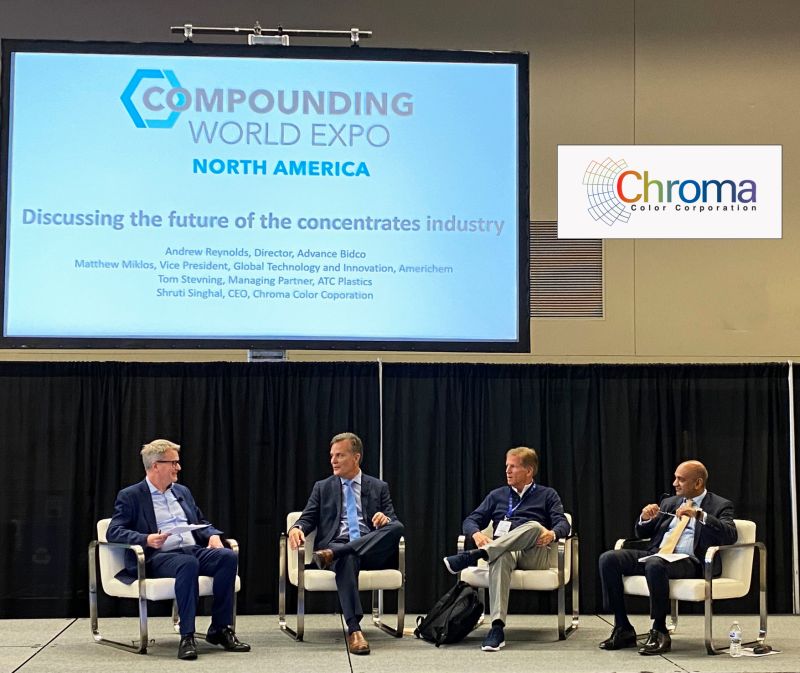
Later that year, he joined a panel on the future of the concentrates industry at Compounding World Expo in Cleveland. The photograph is pleasingly untheatrical: four chairs, a screen, a discussion. In his response afterward, Singhal thanked fellow participants Matthew Miklos and Tom Stevning and the event organizer. Color, it turns out, involves quite a lot of talking.
His message about commercial work became explicit when Chroma appointed Joe Herres to lead sales and marketing in January 2023. Singhal emphasized building strategy around customer input. The point was practical. A materials company can possess considerable expertise and still misunderstand what a customer needs next. Organizing that expertise around the buyer was part of his stated approach.
Recycling, with the factory still attached
In an October 2023 plastics-industry interview, Singhal identified the increased use of recycled materials as a significant development of the preceding decade. He described progress toward practical applications of circular-economy principles and renewable resources. He also pointed to artificial intelligence as a possible aid to processes, efficiency and innovation. The two interests sat together: changing the materials entering production and improving the way production works.
At Chroma, a 2022 environmental, social and governance roadmap had already put structure around that concern. Singhal’s introductory letter described an evaluation of operating and manufacturing practices by the senior leadership team. The plan paired customer collaboration and new solutions with measurable goals. It also made accountability concrete: the board would support the programs and share results with investor Arsenal Capital.
The language of manufacturing has an advantage here. It keeps asking awkwardly useful questions. What changes in the process? How will progress be measured? Who will review the result? Singhal’s Chroma roadmap belonged to that world of operating practices and reporting. Sustainability was being placed alongside the financial and operational performance the company already tracked.
He returned to the theme in Mativ’s later ESG update, describing incremental improvements, process refinement and accountability. The continuity matters more than a fashionable noun. Across two companies, his stated interest involved how a business operates over time. There is less ceremony in refining a process than in announcing a grand ambition. There is also a clearer opportunity to check the work.
“At Mativ, we believe how we operate is as important as what we make.”Shruti Singhal · CEO message, Mativ ESG update
From the board table to the operating seat
Singhal joined Neenah’s board in July 2021. After Neenah and Schweitzer-Mauduit combined to form Mativ in 2022, he served on the new company’s board. Before becoming chief executive, he chaired its nominating and governance committee, served on compensation and previously sat on audit. Those responsibilities gave him a view of oversight, leadership succession and financial scrutiny before he took charge of daily execution.
He had also served as chief executive of Galata Chemicals, a producer of additives used in PVC and polyolefins. By the time Mativ selected him, he had experience with both privately owned specialty materials businesses and public-company governance. His appointment therefore represented a change of responsibility inside an organization he already knew.
The company had already cut more than $20 million in non-operating costs during 2024. With the leadership change came a wider review of its cost structure. Singhal inherited work in progress, along with pressure to accelerate it. His challenge was to carry the existing business forward while improving the financial return from its capabilities. Turnarounds have a way of making every abstract promise answer to a deadline.
A window into the next assignment
Cost control leaves an obvious question: what will the company choose to build? In January 2026, Mativ deepened its partnership with Miru Smart Technologies through an equity investment. The partners were preparing electrochromic windows for commercial production, using capabilities from Mativ’s Argotec polymer-film business. These are windows designed to change their tint, with applications including vehicles.
The collaboration began with a development agreement in 2024. By 2025, the companies had fulfilled initial commercial purchase orders from major glass manufacturers. The expanded partnership addressed production readiness, extrusion capacity and supply-chain coordination. Its next phase involved the unromantic requirements that determine whether an invention becomes a repeatable industrial product.
For Singhal, this is a revealing example of the work ahead. A material developed within one business becomes part of another company’s technology, which must then meet a vehicle manufacturer’s requirements. The chain connects chemistry to equipment, quality expectations and commercial demand. His career has repeatedly occupied those junctions. Smart glass gives the pattern a particularly literal illustration: the material helps decide what someone can see through a window.
Polymer film→Miru
Smart window→Automotive
Production readiness
The expanded partnership announced in January 2026 connects film technology with commercial manufacturing.
The numbers, and the people behind them
By August 2026, Mativ had reported a second quarter with $531.8 million in sales and $3.6 million in GAAP net income, compared with a $9.5 million loss a year earlier. Adjusted EBITDA rose 12% to $75 million. These measures describe different things; the adjusted earnings figure should be read alongside the much smaller accounting profit. The improvement was real, and the distinctions still mattered.
Sales growth was modest. Cash generated from operating activities increased 18% to $67.9 million. Net debt at June 30 stood at $908.2 million, leaving a substantial obligation to manage. Singhal pointed to changes in business development, operating routines and costs. The quarter supplied evidence of progress rather than a license to retire the turnaround agenda.
His public accounts of plant visits offer a smaller-scale view of leadership. In France, he described a meal with the Valence team as a chance to connect personally. In Mexico, his account of visiting the Querétaro release-liner operation also singled out dinner and conversation with colleagues. These are ordinary details, which is their value. The person responsible for the consolidated figures is also meeting the people whose work eventually becomes those figures.
Outside his corporate roles, he has served the Main Line Indian Association, the Mayor’s Commission on Asian American Affairs and the National Association of Manufacturers. His working life spans local civic participation and international industry. Philadelphia remains a point of return in a career that has repeatedly required movement.
The next chapter will be judged by production, customers and cash, as industrial careers generally are. Singhal’s task is to make a collection of technical capabilities perform together, while choosing where its next opportunities lie. The films and coatings may remain inconspicuous. The decisions behind them have become his very visible responsibility.
Adjusted EBITDA: $75.0m, up 12% year over year. This non-GAAP measure differs from net income.