Ted Harris had been at Balchem for about three days when the questions began. On his first quarterly earnings call in 2015, analysts wanted to know what the new chief executive would bring to a company whose ingredients were more familiar to its customers than its name was to the public. It was a reasonable question, delivered at a rather brisk stage of the induction.
Harris reached back to his years running FMC’s food ingredients business. The competitors, the opportunities, the conversations about where to grow: they had “all kind of come back to life again.” He also talked about building plants in China and managing operations in Europe, South America, and Asia. His answer came with a map.
That early exchange offers a useful entry into his career. Harris works in the space between a technical idea and a repeatable business. A promising ingredient needs a customer. A customer needs consistent supply. An acquisition needs people who can work together after the congratulatory announcement has disappeared from the homepage. There is plenty here to occupy an engineer.
An engineer acquires a wider brief
A Philadelphia native, Harris studied chemical engineering at Lehigh University, graduating in 1987, and later earned an MBA at Harvard Business School. The combination put two disciplines on his résumé: understanding how materials behave and understanding how businesses behave. Each can become complicated when exposed to the real world.
Before Balchem, he spent 12 years at FMC and 11 at Ashland. At FMC, his roles included general manager of the food ingredients business. At Ashland, he rose through senior management to become president of Performance Materials and a senior vice president. The work stretched beyond a single product line or factory.
His responsibilities at Ashland included a global supply chain spanning more than 100 manufacturing sites, alongside logistics, purchasing, planning, engineering, and customer service. The list has the rhythm of a corporate biography until you consider the practical connections: purchasing affects production; production affects delivery; delivery determines whether the customer has reason to order again.
Balchem announced his appointment on April 22, 2015, with an effective date of April 28. He succeeded Dino Rossi as president and chief executive and joined the board. Rossi initially remained chairman. By January 2017, Harris had added the chairmanship to his own responsibilities. The handover became a longer assignment in stewardship.
- 1987Lehigh
Chemical engineering - FMCFood ingredients
Global business roles - AshlandPerformance materials
Global supply chain - 2015 →Balchem
President & CEO
The company behind the ingredient list
Balchem was already decades into its story when Harris arrived. Founded in 1967 by a group that included encapsulation specialist Leslie Balassa, it began in a laboratory on the top floor of New York’s Chemists Club. Its first manufacturing site was a former dairy in Slate Hill, New York. For an ingredients company, a former dairy has a certain architectural appropriateness.
The business went public in 1970. Its subsequent development combined new technologies, new uses for existing science, and acquisitions. Harris therefore inherited an established method of growth as well as an established company. His task was to keep finding applications and combinations that customers would buy.
Today, Balchem lists roughly 1,400 employees, 22 manufacturing locations, and eight research and development technology centers. Its headquarters is in Montvale, New Jersey; its operations extend much farther. Those figures give some physical shape to a business that can otherwise vanish inside phrases such as specialty ingredients.
The attraction of this corner of manufacturing is its specificity. A customer buys an ingredient to do a particular job in a formulation or production process. That makes technical knowledge part of the commercial relationship. Harris’s career has repeatedly placed him near that junction, where the laboratory’s vocabulary must eventually make sense to the purchasing department.
Balchem’s published company facts, October 2026.
Buying the next capability
In February 2016, less than a year into Harris’s tenure, Balchem bought Albion International for $111.5 million in cash. Based in Clearfield, Utah, Albion manufactured mineral compounds and brought a portfolio of more than 100 patents. Its previous year’s revenue was approximately $53.5 million. The transaction added intellectual property, products, and another set of technical specialists.
The appeal extended to a broader geographic footprint and ingredient delivery capabilities. For Harris, acquisitions had been part of the job at Ashland, where his work included deals, joint ventures, and their integration. At Balchem, the same kind of work became a visible part of the company’s development.
Another substantial transaction followed in June 2022, when Balchem completed its purchase of Oslo-based Kappa Bioscience. The closing payment, including assumed debt repaid at closing, was approximately $332.5 million. Financing came through the existing revolving credit facility and cash on hand. The agreement also allowed for a later payment tied to performance targets.
The amounts describe commitments, rather than a verdict on the deals. Their eventual value depends on what the combined business can do with the people, products, and capabilities it has bought. An announcement is a date on the calendar. Integration is a succession of decisions, many too small to deserve an announcement of their own.
The less photogenic half of a deal
By the fourth-quarter 2022 earnings call, Harris was discussing exactly that work. Kappa and the recently acquired Bergstrom Nutrition had been brought into a combined commercial structure. Sales teams were being cross-trained. Functional organizations had been integrated. Both businesses were already on Balchem’s Microsoft Dynamics 365 system.
It is difficult to imagine enterprise software receiving a standing ovation at an acquisition celebration. Yet a shared system matters to the next order, the next forecast, and the next conversation between teams. Harris’s account gave the transaction story a practical second act: people learning a broader portfolio and finding opportunities beyond the products they had previously sold.
He described early signs of sales opportunities emerging from those wider customer conversations, while also distinguishing them from the longer-term potential. That distinction matters. A salesperson identifying an opening is one step; turning it into recurring business takes further work. His update stayed close to the mechanics of combining organizations.
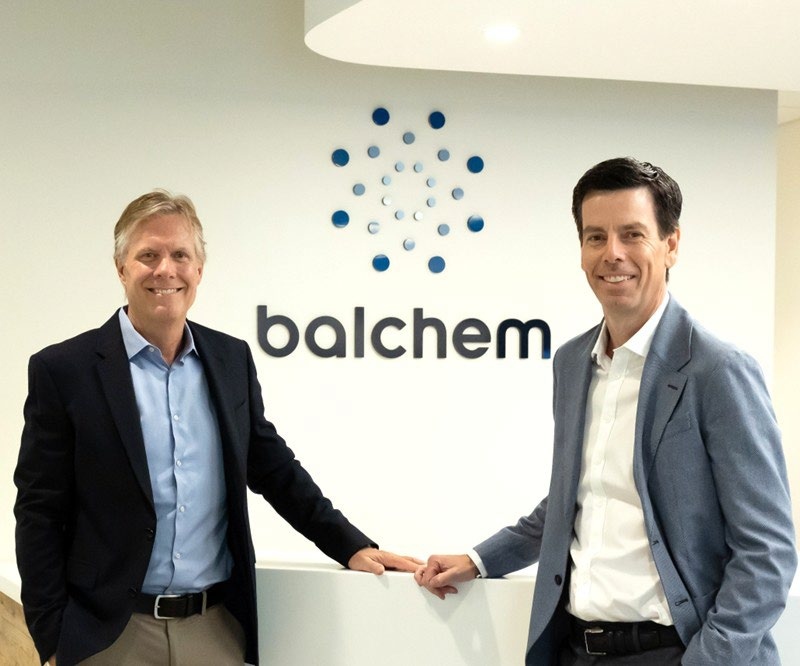
The photograph of Harris with chief financial officer Martin Bengtsson supplies another view of that business. The two executives appear together in Balchem’s investor presentation, and they also share the task of explaining results to investors. Harris brings the operating history; Bengtsson, who joined in 2019 after a career at Honeywell, brings another set of industrial and financial experience.
Who gets room to contribute?
The machinery of a company includes its opportunities for employees. In 2019, Harris and Ria Dake, then general manager of cereal systems, discussed Balchem’s Women’s Impact Network. BWIN had formally launched in 2018 after several years of development. Its purpose was to help women develop professionally and personally through a platform for information, development, and participation.
The joint interview described an initiative that began with executive support and developed momentum across the organization. That sequence gives the project some substance beyond an acronym. Leaders could make room for it, but employees had to make it useful. Harris and Dake linked inclusion to organizational performance, treating it as a concern for the business itself.
Balchem subsequently described leadership training through eCornell and Harris’s participation in the CEO Action Pledge. These are specific commitments to education and participation. They also raise a practical management question: how does an organization with facilities in different places make sure people can contribute and be heard?
His public attention extends to the resources those facilities consume. Balchem has set 2030 goals to reduce greenhouse gas emissions across scopes 1 and 2 and reduce water usage by 25%. In a public post, Harris highlighted responsible water use and the company’s partnership with Partners For Care’s WaterSafe program. The ambition reaches from operating practices to community projects, with the corporate targets still framed as goals.
“We, as leaders, can set the vision and enable all our employees to help bring the vision to life.”
Ted Harris and Ria Dake · joint interview, 2019
A return to Lehigh, a longer horizon
In 2024, Harris became a Lehigh trustee. His listed term runs from July 1, 2024, to June 30, 2028. The graduate who left with a chemical engineering degree now participates in the governance of the institution that awarded it. The connection puts a long span of industrial experience back into a university setting.
He also serves as an independent director of Pentair, the water solutions company. His appointment dates to 2018, when Pentair separated its electrical business into nVent and assembled the board for the remaining water business. It placed Harris alongside leaders from other industries, with a different organization’s decisions to examine.
These roles broaden the setting of his working life beyond Balchem’s headquarters. University governance and public-company oversight bring their own calendars, obligations, and arguments about the future. The common element is responsibility for institutions that must keep functioning after an individual decision has been made.
At Balchem, that future continues to arrive one quarter at a time. On October 23, 2026, the company reported third-quarter net sales of $290.7 million and net earnings of $46.7 million. Adjusted EBITDA was $80.3 million, a measure the company reports separately from its generally accepted accounting principles results. Harris pointed to the balance sheet and the execution of growth initiatives.
The current scale is far removed from a laboratory above the Chemists Club. It is also more than a decade removed from the new chief executive answering questions after three days in the building. The intervening work has involved factories, patents, acquisitions, colleagues, and customers. Small things, assembled carefully, can become a rather large responsibility.
The latest three chapters
Net sales in US dollars. Bars start at zero; figures rounded to one decimal place.