A factory can be a demanding place to discover whether you know what you are talking about. Metal must move through the process. Equipment must do its job. The fluid helping everything along receives considerably less attention than the finished car, aircraft component or sheet of steel. Joe Berquist built his career in that less visible part of manufacturing, where a chemical formulation has to earn its keep.
He joined Quaker in 1997 as a technical service specialist. On November 18, 2024, he became chief executive officer and president of Quaker Houghton. Twenty-seven years separate those two appointments. Between them sit sales territories, regional management, acquisition work, strategy and responsibility for the company’s global commercial business. It is a career with plenty of changes of assignment and very little changing of employer.
Berquist’s present task has an appealing complication. He helped put together the business he now wants to make easier to operate. Knowing where the pieces came from should be useful. Deciding how they ought to fit together is the job.
The ingredient you scarcely notice
Before Quaker, there was AK Steel in Middletown, Ohio. Berquist began his professional life as a blast furnace engineer. He had studied chemical engineering at Youngstown State University; steelmaking gave that education a working address. His move to Quaker took him into technical service in cold rolling, another part of the metals business.
He has been refreshingly plain about the beginning. Getting a job was the immediate objective. Enjoyment of the industry developed through doing the work. That is a credible order for a career to take. Few graduates arrive with a lifelong attachment to industrial lubricants already polished and ready for the recruitment interview.
The company’s range helps explain the scope of that work. Quaker Houghton supplies fluids used in metal rolling, removal and forming, alongside cleaners, surface treatments, greases and other products. Its customers operate in steel, aluminum, aerospace, automotive manufacturing and further industrial markets. The chemistry sits inside processes that have their own exacting requirements.
A supplier in this position needs people who can connect a formulation to an application. Berquist’s early service work, followed by commercial assignments across steel, metalworking and fluid power, put him on both sides of that connection. He subsequently earned an MBA at Case Western Reserve University, completing it in 2008. Technical knowledge acquired a business vocabulary.
A bass line in the background
There was another vocabulary, too. In 2007, while working as a Quaker business director in Cleveland, Berquist was preparing for a reunion with the Februarys. He played bass in the Youngstown indie band. Its members had dispersed; assembling them again meant a few days of concentrated practice at his home before returning to Cedars Lounge.
His memory of the venue was affectionate and specific: a crowded room where the faces were familiar. “The Cedars was a central place, a community,” he said. He was also playing guitar in the Cleveland group the Painted. Business director by day, musician outside working hours: an entirely reasonable arrangement, though it makes a better biographical detail than another committee appointment.
The episode deserves its own small space. A bass guitar need not be pressed into service as a theory of management. It tells us that the person behind the executive title had another place to show up, practice and be heard.
The work between the announcements
The Quaker career continued to widen. Berquist moved through regional sales and metalworking business leadership, then became senior director for North American commercial operations in late 2008. His formal appointment as vice president and managing director for North America took effect on April 1, 2010. The responsibility now covered the regional organization.
In 2017 came an assignment with consequences well beyond a region. Quaker and Houghton were preparing to combine. Berquist was named to co-lead integration planning. The workstreams covered the practical anatomy of a company: commercial operations, manufacturing, procurement, people, facilities and systems. He would retain North American oversight while giving the integration effort his full-time attention.
A merger announcement can fit into a few paragraphs. Reconciling the organizations behind it requires a rather longer document. Which processes will be shared? How will people work together? What happens to products and brands? Integration planning lives among questions like these, after the grand strategic argument has been made.
The combination closed in 2019, bringing Quaker Chemical and Houghton International together as Quaker Houghton. Berquist became senior vice president for global specialty businesses and chief strategy officer. By his CEO appointment, he had participated in executing 24 company acquisitions. The company credited the Quaker-Houghton combination with more than $80 million in synergies. His part was the co-led planning effort; the result belonged to a much larger organization.
Quaker Chemical
Quaker + Houghton
Quaker Houghton
In September 2021, his executive responsibilities expanded again. He also covered EMEA as interim managing director for part of 2022. January 2023 brought the newly created chief commercial officer position, with responsibility across the global businesses. When he succeeded Andy Tometich as CEO, the board chose somebody who had already worked through several layers of its operations.
Bigger is easy to say. Simpler takes work.
Berquist’s early CEO agenda included returning to growth, reducing complexity and deploying capital effectively. In 2025, he described work to align product management and strategy more closely with business segments. He also discussed bringing specialist business-development support to salespeople handling newer technologies. Expertise is useful only if it reaches the conversation where it is needed.
Brands were another issue. Years of acquisitions had left the company with legacy Quaker names, legacy Houghton names and others besides. Berquist outlined an effort to create clearer product positioning within a Quaker Houghton brand family. A customer choosing a fluid should not have to reconstruct the supplier’s acquisition history first.
He described changes in access as well: inside sales, technology and e-commerce tools to help serve smaller customers. These are ordinary commercial mechanisms with a practical purpose. A global supplier has to make its knowledge available at different scales, from an account needing extensive technical involvement to a customer who needs information and a straightforward transaction.
A bigger footprint, a closer customer
The geographic decisions also have a practical side. In June 2026, Quaker Houghton announced the opening of a manufacturing facility in Zhangjiagang, China. It added local production capabilities for die-casting products and greases. The company also expanded its Shanghai laboratory, including facilities for grease development and its fluid-measurement and process-control technology.
Berquist linked those investments to the importance of Asia Pacific and the ability to produce more of the portfolio locally. The relationship between the factory and the laboratory matters: production supplies the customer, while testing and development help determine what the customer should receive. Both sit within the same regional growth effort.
This is where a phrase like global business becomes physical. It means manufacturing capacity, testing equipment and people able to respond near the point of use. The executive who began in cold-rolling service now makes decisions about where that kind of capability should live.
The numbers keep their complications
The first full calendar year of his leadership supplied no tidy victory lap. In 2025, Quaker Houghton recorded an $88.8 million non-cash goodwill impairment associated with EMEA and $35.1 million in restructuring and related charges. Organic sales volumes were broadly unchanged. New business helped offset difficult conditions in customer markets, while costs and the mix of business complicated the result.
By the second quarter of 2026, sales volumes were growing. Net sales reached $532.6 million, compared with $483.4 million a year earlier. The company reported $26.8 million in net income and $85.2 million in adjusted EBITDA. The latter is a non-GAAP measure, and deserves to keep its label attached.
Bars begin at zero. Sales rose approximately 10%; sales volumes rose 7% year over year.
The volume increase came primarily from new business wins across the regions. That distinction matters for judging a supplier’s progress: customer production levels and the supplier’s success winning work are related, but separate forces. Berquist’s emphasis on gaining business makes the volume figure an especially relevant part of his current record.
In October, the company completed a $550 million Term Loan B refinancing, extending that borrowing’s maturity to 2033. Berquist said the arrangement gave the capital structure greater flexibility and reduced required annual debt payments. As of October 23, the next earnings release was scheduled for October 29. The current chapter still has numbers to come.
“I like the fact that we make a difference.”JOE BERQUIST · 2016
Leave a way in
There is a more personal way to read his interest in industrial capability: who gets the chance to learn it? Berquist helped develop Quaker’s STEM partnership with the Norristown Area School District. The activities brought practical problems and laboratory work into lessons. He said graduate-school case studies had clicked for him, giving him the idea to use a similar approach with younger students.
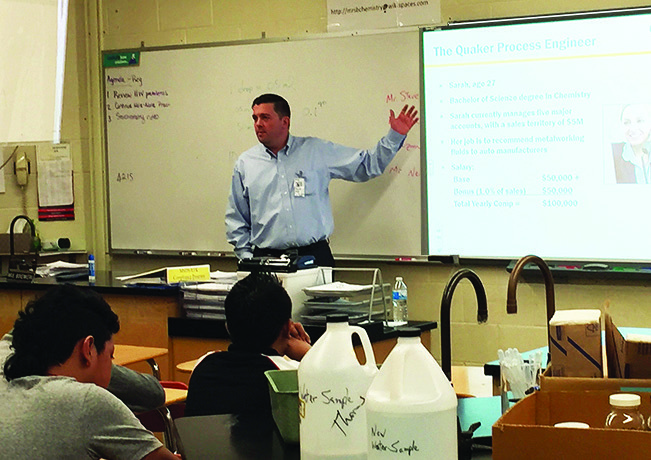
In 2026, that educational interest had another expression. Quaker Houghton backed a Drexel fellowship named for Michael F. Barry, its former CEO and retiring chairman. Berquist described Barry as a mentor to company leaders and welcomed an opportunity to connect students with industrial careers. The program includes mentoring and consideration for work opportunities.
Berquist’s own route began with employment and developed through exposure to the work. The fellowship offers another doorway. A student can meet the people, see the operation and begin to understand the problems. Somewhere between an engineering idea and a customer who needs it to function, there is a career to be made. He has spent most of his working life there.