The buyer had acquired a gas-processing plant in Kansas. Now came the awkward part: getting its accounting to work. The plant had 500 meters, 95 contracts, and a system that needed converting from W Energy to Quorum TIPS. The transition-services agreement allowed 60 days. The software vendor’s standard implementation schedule ran longer. Owning the asset and being ready to operate it were suddenly two different things.
- The job: EAG connects energy operations, business processes, and software.
- The proof: a 60-day plant conversion, with more than $20,000 in avoided expenses reported by EAG.
- The next move: nuEra AI Land Studio prepares land documents for professional review.
The deadline rewrote the method
EAG’s answer was to configure TIPS manually rather than follow the vendor’s full implementation process. Its team redesigned allocations, checked contracts, and tested three months of allocations and settlements. EAG says the plant was ready on time and that the work corrected inherited errors. The useful detail is the testing: urgency changed the route, while validation remained part of the trip.
This is EAG’s territory. Energy businesses accumulate specialized systems, contractual obligations, and records that must agree. An acquisition compresses the time available to reconcile them. The Kansas case describes avoided expenses, rather than the consulting bill or a net return. Its lesson is narrower and more useful: a deadline can justify changing an implementation method if the team understands the underlying work.
A service business that stays for the accounting
Elizabeth Gerbel founded EAG in Houston in 2003, initially around software evaluation and implementation for oil and gas operators. The firm expanded into consulting, back-office outsourcing, managed IT, and automation. Its current website describes a fully U.S.-based team and reports more than 1,000 completed projects. That history matters because implementing software and living with its outputs teach different lessons.

Consider X2 Resources. In a testimonial published by EAG, accounting executive Parker Dalton describes more than six years with its outsourced Enertia accounting team. That is a continuing operating relationship, with recurring work after implementation. For buyers, EAG offers several entry points: a defined conversion project, extra specialist capacity, or an ongoing team handling back-office and IT responsibilities.
Its core customers are upstream and midstream energy businesses, with water, mining, clean-energy, and industrial companies also represented in its market positioning. The practical problems include inherited data, overloaded staff, unreliable reporting, and systems that underperform. Its careers materials emphasize ownership and collaboration, matching a delivery model in which specialists work alongside client teams. EAG sells project delivery and continuing services alongside software. The customer can buy help making a change, then help running what changes.
First, find the leases
A second example is less dramatic than a plant deadline, and perhaps more familiar. In an EAG account of a roughly 7,500-document project, the objective was extracting lease provisions. The extraction technology was available. The obstacle was identifying which files contained the leases. Classification had to happen before the intended analysis could begin.
That distinction explains the appeal of nuEra AI Land Studio, announced in June 2026. It classifies land records, splits packets, extracts information, and prepares outputs for review. A land management system holds the organization’s records; nuEra helps turn source documents into information those records can use. The difference is consequential when a transaction delivers thousands of files in somebody else’s filing scheme.
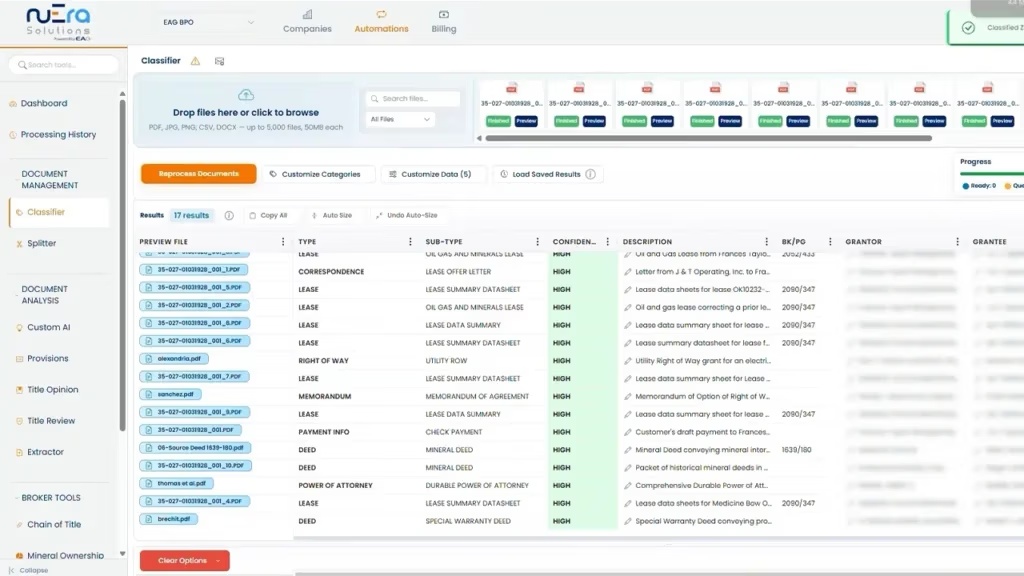
The product targets land departments, brokers, independent landmen, title analysts, and transaction teams. Its current product page lists more than 20 document types and 160 searchable provisions, with a 14-day trial. The workflow keeps a person between extraction and approved use. That gives a buyer something concrete to test: whether the prepared information reduces review effort without increasing correction work.
The economics need the same scrutiny. EAG illustrates a 500-lease package taking 500 hours manually versus 125 with nuEra. That assumes selected tasks run 75% faster; it is an estimate, not a measured customer result. A buyer should check the starting workload before borrowing the saving.
The surprising expense is typing
EAG’s own LinkedIn poll offers a clue about demand. Half of respondents chose manual data entry as their biggest document-review time sink. Only 8% chose interpreting provisions. Those percentages describe answers to a poll, rather than measured shares of a working week. Still, they suggest why a specialized AI product might win attention by doing something as ordinary as preparing information.
“The business is losing that analysis time.”Elizabeth Gerbel
In an interview published by EAG, Gerbel makes a straightforward proposition: experienced people should have more time to examine ambiguity and defend decisions. Automation earns its place by shortening the queue in front of them. The product’s subscription and document-usage model turns that proposition into something a small team can evaluate alongside a larger enterprise.
The advantage is knowing what comes next
EAG sits between software vendors, internal operating teams, and broader consulting firms. Its pitch combines energy-specific implementation knowledge with people who can do the continuing work. In its podcast recap, EAG describes diagnosing configuration and process problems before recommending replacement software. Its M-Files relationship adds document-management delivery; M-Files independently named EAG its Global Reseller of the Year in 2025.
That positioning has limits. A document tool still needs usable inputs, agreed definitions, and qualified review. EAG’s data-quality writing makes the point that an inconsistency can travel from land records into accounting, reporting, and decisions. Faster movement can spread the same confusion. A company expecting autonomous interpretation of consequential legal or commercial questions would be asking more than this workflow promises.
The M-Files connection began with an operating need of EAG’s own. In a partner interview, the firm described seeking shared document controls and approval workflows across back-office applications. It evaluated alternatives and chose M-Files for internal use and clients. The partnership grew from work EAG already had to perform.
A small test beats a large promise
The part worth copying is the order of operations. Pick one repetitive task. Establish how documents enter it, what acceptable output looks like, and who checks exceptions. Test real files, then measure the complete job, including corrections. Gerbel recommends proving one process before expanding. The Kansas deadline and the misplaced leases lead to the same practical question: what must work first so the valuable work can begin?