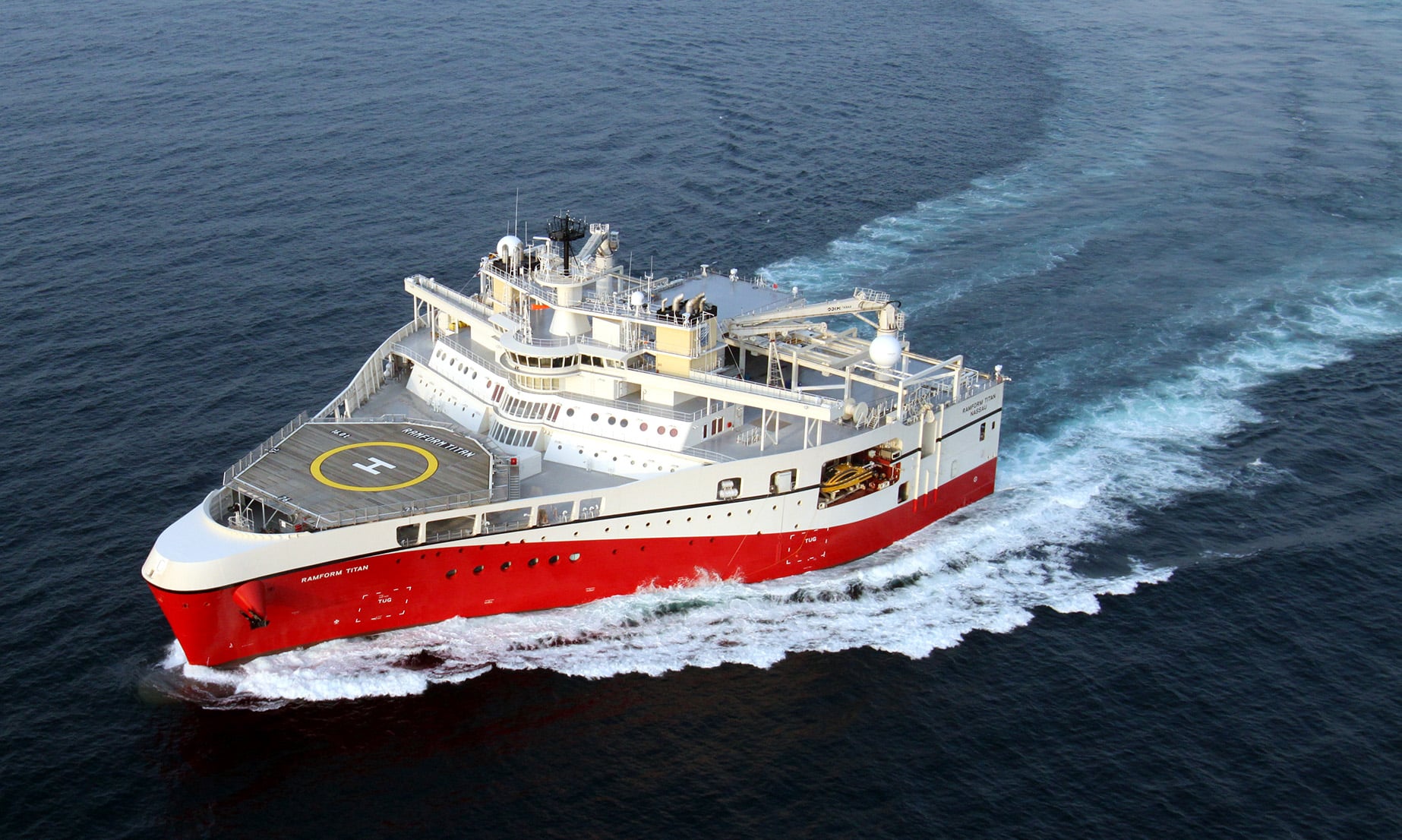
The ship in the photograph is carrying something stranger than cargo: the possibility of selling the same journey repeatedly. Ramform Titan belongs to the seismic world, where vessels help record what lies beneath the seabed. For TGS, those recordings can become a library. One customer licenses a survey. Another licenses it later. The ship moves on; the information keeps working.
- TGS sells seismic data, acquisition services and imaging software to energy companies.
- Its multi-client model spreads one survey’s cost across several buyers.
- The PGS merger added ships and technology, along with the demands of keeping them productive.
That arrangement makes TGS worth understanding even if your knowledge of offshore exploration begins and ends with a drilling rig. It raises a wonderfully practical question: when research is expensive, must every customer pay to discover the same thing? TGS has spent decades building a business around sharing the bill while retaining something it can sell again.
One voyage, several buyers
Seismic exploration turns recorded wavefields into images of underground structures. Energy companies use those images to evaluate acreage, plan development and understand reservoirs. The customer wants a clearer decision before committing more money underground. TGS supplies the recordings, the processing and, increasingly, the tools used to make sense of them.
The commercial trick is called multi-client. A survey can serve several companies rather than belong exclusively to the operator that commissioned it. Early customers help fund a project; later customers buy access to the completed library. Geographic coverage becomes inventory, waiting for an exploration campaign, an acreage award or a fresh geological question.
The reusable asset is the dataset. Each customer still needs the right coverage and license.
On its company overview, TGS says it typically targets sales of two to two-and-a-half times project investment. That is a revenue multiple, before considering the distinction between sales and profit. Lower-return projects require stronger prefunding. The discipline is instructive: establish several plausible buyers before paying for the expensive first copy.
The library buys the ships
TGS began in Houston in 1981. That same year, NOPEC began in Oslo. Their eventual 1998 combination brought together businesses built around different geographic libraries. The company’s history reads partly as an exercise in assembling complementary views of the Earth: more regions, more data types, more processing capability.
Then came a more physical combination. The PGS merger closed on July 1, 2024. Today’s TGS pairs its library with Ramform vessels, GeoStreamer technology and ocean-bottom-node acquisition. Streamers collect measurements behind a vessel; nodes put receivers on the seabed. Different geological problems and survey objectives call for different arrangements.
The logic is understandable. A company selling subsurface intelligence can coordinate how the information is collected, processed and delivered. It also takes on the harder operational question of where its equipment should work next. A vessel occupied by a proprietary customer contract cannot simultaneously acquire a speculative library survey elsewhere.
A customer replaces its own software
The software side offers a revealing customer story. In July 2024, TGS announced a four-year agreement licensing Imaging AnyWare to Shell. Shell would migrate from its in-house software. For a supplier, that is a meaningful kind of adoption: a customer chooses an outside platform for work it previously supported with its own system.
Imaging AnyWare processes and images seismic data in cloud, on-premises or hybrid environments. Its capabilities include parallel processing, visualization and machine-learning tools. TGS also provides imaging services, including full waveform inversion, which uses the recorded wavefield to reconstruct subsurface properties. Better processing can make existing recordings useful in new ways.
Customers have alternatives. Viridien sells multi-client Earth data and geophysical processing software. Operators can commission proprietary surveys or retain internal systems. SLB overlaps in seismic services while partnering with TGS on selected projects. In this market, the company across the negotiating table can also be tomorrow’s collaborator.
“The data foundation is critical to our operations”Paula Doyle, CDO, Aker BP · October 2026
Aker BP illustrates another use case. Its expanded October 2026 agreement uses Prediktor Data Gateway to collect and structure operational data for enterprise applications. Here the problem is connecting industrial systems reliably. The practical benefit begins with consistent information reaching the people and applications that need it.
The expensive part of being right
Scale does not remove the cost of this work. TGS reported $1,526.9 million in 2025 revenue, against $1,318.2 million in 2024. The comparison includes the first full year following the PGS merger. Operating profit fell from $195.6 million to $182.4 million. A larger business can sell more while earning less from operations.
IFRS revenue, rounded. PGS: six months in 2024; full year in 2025. This is not an organic-growth comparison.
The latest quarter makes the tradeoff concrete. In October 2026, management reported that operational challenges and low contract pricing had pressured margins. Increased contract opportunities also prompted TGS to defer some multi-client projects and reduce its annual investment expectation. The bottleneck was allocating working capacity profitably, even as demand improved.

A smaller portfolio, a clearer bet
TGS has also become more selective about what belongs in its portfolio. In July 2026, it sold its North American well data products business to Enverus for $100 million at closing, plus a possible $15 million earn-out. Its explanation was straightforward: after offshore acquisitions, the onshore geological business had become less strategic. TGS retained an internal-use license.
Meanwhile, it continues investing offshore. An October announcement with SLB outlined Pelotas Sul Phase 2 in Brazil, covering approximately 11,200 square kilometers. Chevron’s earlier three-year capacity agreement supplied another kind of commitment: a minimum 18 months of combined streamer and node services. Both depend on customers having worthwhile questions to investigate.
The transferable lesson has boundaries. Reusable research works when several buyers need overlapping information, licensing rights permit reuse and the findings remain useful. It weakens when customers need exclusivity, coverage misses the target or exploration budgets disappear. TGS’s business depends on choosing the right patch of Earth, then finding enough people who need to see it clearly.