Before Viridien could sell computing power to a company simulating a human heart, it had to get very good at listening to explosions. For much of its history, the French company was CGG, a name familiar in oil circles and nearly invisible outside them. Crews sent sound into the ground or seabed. Sensors recorded the returning waves. Geophysicists and machines then performed the hard trick: reconstructing a useful picture of rock formations hidden miles below.
That trick is less niche than it sounds. It requires enormous datasets, numerical physics, specialized algorithms, high-performance computers and people who know when a clean-looking result is wrong. Viridien now packages those capabilities for a wider collection of customers. An energy producer can use them to place a well. A carbon-storage developer can track a CO2 plume. A miner can narrow a search area. An infrastructure owner can monitor a bridge or embankment. A materials company can rent an optimized computing outcome rather than assemble a supercomputer team.
The transformation has a crisp corporate marker. In 2024, shareholders changed the name from CGG to Viridien after a strategic retreat from capital-heavy seismic acquisition. The boats and field operations had defined the old company. The new company wanted to be paid for the more defensible layers: the data, processing, equipment, software, computing and judgment around them.
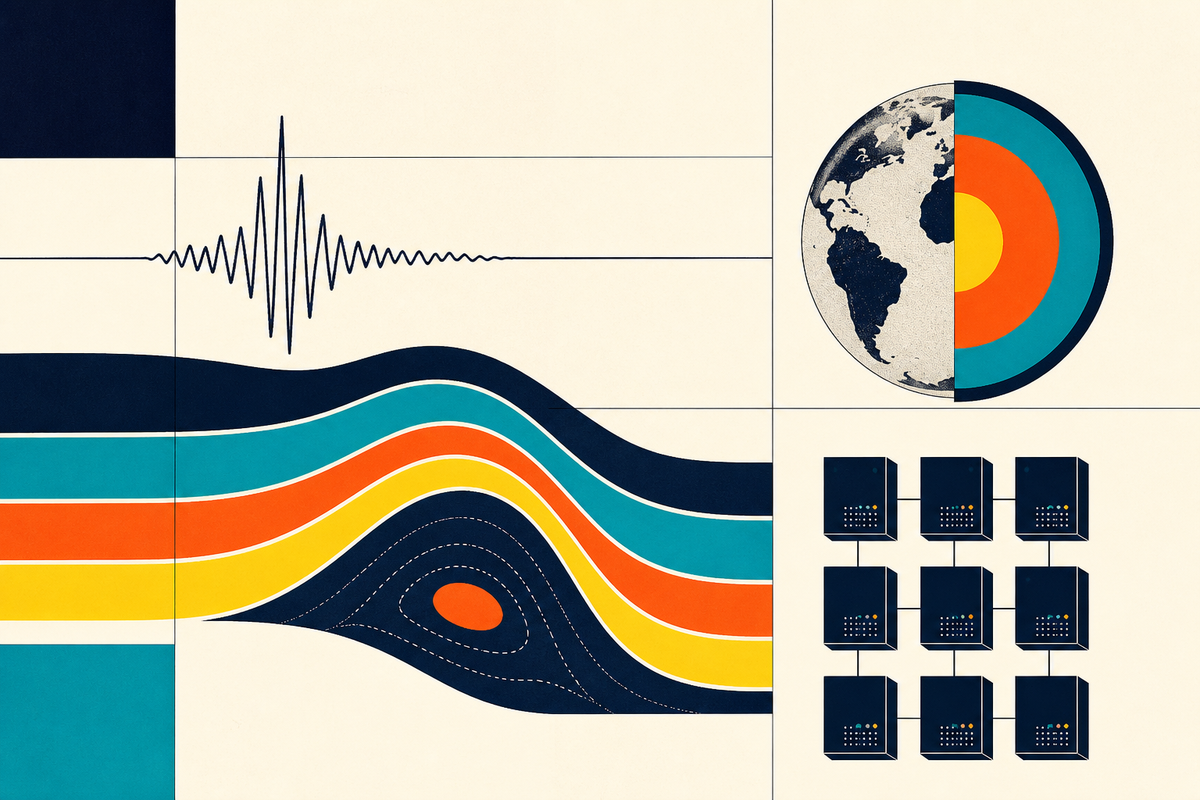
A factory for making the invisible legible
Viridien's portfolio makes more sense as a pipeline than as a catalog. Sercel, its sensing and monitoring arm, makes seismic equipment and systems for marine, structural and geotechnical monitoring. Viridien's Earth Data business owns large multi-client libraries of seismic, geological, gravity, magnetic, satellite and environmental information. Its geoscience teams process and interpret that material. Its computing operation supplies the industrial muscle.
Seismic, fiber, marine and structural signals
Reusable libraries and cloud delivery
Imaging, inversion, AI and modeling
Domain judgment for costly decisions
One flagship technique is full-waveform inversion. Rather than treating selected parts of a seismic recording as a simple echo, FWI uses much more of the recorded wavefield and iteratively adjusts a model until its simulated response resembles the real data. It is computationally hungry. It is also useful where geology is uncooperative - beneath salt, around carbonates, in shallow water or where time-lapse changes matter.
The commercial result is not merely a prettier underground image. Better placement can mean fewer wells, less wasted capital and a smaller physical footprint. Better monitoring can show how reservoir fluids or injected carbon move. In the Gulf of Mexico, high-resolution imaging helps operators identify pressure hazards. In Norway, data from Viridien's Northern Viking Graben library supported the Northern Lights carbon-storage project.
Viridien's product is the whole loop from faint physical signal to expensive real-world decision.
The data library that improves with age
The Earth Data business has an attractive quirk. Viridien invests selectively in a survey, then licenses that data to multiple customers. Years later, a better imaging method can extract more detail from the same underlying recordings. Old data is not necessarily obsolete. Reprocessing can make it commercially interesting again, especially where acquiring a new survey would cost more, take longer or face permitting constraints.
GeoStore lets customers search this library and receive data through several cloud options. GeoVerse organizes geological datasets in cloud-accessible applications. The data-transformation practice handles a less glamorous but expensive problem: subsurface information stranded in inconsistent files, documents and legacy systems. Viridien uses domain-aware automation and AI to classify, validate and move it into modern platforms such as OSDU.
The view from orbit adds another layer. Viridien's satellite-mapping group traces its roots to Nigel Press Associates, founded in 1972 as the first Landsat satellite arrived. Today the team works with optical and radar imagery, elevation data and geological mapping. It can look for natural oil seeps offshore, watch greenhouse-gas emissions, map terrain and monitor pollution. This is the same basic editorial act performed at a different altitude: reduce an overwhelming field of measurements to the few changes a customer needs to notice.
Distributed acoustic sensing pushes in the other direction, closer to the ground. An interrogator reads tiny strain changes along ordinary optical fiber and turns the cable into a dense seismic array. Fiber already installed in a well, on a seabed or beside infrastructure can support repeat measurements without rebuilding a conventional sensor spread. Viridien says it has worked on more than 50 two-, three- and four-dimensional DAS projects. For carbon storage, where operators must show where an injected plume went over time, repeatability can matter as much as resolution.
In 2025, Viridien reported $1.165 billion in segment revenue and $551 million in adjusted segment EBITDAs. Geoscience produced $444 million and Earth Data $406 million. Sensing & Monitoring supplied the remaining $315 million. Those numbers show the center of gravity: the data-and-digital side is now the larger engine, but equipment remains substantial.
Oil built the machine. Can other markets use it?
Viridien's diversification story needs one important footnote: oil and gas still pays most of the bills. In a 2025 interview, then-CEO Sophie Zurquiyah said roughly 90 percent of the client base was in the sector. The company is not a clean-energy startup that happens to understand geology. It is a long-established oil-services technology supplier applying its stack to adjacent problems.
That makes the strategy more practical and more exposed. Carbon storage, geothermal and mining share the need to understand the subsurface, so the technical adjacency is strong. Commercial timing is less predictable. Viridien reported that diversification activities supplied 9 percent of 2025 revenue, down as uncertainty slowed carbon-storage markets. A capable imaging workflow cannot make a delayed project reach final investment approval.
The HPC business reaches farther. Seismic imaging taught Viridien how to tune large scientific workloads, operate dedicated facilities and optimize software against hardware. Its main computing hubs sit in Texas, the United Kingdom and France. In 2025, total power reached 690 petaflops, 33 percent more than a year earlier.
Do not sell a generic machine to a scientist. Sell a completed class of work. Viridien calls its version Outcome-as-a-Service: infrastructure, optimization and domain support are bundled around simulations finished, not merely servers consumed.
This is why a virtual heart belongs in the story. ELEM Biotech used Viridien's HPC and cloud operation to streamline cardiac simulations by 40 percent. Materials-discovery company Matnex partnered with Viridien to scale computational searches for new compounds. The annual report also points to work involving digital entertainment and software used in AI-driven drug development. Different science, familiar bottleneck.
A moat made of accumulated context
Viridien faces large alternatives. TGS has deep seismic-data holdings. SLB and Halliburton sell broad subsurface technology and services. Fugro works across geodata and monitoring. Hyperscale clouds can supply vast computing resources. Satellite specialists, engineering-software firms and focused AI companies each attack pieces of the portfolio.
Its distinction is the combination. Viridien can connect proprietary Earth data, imaging research, geoscience experts, owned computing capacity and Sercel hardware. That vertical span matters when the customer is not buying a clean software seat but asking a consequential question: Where should we drill? Is this storage site contained? Is that structure moving? Which simulation can finish before the research deadline?
The expertise is difficult to compress into a demo. The company traces its roots to 1931, acquired an IBM 604 for field-data processing in 1954, and has spent decades refining seismic software. Its satellite-mapping lineage goes back to 1972 and the first Landsat era. Viridien says its distributed-acoustic-sensing teams have worked on more than 50 projects. These are not guarantees of a correct answer, but they are accumulated examples against which new answers can be tested.
Culture follows the work. Viridien describes itself through four values - problem solving, openness, responsibility and going beyond expectations. The more revealing detail is occupational: geophysicists work beside mathematicians, remote-sensing scientists, engineers, developers and data scientists. In 2025 the company reported continuous-training access for every employee. Specialized knowledge is inventory here, and it depreciates when people stop learning.
The next layer
Henning Berg became chief executive in June 2026 after a long career managing energy technology and services at SLB. Sophie Zurquiyah, who led the asset-light transformation from 2018, remained chair. The handoff signals a shift from repairing the business model toward making the new one grow.
The financial backdrop is improved but not frictionless. Viridien generated $107 million of net cash flow in 2025 and continued reducing debt. By June 2026, net debt excluding leases had fallen to $692 million, down from $856 million a year earlier. Second-quarter segment revenue declined amid geopolitical disruption, especially in Sensing & Monitoring, while the Geoscience backlog rose 19 percent from December. Management kept its $100 million full-year cash-flow objective.
New alliances show where it is pushing. A 2026 initiative with NVIDIA targets seismic imaging on modern accelerated-computing platforms. In August, Viridien signed a multi-client agreement with Senegal's PETROSEN to enhance seismic data and assess petroleum potential. The first points toward a faster technical engine. The second is the familiar Earth-data model at work.
That duality is Viridien's market position. It is neither a conventional software company nor a field-services contractor, neither a pure climate play nor simply the old CGG. It occupies the expensive middle between raw physical signals and a customer's decision. The company learned to see through rock. Its future depends on how many other hard problems can be made to look like rock.