The first machine was a Sinclair ZX81. Abhay Parasnis remembers spending hours with it in Pune, writing code and finding out what a modest home computer would let him make. His parents, he recalled, were less delighted by the time it consumed. The important discovery was that instructions typed by one person could become something visible and useful. It is a small beginning for a career that would eventually encompass cloud platforms, creative software and a company built around artificial intelligence. It also gives that career a neat, human scale: before the architecture diagrams and corporate titles, there was a child trying things on a keyboard.
Pune mattered. Parasnis has described the western Indian city as an education hub with a strong software culture. He studied electronics and telecommunications at the College of Engineering Pune and earned an advanced diploma in computer science from the National Institute of Information Technology. The first professional stop was IBM in India, where he began as a software researcher in 1996. A place on an early Java project gave him a close look at internet software as it was taking shape. He later called it a lucky break. In a field that changes its vocabulary every few years, he learned early that timing can be as consequential as technical skill.
A career in the plumbing of possibility
The résumé after IBM reads like a map of enterprise computing's successive ambitions. At i2 Technologies he became a chief architect. He spent roughly a decade at Microsoft, then joined Oracle's public cloud effort. He became president and chief operating officer of Kony, an enterprise mobility company, before Adobe hired him in 2015 as chief technology officer and senior vice president of Platform Technology and Services. Those jobs differ in product and period, but they share a particular problem: how to make complex technology reliable enough for other people to build on.
At Adobe, the task carried an unusual creative charge. The company was extending its cloud services, and Parasnis was charged with technology strategy, architecture and the experience of moving among them. He later held strategy and product leadership responsibilities, ultimately serving as both chief technology officer and chief product officer. He was working at a company whose software was used by photographers, designers, marketers and document workers, each of whom would encounter the engineering decisions only when something went wrong, or when a new capability suddenly felt natural.
He had his own reasons to care about that last group of users. Parasnis was a hobbyist landscape photographer. When he joined Adobe, he said he could not live without Photoshop and had become a devoted Lightroom user. This is a charming complication in the usual story of the executive engineer: the person overseeing systems also wanted to make pictures. His view of invention was similarly grounded. A patent mattered to him most, he said, when it helped put usable software into people's hands. He is credited with more than 35 patents and co-authored two books about JavaBeans. The number is impressive, but his stated test was what happened after the idea left the page.
“I get most excited when patents are used effectively to build software that gets into the hands of users.”Abhay Parasnis, 2015
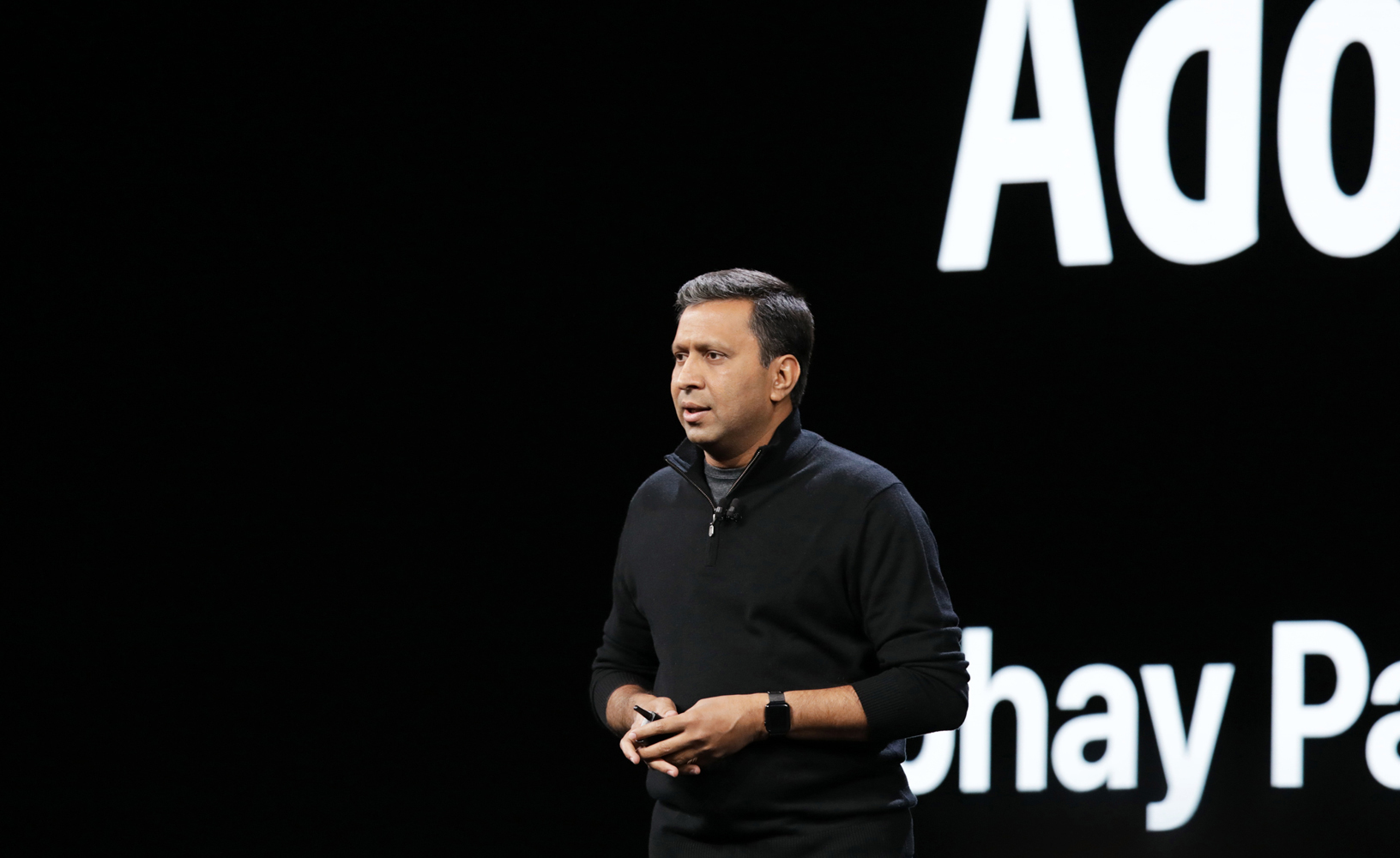
For a glimpse of this thinking in public, look at Apple’s 2018 developer conference. Parasnis took the stage during the announcement of USDZ, a file format intended to help augmented reality move more easily across apps and devices. There he was, under a vast black screen, explaining a piece of infrastructure in a room tuned to new experiences. The format was technical; the imagined result was a person placing and sharing digital objects in the physical world. It was the recurring move of his career: hide hard machinery beneath an action that feels simple.
The bottleneck moves
By the time Parasnis left Adobe in 2022, he had a different piece of machinery in mind. Companies had grown adept at collecting customer data and managing digital channels. Their demand for content, meanwhile, had become relentless. A campaign could require different words, images and formats for different audiences and locations. The work moved through brand teams, creative teams, legal review, outside agencies and software systems that rarely seemed designed to agree with one another. The distance between a promising idea and a finished, approved campaign was often measured in handoffs.
He founded Typeface in May 2022, before ChatGPT had become shorthand for a whole industry. The company's premise was that generative AI could help businesses create content in their own voices, with their own data and rules in view. It emerged from stealth in February 2023 with an announced $65 million round. A further $100 million Series B followed that June, when the company reported $165 million raised in total and a $1 billion valuation. Those are company financing figures, not a measure of what a marketer can accomplish on a Tuesday afternoon. But they show how quickly investors recognized the size of the work Typeface was addressing.
At first, the proposition was easy to picture: give a company a way to generate copy and imagery that sounded and looked like itself. Yet an asset made in seconds still has to pass through the rest of an organization. Parasnis began to describe a wider system. Typeface Arc, introduced in 2024, aimed to coordinate campaigns rather than produce isolated pieces. In 2025 he outlined Arc Graph for brand knowledge, Arc Agents for specialized tasks, and Arc Spaces for people and agents to work together. In March 2026 the company presented a Marketing Orchestration Engine joining marketing, IT and creative workflows. By September it was describing a further connection between brand context, agents and campaign performance.
There is a steady logic to that expansion. A brand guide is useful only when it informs what gets made. A generated draft saves little time if it stalls in review. A campaign's results become more valuable when they shape the next one. Parasnis has argued that AI systems ought to learn how people work, instead of requiring every worker to master an elaborate prompt. It is a point made by someone who has watched powerful technology become ordinary only when the surrounding workflow catches up.
“These AI models should get smart enough to learn how we work.”Abhay Parasnis, 2024
The people inside the platform
Large-company marketing is a collective act, however much a single prompt box may suggest otherwise. Someone chooses the audience. Someone knows why a certain phrase will make the legal team wince. Someone has to decide whether an image feels like the brand or merely resembles last quarter's campaign. Typeface's materials now speak repeatedly about governance and judgment. In a 2026 company report, Parasnis framed the next phase as a redesign of workflows, systems, controls and human decision-making together. The language is less cinematic than “press a button and create,” but it fits the work.
His wider professional life sits around that same intersection. Parasnis serves on the boards of Dropbox and Schneider Electric and, advises McLaren Racing. He co-founded Salience Capital and has invested in AI companies including Perplexity, Common Sense Machines, Higgsfield and Cartesia. These connections put him in rooms where software must meet very different kinds of users: a file-sharing customer, an industrial business, a racing team, a marketer with five versions of a campaign due before lunch. The technologies vary. The question of adoption does not disappear.
It would be tidy to cast the ZX81 as the first step of an inevitable march to an AI company. Lives are seldom so well outlined in advance. Parasnis himself described the early IBM assignment as luck. His career contains changes in employer, technology and audience that no childhood programmer could have planned. What persists is a habit of looking beyond the machine in front of him. At IBM, the promise was software arriving through the internet. At Adobe, it was technology that could serve creators. At Typeface, it is a workflow that might let a team carry an idea all the way into the world.
There is room for a little mischief in this earnest enterprise story. The former Adobe CTO who speaks about brand governance is also the father who admitted in 2015 that his son had pulled him into Minecraft. He said he had become addicted to building worlds together. It is a good reminder that tools earn affection through what people do with them, even if the builders once spent their careers explaining clouds and architectures. A game shared with a child and a campaign built by a team are hardly the same undertaking. Both, however, begin with somebody imagining something and wanting the tool to keep up.
Parasnis's current wager is that marketing software can become less of a queue and more of a working surface, where context travels with the work and people remain responsible for the choices that matter. Whether that vision lands across every enterprise will be decided in the ordinary places where campaigns are briefed, checked, revised and published. It is a fitting test for the boy from Pune. The real thrill of his first computer was never that it could calculate. It was that he could give it an idea and see what happened next.