In July 2016, a newly appointed chief executive explained why his company preferred to leave the ships to somebody else. Kristian Johansen had taken charge of TGS four months earlier. The seismic industry was in a downturn, vessels were plentiful, and keeping them off the balance sheet gave his business room to move. “Running vessels is not our core competence,” he said. Eight years later, TGS completed a merger that brought a fleet into the company. The distance between those two decisions is where his story gets interesting.
Corporate rules acquire a certain dignity with age. Repeat one through enough investor presentations and it can start to sound like a law of nature. TGS’s approach had a practical foundation: assemble geoscience data that energy companies need, pay others to gather it, then earn money from the library. Owning the means of collection introduced another set of costs. Johansen understood the distinction. He had spent years looking after the accounts.
By 2024, he was prepared to change the arrangement. The PGS merger added vessels, technology, processing capacity and a complementary data library. It also made his daily responsibilities heavier in a quite literal sense. Ships require work, maintenance and decisions about where to send them. A change of strategy eventually needs a sailing schedule.
A long way south from Narvik
Johansen grew up in Narvik, in Norway’s far north. At 20, his next substantial move took him to New Mexico on a skiing scholarship. He completed his undergraduate business-administration degree in 1998 and his master’s the following year at the University of New Mexico. The geographical jump is a useful corrective to the tidy executive biography: before the Houston office and the Oslo-listed company came a Norwegian student whose skiing helped take him to the American Southwest.
His working background crossed sectors before he arrived at TGS. He was executive vice president and chief financial officer of EDB Business Partner in Oslo, a Nordic information-technology group. His earlier experience included construction, banking and oil. These are businesses with different products and customers, but each makes its own demands on capital. By the time TGS announced his appointment in February 2010, financial oversight, treasury and investor relations were already part of his professional equipment.
That background matters because TGS sells knowledge about a physical world that is expensive to investigate. The product may arrive as data, but getting it involves technical judgment, equipment and investment well before the customer makes a drilling decision. The executive overseeing the money has to understand what the scientists and commercial teams believe they can sell.
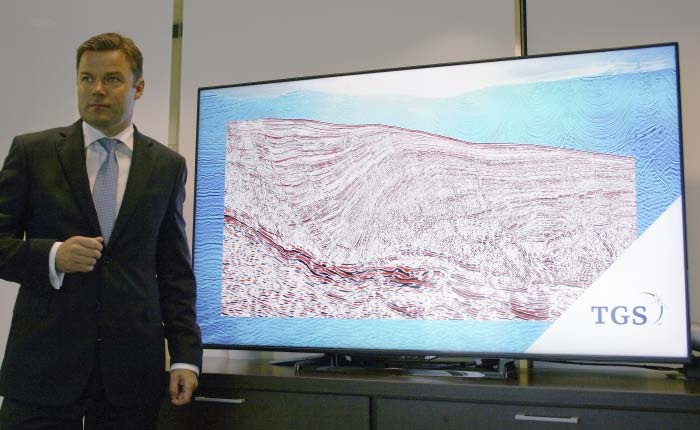
First the accounts, then the operations
In early 2015, Johansen became chief operating officer. The move put a finance executive closer to the work on which the financial results depended. Robert Hobbs, then CEO, described the new role as giving Johansen responsibility for the continued development of the data library. It was a practical apprenticeship for the job that followed: understand the capital, then understand the projects competing for it.
He succeeded Hobbs as chief executive in March 2016. The handover came during a difficult exploration market. This was hardly a setting in which an incoming leader could assume that customer budgets would take care of the next quarter. His early explanation of TGS’s resilience leaned on flexibility: keep room in the balance sheet and choose investments carefully. At that point, avoiding vessel ownership was part of the answer.
The progression from CFO to COO to CEO can look uneventful when reduced to three dates. In this case, it puts the later strategic turn in perspective. Johansen had worked inside the old model from more than one vantage point. When he changed it, he was revising a system he had helped administer.
The library gets larger
The first substantial acquisition in this sequence enlarged a familiar business. TGS completed the purchase of Spectrum in August 2019. Spectrum brought a multi-client portfolio with coverage in mature and frontier basins. Its position in areas including Brazil and Argentina complemented TGS’s existing library. Johansen emphasized the similarity of the two companies’ business models and cultures.
Multi-client data has an appealing commercial premise. Several customers can license information from the same survey rather than each commissioning an entirely separate exercise. The provider invests in an asset whose usefulness may extend beyond its first buyer. That makes coverage, timing and the choice of survey areas consequential. A library is only commercially valuable if it contains something a customer wants to examine.
Spectrum expanded that proposition. The acquisition strengthened TGS’s South Atlantic coverage, including Latin America and West Africa. It fitted a company adding to its stock of information. The later deals would ask a different question: how much of the process of obtaining that information should TGS perform itself?
From buying data to doing more of the work
In June 2022, TGS announced its proposed acquisition of Magseis Fairfield. The rationale was specific. Customers were increasingly interested in exploration around existing infrastructure and in monitoring production. Magseis’s ocean-bottom node capabilities could be combined with TGS’s processing and multi-client activities. Recording equipment placed on the seabed offered another way to investigate the subsurface.
The voluntary offer settled in October 2022, giving TGS approximately 75.4 percent of the shares at that stage. This distinction is worth preserving: acquiring control was a step in a transaction process, rather than an instant purchase of every remaining share. By early January 2023, TGS had reached full ownership.
It was also an organizational change. The business would sit inside TGS with responsibility for ocean-bottom acquisition and other acquisition activities, led by former Magseis chief executive Carel Hooijkaas. The added capability came with people who knew how to operate it. Integration meant deciding where their experience belonged in the larger company.
More geographical coverage in the data library.
Ocean-bottom nodes and acquisition capabilities.
A streamer fleet, processing capacity and additional data.
Then came the ships
The PGS merger formally closed on 1 July 2024. For Johansen, it completed a conspicuous departure from the earlier vessel-free approach. The combined company could offer a broader range of services, with more of the work performed inside the organization. But breadth carries obligations. The annual accounts recorded substantial property and equipment alongside the acquired data library, as well as debt and lease liabilities.
His explanation rested on a changing market. Frontier exploration had become a smaller opportunity, while customers increasingly sought surveys near existing reservoirs. An approach built around a particular kind of demand could become vulnerable when that demand changed. Bringing acquisition and processing together offered TGS more ways to serve a customer.
The argument has an everyday counterpart. A business can buy a service when it needs it, or own the capability and accept the responsibility for keeping it productive. Each arrangement gives management a different kind of flexibility. Neither relieves it of having to find customers. In TGS’s case, the decision moved that trade-off into the middle of Johansen’s job.
By August 2024, TGS had raised its annual synergy target to between $110 million and $130 million by the end of 2025. That was a target, attached to an integration still underway. It described the savings and efficiencies management intended to achieve. The distinction between a plan and a completed result matters particularly when the plan involves combining organizations that previously made their own decisions.
The sea submits its own quarterly report
The results released on 22 October 2026 offer a current test of the broader model. Third-quarter revenue was $397 million, compared with $388 million a year earlier. Order backlog stood at $679 million, up 52 percent. Johansen described strong contract activity, but operating challenges and low contract pricing squeezed margins. More work and better economics do not automatically arrive together.
TGS said its streamer fleet was fully booked for the fourth quarter. It also deferred some multi-client projects in response to the pipeline of contract work, lowering expected 2026 multi-client investment to about $510 million from approximately $550 million. Here was integration expressed as an allocation decision: decide which work to do now, using capacity that has competing demands on it.
Revenue: $388m in Q3 2025 → $397m in Q3 2026
*Backlog excludes the sold North American well-data business. Higher costs and low contract pricing affected margins.
Two clocks on the desk
By 2026, Johansen had spent a decade as CEO. His responsibilities also extended to non-executive board roles at Valaris and International Seaways, adding drilling and shipping perspectives to a career already spanning finance, technology and energy. He had previously chaired EnerGeo Alliance. The connections place him among businesses whose decisions depend on long investment horizons and uncertain demand.
He describes enjoying urgency and a fast-changing working environment. Yet exploration rewards patience on a scale that quarterly reporting rarely accommodates. That tension makes the job more complicated than waiting confidently for another upturn.
“Managing short-term pressure with long-term needs is always a challenge.”Kristian Johansen · June 2026
Exploration and reporting continue to run on their separate clocks.
Outside work, he names family time, golf and skiing among his interests. The skiing supplies a modest thread back to the scholarship that took him out of northern Norway. It requires no elaborate metaphor. The career itself contains enough changes of terrain.
Johansen’s next chapter will be measured in ordinary business particulars: delivery, costs, pricing and whether customers keep placing orders. His distinctive decision was to put a different company around those questions. The former CFO who once defended keeping ships outside TGS now has to make the ships inside it earn their place.