In 1999, when the Permian Basin looked less like a gold rush than a retirement party, four oil-patch veterans began organizing the records that independent producers needed to decide where to drill. The product was called Drillinginfo. The name was admirably literal, the database was relatively simple, and the first customers were small operators who could not afford armies of analysts. That modest wedge became Enverus - a company that now sits behind decisions about wells, solar farms, transmission queues, mineral rights, commodity trades, invoices and multibillion-dollar acquisitions.
Today, Enverus says more than 8,000 companies in 50 countries use its products. Its network reaches over 40,000 suppliers and processes more than $500 billion in annual transaction activity. Blackstone bought the business in 2025 in a transaction whose official terms were not disclosed; financial reporting put the value above $6 billion, potentially reaching $6.5 billion with earnouts. That is a remarkable destination for a company that began by cleaning up maps and well records.
The first thing that failed was the name
Drillinginfo worked until it worked too well. Customers still pictured the product they had first bought in 2002 or 2010, while the company had accumulated trading data, accounting automation, mineral-management tools and power-market intelligence. By 2019 it had passed $300 million in annual recurring revenue. The narrow name had become a sales objection.
The company became Enverus on its 20th birthday. Co-founder Allen Gilmer said the old name no longer reflected its reach. Even the invented replacement carries the expansion thesis: “EN” for energy, “VER” for clarity and truth, and “US” for partnership. Corporate etymology can be a little precious, but the strategic point was sound. The company was no longer selling drilling information. It was selling a way to see an entire energy decision before spending money on it.
What the customer is actually buying
Enverus is often described as energy SaaS, which is accurate in the way that calling a refinery “a collection of pipes” is accurate. The flagship PRISM platform pulls together maps, ownership, geology, production, costs, deals, grid projects, forecasts and economic models. Analysts use it to screen an oil field, compare operators, value a mineral position, locate a renewable site or study a market. Enverus Intelligence Research adds more than 150 domain specialists. APIs feed licensed data into customer systems.
Then there are the workflows. OpenInvoice and the broader Source-to-Pay suite automate bids, field tickets, contracts and invoices. EnergyLink handles revenue and joint-interest billing. MarketView serves commodity traders. RatedPower turns a promising parcel into a preliminary utility-scale solar design, bill of quantities and yield model. Pearl Street’s software studies the risk of connecting a project to the grid. In 2026, Enverus ONE arrived as a governed AI layer intended to turn questions and documents into traceable work products inside those existing processes.
The Enverus loop - why the bundle gets harder to replace
The business model follows the enterprise-software playbook: custom-priced subscriptions, data licenses, APIs, research, implementation and services. Public terms say fees are generally paid in advance, attached to products purchased rather than actual usage, and non-cancelable during the order term. Enverus does not publish a menu price. Buyers are expected to have a costly enough problem that a sales conversation is worth everyone’s time.
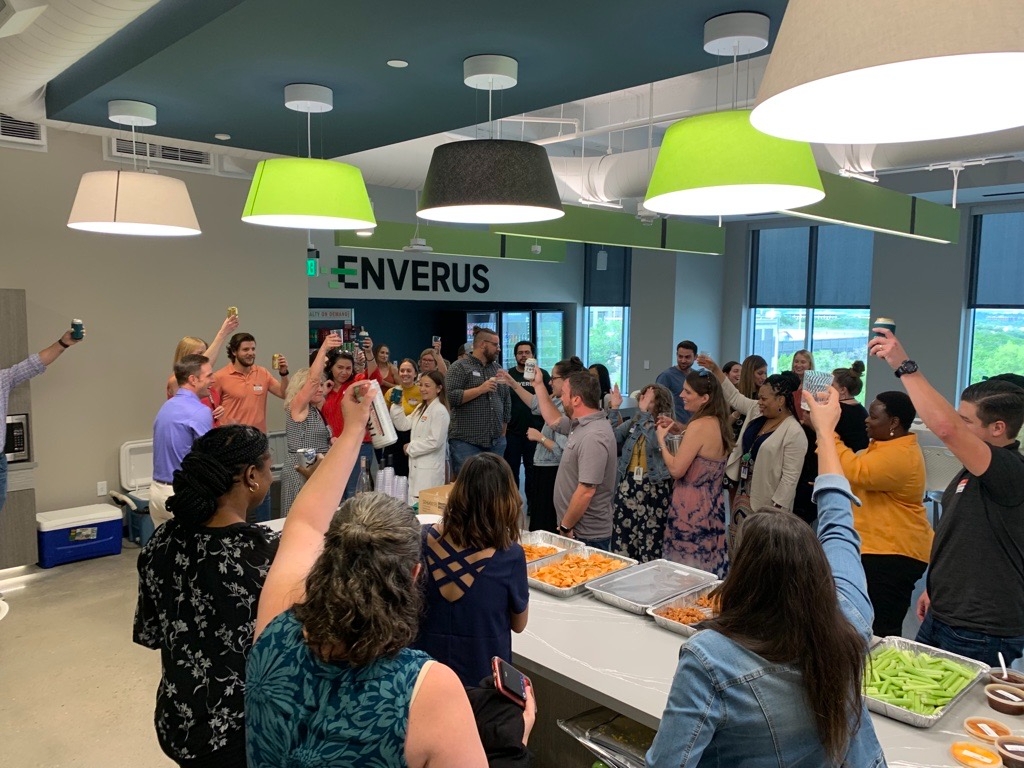
The human layer matters because energy data is full of traps that look tidy on a screen. A courthouse record can lag reality. Two operators can report the same cost differently. A proposed power project can sit in a queue long after its commercial prospects have evaporated. Enverus employs geologists, petroleum engineers, economists and power-market specialists to normalize those mismatches and explain what the model cannot. The company says more than 150 analysts contribute research and advice. That expertise also shapes the culture: software teams are expected to understand the physical and financial work, while industry veterans have to turn judgment into repeatable products. It is a harder hiring brief than “knows Python,” but it keeps the platform from becoming an attractive warehouse of incomparable numbers.
The proof is measured in hours nobody misses
The most persuasive Enverus stories are not about “insight.” They are about chores disappearing. Pitts Energy, a roughly 50-person operator, moved invoice approvals from paper to OpenInvoice. One engineer who used to lose the last day of every month to an invoice pile could approve 100 in 20 minutes. Staff began coding and approving from their phones. The first operational failure was human habit - printing, driving paper across town, saving the stack until month-end. A test environment and vendor onboarding changed minds because the replacement felt less risky than the ritual.
For Hodson Energy, the expensive bottleneck was solar development. The team had outsourced work and spent time on parcels that would never become good projects. PRISM filters helped it reject weak opportunities earlier; RatedPower automated layouts and engineering documentation. Hodson reported a 15 to 20 percent time saving, with a layout that once took weeks produced in minutes. The win was not predicting the future perfectly. It was buying more iterations before committing capital.
A broader set of company case studies says Permian Resources cut a reporting job from 20 hours to one, Discovery Natural Resources saved 40 accounts-payable hours each week, and a Source-to-Pay customer saved more than $1 million in a year through competitive bids and renegotiated prices. These are customer and company-reported outcomes, not controlled experiments. Still, the pattern is consistent: consolidate the data, remove re-keying, expose a benchmark, and let the specialist spend time on the exception instead of the queue.
A moat made of old records and new plumbing
The obvious competitors are research and data firms such as S&P Global Commodity Insights, Wood Mackenzie and Rystad Energy. But the alternative is often less glamorous: public records, a GIS package, a consultant, an internal database and a heroic spreadsheet. Point products compete at every seam - upstream analytics, renewable siting, grid data, procurement, trading. Enverus’s advantage is that the seams connect.
It has spent years buying those connections. Energy Acuity expanded renewable-project data. RatedPower added solar engineering. Pearl Street added automated interconnection studies. Spatial Business Systems brought utility design automation. In 2026, four PDS exchanges extended the network into frac interference, well data, production and water logistics; the A2D library from TGS added a deep commercial collection of well logs. The company’s stated foundation now includes 7 million wells, more than 88,000 renewable projects, 350 million courthouse records and over $1 trillion in M&A history.
This is also why its AI pitch is more credible than most. A general model can explain a production curve. It cannot recreate a quarter-century of normalized records, licensed transactions and in-house research by asking the public internet nicely. Enverus ONE is the attempt to make that context conversational and executable without letting it leak into an unmanaged chatbot. The hard problem is governance, attribution and the last mile into a decision - not generating another paragraph.
What to copy - and when the trick breaks
The Enverus playbook is wonderfully unfashionable. Start with one neglected dataset in a huge industry. Sell first to practitioners with a sharp, frequent problem. Let those customers carry the product into larger accounts. Add adjacent workflows only when the same information makes them meaningfully better. Build a transaction network where participation produces benchmarks that attract more participation. Finally, use AI to open the accumulated context, not to disguise the absence of it.
That recipe works when the decisions are expensive, the records are fragmented, the workflow repeats and buyers will pay to avoid a bad call. Energy checks every box: one wrong parcel, well, hedge or acquisition can erase years of subscription fees. The same approach can work in insurance, construction, logistics, compliance and other document-heavy verticals.
Where the model does not travel
It breaks when the problem is occasional, the data is already clean and public, or the buyer cannot support enterprise pricing and implementation. Enverus’s own agreement says its data may contain errors, gaps and inaccuracies and should supplement - not replace - professional judgment. Redistribution is restricted, raw data cannot simply be poured into outside AI systems without permission, and subscriptions are generally non-refundable. Small teams should compare the platform with a narrow point tool or an internal public-data stack before buying the whole machine.
The most useful way to understand Enverus is not as a bet on oil, renewables or AI. It is a bet that energy complexity keeps compounding. Power demand is rising, grid queues are clogged, capital is moving between technologies, and each physical project produces more records and counterparties. Enverus wants to be present when a person turns that mess into a decision - and again when the invoice arrives.