A tanker crossing an ocean is easy enough to picture. Its commercial meaning is harder. What grade of oil is aboard? Where will it unload? Is the destination a firm commitment or an educated guess? And by the time it arrives, will the freight bill have swallowed the trader’s margin? Vortexa has built its business around those questions. The ship is the visible part. The information surrounding it is what customers buy.
The London company sells a connected view of waterborne energy: cargo flows, tanker availability, freight prices and crude inventories. Its customers include traders, analysts, charterers and financial institutions. The attraction is practical. A change in where oil travels can alter regional supply; a shortage of available ships can change what it costs to move the next barrel. Understanding both can make a promising trade look rather less promising.
Annual waterborne energy trade tracked, according to Vortexa’s September 2026 announcement. Cargo value, not company revenue.
A dot on a map is a starting point
Vortexa’s raw material comes from a crowded cast: satellite and terrestrial vessel signals, port agents, shipbrokers, customs information, public records and other industry sources. Its methodology describes machine-learning models estimating cargo quantities, products, destinations and arrival times. Market specialists provide context and validation. The resulting picture includes things already observed and things expected to happen, a distinction that matters when money is at stake.
A vessel’s position does not, by itself, identify the commercial cargo inside it. Vortexa builds its view cargo by cargo and vessel by vessel, then lets users examine wider flows. An analyst can start with imports into a region and work down toward individual movements. The company’s pitch rests heavily on that traceability: the ability to ask what supports a number instead of simply accepting a total.
The product covers crude oil, refined products, liquefied petroleum gas and liquefied natural gas. Grade-level detail matters because a barrel is not always interchangeable with another barrel. Different crude grades and refined products serve different markets. Group them too casually and the apparent supply picture can conceal the very shortage a trader wants to understand.
The founders knew the trading desk
Founded in 2016 by Fabio Kuhn and Etienne Amic, Vortexa came with experience inside the market it wanted to explain. Kuhn had led trading technology and analytics at BP. Amic had held senior energy roles at JPMorgan and Mercuria. Their starting point was an industry where participants could have very different views of the same physical market.
There was also a technical opening. Vortexa’s account of its origins points to cheaper satellites, cloud computing and advances in machine learning. These developments made more information available and gave a new company ways to process it. Industry knowledge supplied the questions; computing supplied a way to pursue them across the world’s fleet.

Notion Capital investor Patrick Norris explained his 2019 investment in terms of information access and the founders’ ability to build industry relationships. That is a useful clue to the business. Buying data is only part of the work. A supplier has to understand what traders consider credible, establish relationships with information providers and produce answers that survive scrutiny from people who know the market.
First follow the cargo. Then price the trip.
Energy Analytics is the core view of imports, exports and cargo movements. Freight Analytics adds vessel availability, fleet distribution and voyage activity. Onshore Crude Inventories brings storage into the calculation. Together they let a desk investigate connected questions: are supplies arriving, are they accumulating in tanks, and are enough ships available for the next wave of exports?
Consider an illustrative decision. A trader sees a price difference between two regions and explores moving a cargo. The price gap alone is insufficient. Freight, timing and available tonnage affect whether the opportunity survives. An analyst can examine the flows; a charterer can investigate suitable vessels; both can compare shipping economics. This is the kind of shared workflow Vortexa sells.
Anywhere Freight Pricing, introduced in February 2025, moved the company further into that calculation. It began with clean petroleum products and subsequently expanded to clean and dirty routes. The current product advertises more than 90,000 active routes, historical prices and comparisons across vessel classes. Users can explore a route before announcing their interest to the market, a useful feature in a business where intentions themselves carry information.
The delivery is deliberately familiar. Customers can work in the browser, pull data through an API, use a Python SDK or update an Excel workbook. A data scientist might build a model; a desk analyst might refresh an existing spreadsheet. Both need the information to arrive where the work happens. Vortexa’s public engineering account, amusingly named VorTECHsa, even includes a tool for extracting awkwardly structured Excel data.
A forecast has to show its working
In June 2026, Vortexa added Anywhere Freight Pricing Forecasts. Its current feature page describes a 12-week view for clean freight routes, based on physical-market fundamentals. The proposition is to connect expected rates to cargo flows, vessel availability and fleet positioning, giving users another view alongside forward freight agreements, which reflect traded market expectations.
The launch announcement offers a revealing piece of customer feedback. An unnamed early-access user objected to models whose apparent drivers had little connection to shipping. That is a specific failure of confidence: a forecast loses credibility when a knowledgeable customer cannot reconcile its reasoning with the market.
“Transparency about what’s actually feeding the forecast is what makes it usable.”
Early-access user, quoted in Vortexa’s June 2026 launch announcement
Vortexa’s response includes explanations of the physical inputs behind projected rates. The announcement also explicitly ties the product to client demand for more predictive insight. That makes the development intelligible as a commercial response: customers wanted help looking forward, with enough explanation to challenge what they were seeing.
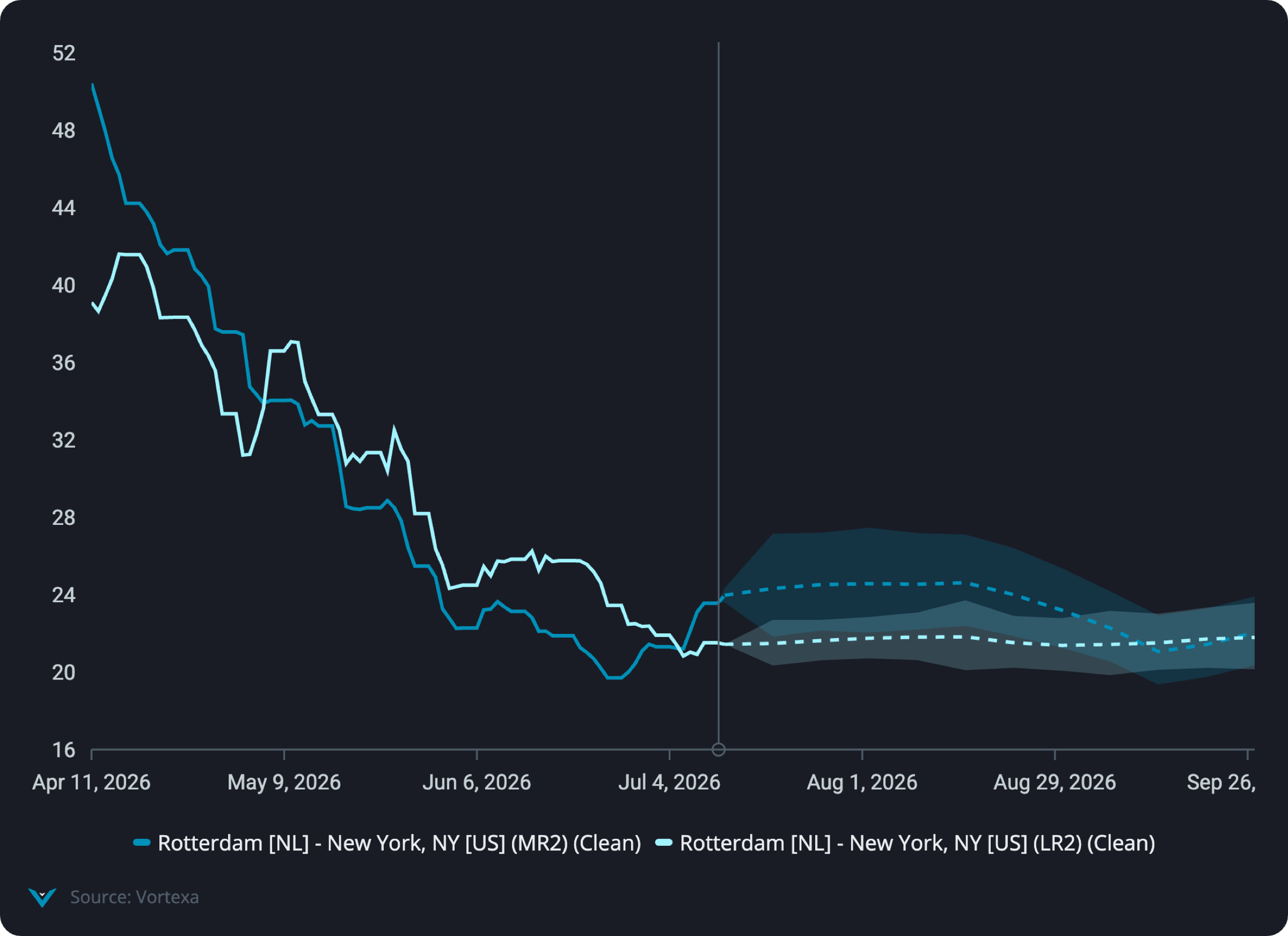
The practical lesson for other data businesses is worth copying. Put the explanation near the prediction. Let users follow a result back to relevant inputs. Give specialists a way to question it. In a professional workflow, being able to disagree intelligently with a model can be part of the product’s value.
The information business has a capital bill
Vortexa sells subscriptions and data access to organisations. Its commercial entry points are sales conversations and demonstrations, with scope settled through the customer agreement. For a prospective buyer, the useful cost question is tied to the desk’s requirements: which commodities, which freight tools, how many users and what access to underlying data?
Building the supplier has required substantial financing. Vortexa raised a $5 million Series A in 2019 and a $19 million Series B in February 2021. A $34 million Series C followed in January 2024, led by investment funds managed by Morgan Stanley Expansion Capital. The company said that round took total funding above $60 million.
Yellow: equity rounds. Teal: debt financing. Announced amounts do not measure spending or outstanding debt.
Later that year came $25 million in strategic debt financing from CIBC Innovation Banking. In April 2026, Vortexa announced another $50 million financing with Oxford Finance. These announcements belong in a separate mental column from venture equity. They describe financing arrangements, and cannot be treated as an itemised bill for software development or simply added up as money currently in the bank.
The operating work spans data acquisition, engineering, model development, market expertise and customer support. Vortexa’s June 2026 announcement described a team of more than 180 experts across its international offices. Its careers material emphasises collaboration across those disciplines. The machinery needs people who can build it and people who can recognise when its answers deserve another look.

A crowded desk, and a sharper test
Vortexa’s company page reports more than 250 clients. Rapidan publicly endorses daily use of its data. A 2023 agreement brought its flows into Energy Aspects research; partnerships with the Baltic Exchange and Lloyd’s List Intelligence connect freight benchmarks and maritime information to its analytics. These relationships show how specialised data moves through a wider information market.
That market has substantial alternatives. Kpler supplies commodity-flow and maritime intelligence. S&P Global’s Commodities at Sea offers cargo volumes, voyage details and fleet analytics. Vortexa’s emphasis is the connection between energy flows, freight and inventories, with detail that users can investigate. Buyers still need to test the particular grades, routes and delivery tools their work requires.
The competitive traffic also runs through the executive suite. On September 2, 2026, Vortexa appointed Richard Quin as chief strategy officer. He previously held strategy and operating leadership roles at Kpler. His new remit covers strategy, data partnerships and market analysis, areas where a data company’s commercial position is built as much through execution as through a fresh interface.
There are clear boundaries to the proposition. A forecast remains conditional on its inputs and assumptions; a diversion or sudden disruption can change the physical picture. A desk trading something outside Vortexa’s energy focus will need other information. And seeing an apparent opportunity does not provide a ship, a counterparty or a guaranteed margin. The useful test is concrete: can the desk trace the cargo, understand the shipping economics and reach a better-supported decision before it commits?