The first version of AEGIS Hedging was almost comically analog: Chris Croom and Justin McCrann in a 150-square-foot office, helping oil and gas producers decide how much future production to lock in and which sophisticated counterparty should take the other side. Their printer had not even graduated from its cardboard box. The stakes, however, were adult-sized. A wrong hedge can pinch cash flow for quarters. No hedge at all can leave a drilling program at the mercy of a weather map, a pipeline outage or a geopolitical surprise.
That origin explains AEGIS better than the word “fintech” does. The company did not begin by promising to automate experts out of the room. It began with the experts in the room, watching where their work bogged down. Pricing lived in one place, approvals in another, trade recaps in email, portfolio valuations in a spreadsheet and settlement evidence somewhere downstream. AEGIS's eventual product map is simply that mess, pulled together one stubborn piece at a time.
The first thing to break was the software
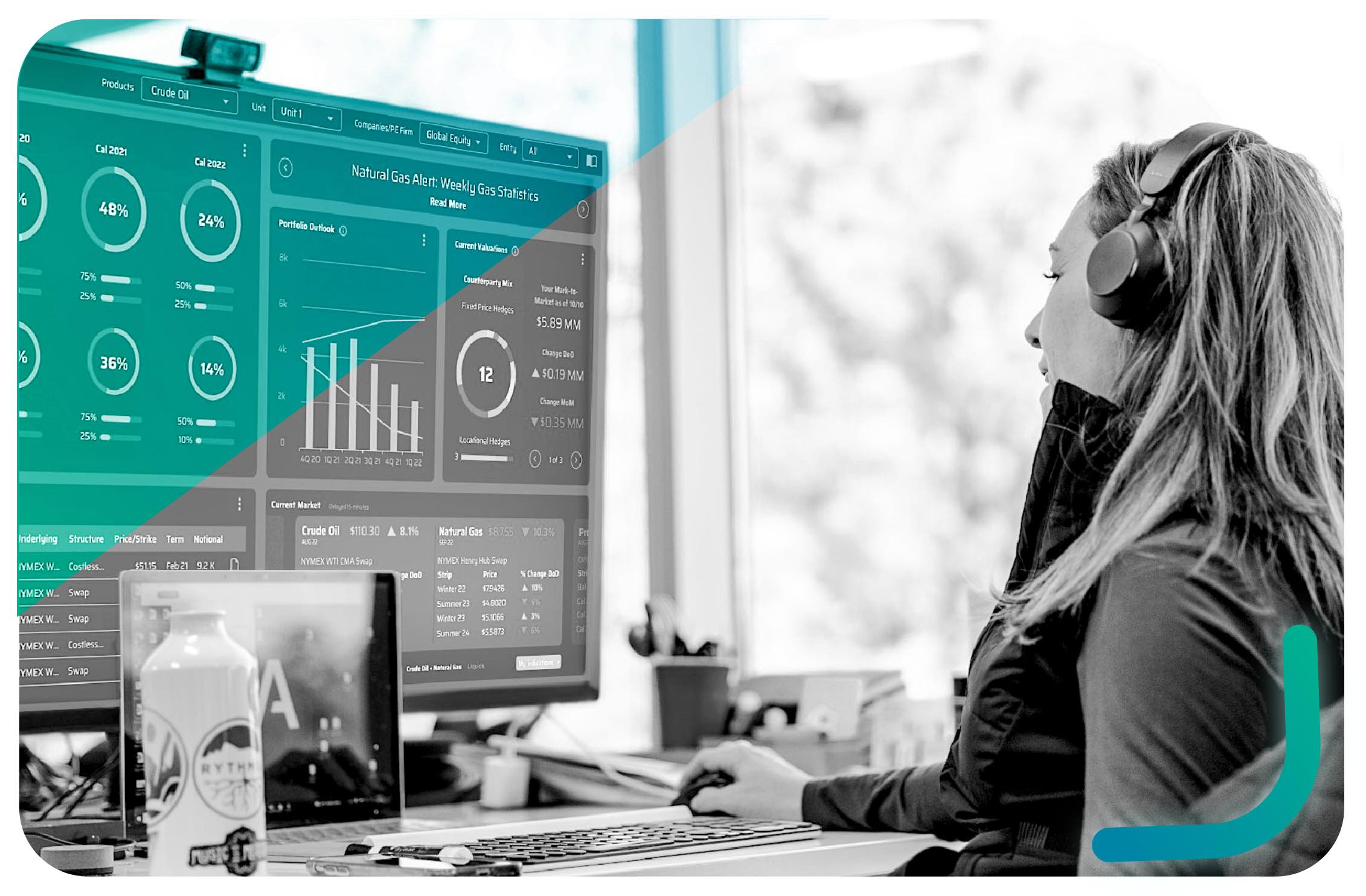
By 2018, AEGIS had 10 employees and a few dozen customers. It released FLOW, its own interface for valuations, reporting, counterparty exposure, research and hedge workflows. The need was not theoretical. Advisers could recommend a smart trade, but clients still had to operate through commodity trading and risk-management systems built for an earlier era. Cloud deployment, clean interfaces and rapid product updates were not standard features in that corner of enterprise software.
AEGIS first tried to partner with legacy CTRM vendors. Then, in the company's own telling, those systems became too slow and began holding back development. That changed the build-versus-buy calculation. In 2021 it acquired InstaNext, a SaaS-first E/CTRM product founded in 2013. The purchase brought the ledger underneath AEGIS's analytics into the same house.
“We had not intended to own a CTRM.”AEGIS, explaining the InstaNext acquisition
This is the most copyable part of the AEGIS story. Start with paid, high-trust service work. Observe the recurring friction. Build only where the friction repeats. And when an external dependency becomes the speed limit, buy or replace the layer instead of decorating around it. It is not cheap advice. Buying a regulated software business and integrating customer records, valuation logic and controls requires capital and patience. But it is more grounded than inventing a dashboard and searching for a painful use case afterward.
From adviser to market plumbing
Software organized the work, but the trade itself still moved through calls, chats and emails. AEGIS made the slower, stranger bet: become regulated market infrastructure. It filed to register a swap execution facility with the Commodity Futures Trading Commission in 2021 and won approval in July 2022. AEGIS Markets opened as a bilateral digital venue built specifically for companies hedging real commodity exposure.
The distinction matters. This is not an anonymous casino where an algorithm chooses the counterparty. A customer can authorize a product, structure, volume and tenor, invite approved banks, hedge funds or merchant energy firms, compare bids and select the counterparty. The platform creates the trade details once and carries the workflow into records and analysis. It preserves bilateral choice while removing the ritual of retyping the same deal into multiple windows.
About 300 million barrels of oil and refined products and 1.5 trillion cubic feet of natural gas traded during the quarter. The two units are not directly comparable; the bar is a visual inventory, not a common-scale chart.
By December 2025, AEGIS said the venue had passed two million executed contracts. In the first quarter of 2026, it reported trading activity spanning about 300 million barrels of oil and refined products and 1.5 trillion cubic feet of natural gas. Those are company-reported figures, but they show why a marketplace is different from ordinary SaaS. Every participating counterparty can make the venue more useful to the next customer, while each transaction produces cleaner workflows and a richer view of liquidity.
The hedge was right. The check was wrong.
A successful hedge does not guarantee correct revenue. Oil and gas producers still have to move molecules through gathering systems, processors and pipelines, sell into physical markets and reconcile a small library of monthly statements. A producer can negotiate a good price and still surrender value to an unfavorable deduction, a missed contract term or plain clerical error.
That gap pulled AEGIS farther from the screen and closer to the wellhead. It bought Nexidus Commodities and Risked Revenue in 2020, adding metals and energy analytics. In 2023 it acquired ARM Energy's hedge-advisory contracts. The pivotal physical move came in January 2024 with Ancova Energy, which added 50 customers, 13 specialists and software for well-level revenue insight, contracts and auditing.
Ancova also brought an opinionated business model. AEGIS markets oil, gas and NGLs as the producer's agent, negotiating and executing in the client's name. It says it charges a transparent fixed fee, passes through the achieved netback and does not take speculative positions using client volumes. That contrasts with a market maker that buys the product and earns an embedded margin. The attraction is alignment; the tradeoff is that the client is paying explicitly for specialists rather than burying the economics in the commodity price.
What did it cost?
AEGIS does not publish a universal price card. Physical marketing uses disclosed fixed fees, while advisory, software and execution are sold to enterprises by quote. Its acquisitions and the July 2026 Goldman Sachs transaction also carried undisclosed prices. The honest number is therefore not a neat subscription fee; it depends on commodities, volumes, modules and service depth.
Revenue Capture is the software expression of that expansion. It uses AI agents and machine learning to extract volumes, fees and payments from mismatched gas, crude, transportation and royalty documents, normalize them, connect statements to contracts and surface variances. AEGIS says the product has captured more than 353,000 statements, over $9.6 billion of residue and NGL value and $3.4 billion in fees and taxes. One published case study says a customer recovered $100,000 in incorrect compression fees and fuel deductions. Another says an acquisition team processed hundreds of statements in under an hour rather than spending weeks on the work.
A category with deliberately blurry edges
AEGIS now sells hedge strategy, execution, portfolio software, market research, contract capture, revenue reconciliation, physical marketing and a regulated venue. That can look like product sprawl. The coherent version is simpler: follow the commodity dollar from forecast to hedge, from wellhead to buyer, and from contract to bank account. The same underlying data becomes useful to producers, manufacturers, traders, finance teams, lenders and private-equity owners.
Competitors tend to own only one segment. Banks and brokers execute trades. Specialist advisers design programs. Legacy E/CTRM systems store positions. Physical marketers move product. Newer commodity SaaS companies modernize the interface. AEGIS's difference is the bundle, plus the market activity flowing through AEGIS Markets. Its human advisers are not an embarrassing pre-software phase; they are the distribution, quality control and source of edge cases for the product.
The model works best where risk is material, contracts are numerous, trading is repeated and a mistake costs more than specialist help. It is less compelling for a small company with simple exposure, few counterparties and enough spreadsheet discipline to manage the work internally. It also depends on data access and quality. AI cannot reconcile a statement that never arrives, and a marketplace without enough approved liquidity providers is only a tidy empty room. Regulated infrastructure adds trust, but it also adds cost and slows improvisation.
The Goldman chapter is not yet a victory lap
In July 2026, Private Equity at Goldman Sachs Alternatives agreed to acquire AEGIS alongside the existing management team, succeeding Greenbelt Capital Partners and Baird Capital as institutional backer. The announcement said Bryan Sansbury would remain CEO and the employees, customer relationships and platform would stay in place. Financial terms were not disclosed, and at announcement the deal was expected to close in the third quarter subject to customary conditions.
The money is supposed to accelerate advisory, technology, proprietary data, AI and regulated infrastructure. The harder task is organizational. AEGIS describes a blunt culture: hustle, do things others will not, leave it all on the field, raise people up and do not tolerate jerks. That line is funny because most corporate values pages would send it through three committees. It is also a promise that becomes harder to keep as nearly 100 colleagues, several acquired teams and a large new owner share the same field.
Still, the company's path offers a useful correction to the standard software story. It did not discover an old industry and sprinkle AI over it. It accumulated trust, learned the manual work, built workflows, bought missing infrastructure, accepted regulation and only then widened the claim from hedging to “revenue intelligence.” The sequence matters. Copy the observation loop and the disciplined expansion. Do not copy the acquisition list unless customers are already pulling the business into the next layer.
The real AEGIS product is not a hedge ticket. It is the chain of evidence from a market decision to the money that finally arrives.