In June 2018, Jud Walker offered a small warning about a large opportunity. Oil companies were returning to the Austin Chalk, a formation with a history of attracting enthusiasm and then complicating it. Walker, then president of EnerVest Operating, pointed to the rock itself. Its character could change over short distances. Knowing the name of the formation was only the beginning of knowing where to drill.
“The Chalk changes pretty rapidly over small distances,” he said. His explanation continued with the need for geological work to understand where production would occur. Amid renewed interest in an old play, he was talking about the particulars. The investment opportunity came with homework. The earth, inconveniently, had declined to become a standardized product.
Walker now serves as president and chief executive officer of Houston-based EnerVest, Ltd., and as chief executive of United Production Partners. Yet that earlier observation is a useful place to meet him. It puts a geoscientist in the conversation before the executive title arrives. His professional history includes both the evaluation of underground prospects and the management of the organization responsible for turning them into producing properties.
Oil and gas is often narrated through a discovery, a purchase or a price chart. Walker’s career supplies another route into the subject: the technical person whose responsibilities gradually widen. A prospect becomes an asset team. An asset team becomes an operating company. Eventually, the decisions extend to capital, partnerships and the public arguments surrounding the industry. The rock remains part of the job, even when the job gets a larger desk.
“The Chalk changes pretty rapidly over small distances.”
Jud Walker · June 2018
A surname, and seven years elsewhere
Walker’s father, John B. Walker, founded EnerVest with partners in 1992. That relationship belongs in the story plainly. So does the experience Jud accumulated before joining the family-associated business. He worked at Chesapeake for seven years, serving as lead geoscientist on multiple plays in the Delaware and Val Verde basins. EnerVest would come later, in 2009.
His education was geological throughout: a bachelor’s degree in geology from Texas Christian University, earned cum laude, followed by a master’s degree in geological sciences at the University of Texas at Austin, earned summa cum laude. TCU identifies him as a member of its class of 2001. The degrees place his preparation in the study of the subsurface, the same subject that would feature in his remarks about the Chalk.
John offered one memorable detail about his son’s early Chesapeake work in a 2017 interview: the company drilled 28 wells generated by Jud in his first year there. It is a father’s account, and should be read as such. Still, its specificity is useful. It describes an early career in which geological proposals reached the drilling stage, rather than remaining exercises on paper.
At EnerVest, Jud joined as vice president of geosciences and director of new ventures. The pairing matters. One part of the title concerned understanding the ground; the other concerned finding the next opportunity. His subsequent responsibilities included leadership of the San Juan/Permian asset team. Before he was responsible for the entire business, he had held jobs close to its technical and operating decisions.
An early-career detail recalled by his father, John, in a 2017 interview.
Promotions in an unforgiving business
In January 2014, Walker was named executive vice president and chief operating officer of EnerVest Operating. He later became that company’s president and CEO. The operating subsidiary put him in charge of asset teams, drilling and completions, and geoscience technologies. These were responsibilities spanning the evaluation of properties and the work of developing them.
The distinction between the two EnerVest entities helps explain the progression. EnerVest, Ltd. raises capital and buys oil and gas assets and acreage. EnerVest Operating runs properties. Moving from the operating company to leadership of EnerVest, Ltd. meant taking on the direction of a business with an investment function as well as an operating one. The names resemble each other; their jobs deserve separate lines.
He became president of EnerVest, Ltd. in July 2018, with the appointment announced publicly in August. At that point, he was to manage the company’s direction alongside John, who remained CEO. In December 2020, Jud took the combined president and chief executive role. The succession unfolded through a series of appointments, rather than a single announcement that explained everything.
The year 2018 also brought a far less flattering chapter for EnerVest. By May, the company had suffered losses exceeding $2 billion for investors and lenders during the oil-price downturn. It had sold assets and cut jobs. This history belongs alongside the promotions. A leadership biography that includes every new title but leaves out the difficult business conditions would have a suspiciously agreeable view of the oil cycle.
At the time, Jud discussed the opportunity to work with other private equity businesses that lacked sufficient technical staff. His argument concerned operating capability: owning drilling rights and having the people to develop them are different requirements. It was a proposed route forward during a period of retrenchment. The proposition could be stated simply, even if executing it would require much more than a sentence.
- 2009Geosciences &
new ventures - 2014Operating
company COO - 2018EnerVest, Ltd.
president - 2020President
& CEO
The work after the acquisition
United Production Partners gives that operating theme a concrete setting. Formed in 2019, UPP combined long-life natural gas assets located primarily in Tarrant, Johnson and Sutton counties in Texas. Its stated purpose was to improve production and lower operating costs. EnerVest Operating is its operator. Walker is CEO of UPP and its subsidiaries while also leading EnerVest, Ltd.
The assets in this account were already part of a producing business. The task described was to make their continuing operation more effective. That directs attention toward costs, measurements and the management of wells over time. A transaction has a closing date. Operating work carries on after the announcements have disappeared from the news page.
UPP says the majority of its wells are connected to electronic measurement, allowing round-the-clock remote monitoring of wells and facilities. This is a specific example of technology inside the business Walker leads. It places the digital oilfield in the ordinary activity of watching production. The word “digital” sounds rather more glamorous than checking measurements; the measurements are where its usefulness has to show up.
EnerVest’s broader company description also emphasizes automation, drilling technology and cost reductions across its platform. Those are company commitments, rather than personal inventions credited to Walker. His place in this story is as an executive with a geoscience background leading businesses whose operating model depends on technical staff and sustained attention to producing assets.
Acquire assets
the properties
From the lectern to the industry argument
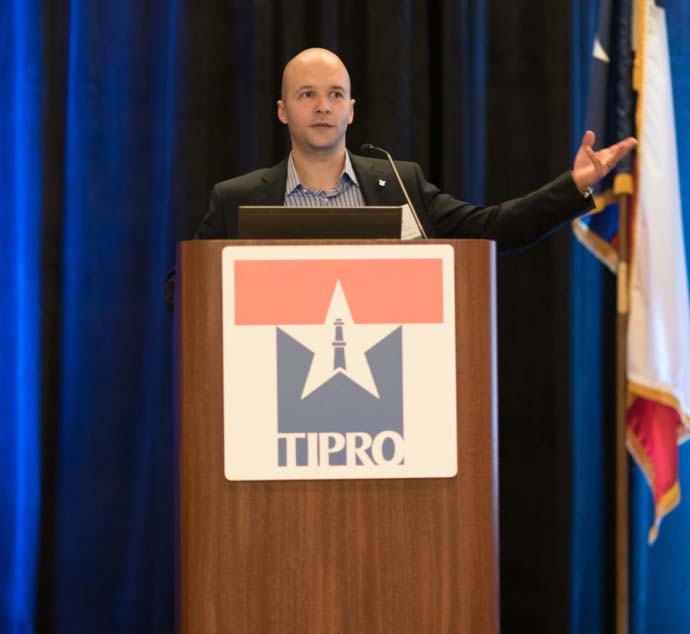
A photograph from TIPRO’s 2015 summer conference shows Walker at a lectern, one arm extended as he speaks. Another shows the room listening to his morning keynote. He was then an executive vice president of EnerVest Operating. The conference photographs capture a public-facing part of his career several years before he took the top job at EnerVest, Ltd.
In March 2022, members of the Texas Independent Producers and Royalty Owners Association confirmed him as their next chairman, with his term beginning that July. He had previously been an at-large board representative. On accepting the chairmanship, he emphasized support for domestic production and the work of Texas producers and royalty owners. It was an industry advocacy role, carrying a constituency wider than his own company.
By March 2024, his remarks at TIPRO’s annual meeting addressed natural gas demand, liquefied natural gas exports, investors and acquisition markets. He expected export terminals under construction to support future gas demand. He also discussed the return of institutional interest as producers exercised capital discipline. These were forecasts and assessments made in 2024, rather than results to be assigned to him afterward.
That distinction is particularly relevant in a business full of predictions. Geological judgment deals with what might be underground. Investment judgment deals with what a property might earn. Industry advocacy adds arguments about policy and future demand. Walker’s public work moves among all three, and each requires the reader to keep an opinion separate from an outcome.
In August 2024, T. Grant Johnson succeeded him as TIPRO chairman. Walker continued as immediate past chairman; the association’s current leadership page lists him as a past chairman and Class D director. He is also listed among the Independent Petroleum Association of America’s at-large directors. The appointments connect his operating career with the institutions through which producers organize their public voice.

An invitation with four words
Walker’s employee welcome message offers a quieter passage than the conference platform. He writes about retaining EnerVest’s “small company spirit” as the business grows, and encourages communication through an open-door policy. One sentence is especially economical: “We want your input.” It gives a new employee a direct invitation without requiring a glossary of corporate values.
The message presents support for employees and their ideas as part of how innovation happens. It is a statement of the culture he wants the company to maintain. A welcome letter cannot measure how every workplace conversation unfolds, but it can show what the chief executive chooses to say at the beginning of a colleague’s career. Here, the emphasis falls on participation and access.
His Houston connections extend beyond energy companies. He is a founding member of the Next Generation Giving Circle associated with the Greater Houston Community Foundation. The foundation also lists him among its Next Gen Donor Institute alumni. These affiliations add a civic dimension to a public biography otherwise dominated by assets, basins and appointments.
TIPRO’s leadership biography records service on the Sam Houston Area Council board and describes him as executive chairman of its Eagle Scout Association. Alongside the giving circle, that offers two specific settings for his community involvement. They are organizations with their own members and purposes, rather than a vague claim that an executive somehow gives back to everyone.
“We want your input.”
Jud Walker · Employee welcome message
Back to the particulars
There is a temptation to make a career like Walker’s into a tidy succession tale. The family connection is real. The company titles are real. But the intervening detail makes the account more interesting: years at Chesapeake, training in geology, new ventures, an asset team, an operating subsidiary, and leadership during a period when the business had serious damage to repair.
His 2018 explanation of the Austin Chalk is a fitting final detail because it concerns variation. Nearby rock can behave differently. A familiar formation name does not finish the analysis. The work continues at a smaller scale, where a general thesis meets a particular property. For a geologist who became a chief executive, it is an unusually concise description of the subject that started his career.
Today, the two companies he leads keep that relationship between ownership and operations in view. Capital buys an interest in an asset. Technical and operating work determine how it is developed and managed. Walker has occupied jobs on both sides of that relationship. The public record of his career is most revealing when it follows those responsibilities, one by one, all the way back to the ground.
Follow the wells, follow the work
Company pages, public remarks and further reading.
- EnerVest biography
- EnerVest company website
- LinkedIn profile (provided)
- United Production Partners leadership
- TCU alumni feature
- Austin Chalk interview · 2018
- EnerVest’s difficult 2018 chapter
- John Walker’s family recollections · 2017
- TIPRO chairmanship announcement · 2022
- TIPRO leadership change · 2024
- Natural gas outlook remarks · 2024
- IPAA board of directors
- TIPRO presentations archive
- 2015 conference photo edition