John Christmann was studying petroleum engineering when the oil business offered an unhelpful preview of his future. In 1986, the industry was in a slump. Graduation was two years away. He asked his grandfather, another Colorado School of Mines graduate, whether he had chosen badly. His grandfather thought a retreating crowd could be a reason to enter. Christmann stayed.
He graduated in 1988, the eleventh member of his family to finish at Mines. That is quite a family tradition to bring into a job interview. Decades later, he would describe the education as preparation for taking a difficult problem apart and working through its pieces. The problems grew larger. The method remained recognizably an engineer’s.
Today, as chief executive of APA Corporation, he is waiting on a different calendar: first oil from GranMorgu, the development offshore Suriname scheduled to begin producing in 2028. Between a student’s career decision and a floating production vessel lies a working life spent moving between the physical business of extracting oil and the financial business of deciding which oil is worth extracting.
The education between the wells
Before Apache, Christmann worked at Vastar Resources and ARCO Oil and Gas. His assignments included production, operations and reservoir engineering, along with crude oil marketing and business development. A reservoir engineer considers what a field can deliver. A marketer encounters what someone will pay. A career that visits both desks gets an early introduction to disagreement.
He joined Apache in 1997 and advanced through business development. In 2003, he briefly served as production manager for the Gulf Coast region. From 2004 through 2009, he was vice president of business development. He also earned an MBA from Southern Methodist University, adding a business qualification to his petroleum engineering degree.
The sequence matters because his eventual job would require both kinds of judgment. Buying acreage and operating it are related activities with different opportunities for embarrassment. A purchase can look sensible in a presentation and become awkward at the wellhead. Christmann’s professional preparation included responsibility on either side of that transaction.
In 2010, he took charge of Apache’s Permian region. He established the company’s Midland office, and production doubled during his tenure through 2013. His earlier business development team had handled more than $6 billion in acquisitions and divestments. These were two concrete entries on his record: assembling a portfolio and expanding the output of a region.
A promotion with the price falling
Christmann became executive vice president and chief operating officer for North America in January 2014. A year later, on January 20, 2015, he succeeded G. Steven Farris as chief executive and president and joined Apache’s board. He had spent eighteen years inside the company before taking its top operating job.
The timing was inhospitable. By April 2015, oil prices had fallen roughly half from the previous summer, and Apache had reduced spending plans by about half. Christmann was taking over a company that had reported a $4.8 billion fourth-quarter loss for 2014. A promotion is usually accompanied by congratulations. This one came with arithmetic.
He later supplied a dry account of the period: “I was not on many people’s Christmas card lists.” The joke has the advantage of acknowledging that changing a company’s direction can make a leader unpopular. It also sounds more plausible than the version of corporate change in which everybody applauds as the difficult decisions arrive.
The distinction between engineering confidence and commercial humility runs through his career. Technical knowledge gives an executive a way to interrogate a plan. It cannot negotiate with the oil price. For a chief executive, being right about the rocks leaves plenty of room to be wrong about the spending.
“I was not on many people’s Christmas card lists.”
John Christmann, recalling the 2015 reset
The name changed; the work continued
In March 2021, APA Corporation became the public holding company above Apache. Shareholders received APA shares on a one-for-one basis, and Apache became its wholly owned subsidiary. The board and executive officers continued in their roles. The reorganization gave the expanding international business a different legal structure while retaining the familiar stock ticker.
That distinction explains why a career that began at Apache now appears under APA. It was a corporate reorganization within the same business. Apache continued to hold its existing U.S. assets and subsidiaries in Egypt and the United Kingdom; APA acquired the Suriname and Dominican Republic subsidiaries as part of the change.
His title evolved again in January 2024, when Stephen Riney became president and chief financial officer. Christmann continued as chief executive and a director. Riney is now president, and Ben Rodgers is chief financial officer. The division of responsibilities is useful context for a leader whose public career is often compressed into an outdated two-word title.
Returning to familiar ground
The Permian remained central. On April 1, 2024, APA completed its acquisition of Callon Petroleum, adding approximately 120,000 net acres in the Delaware Basin and 25,000 in the Midland Basin. At closing, the company said roughly two-thirds of its approximately 500,000 barrels of oil equivalent in daily reported production would come from the Permian.
For Christmann, the case rested on applying APA’s technical methods across the acquired acreage and improving the economics of the combined operation. Ownership was only the beginning. The promised benefits depended on well performance, capital productivity and cost savings. An acquisition announcement celebrates a signature; the operating organization inherits the homework.
Before the transaction closed, he emphasized extensive data collection and analysis, along with workflows extending from planning to execution. That is a revealing emphasis from someone trained to understand reservoirs and later employed to buy assets. More acreage creates more choices. Deciding which choices deserve capital is where the engineering and the MBA meet.
A new dawn, with a fish attached
Across the Atlantic, a much longer undertaking reached its investment decision on October 1, 2024. Christmann met in Paramaribo with Suriname’s then president, Chandrikapersad Santokhi, Staatsolie chief Annand Jagesar and TotalEnergies chief Patrick Pouyanné. The partners were moving the GranMorgu project from exploration and appraisal toward development.
APA had entered the Suriname basin in 2012 and acquired Block 58 in 2015. The development would combine the Sapakara and Krabdagu discoveries. Its production vessel was designed for 220,000 barrels of oil a day, with first production expected in 2028. The gap between obtaining a position and producing oil makes patience a practical business requirement.
The name provides some welcome relief from the vocabulary of capital allocation. In Sranan Tongo, GranMorgu means both “new dawn” and “Goliath grouper.” Most investment projects would settle for one metaphor. This one has a sunrise and a substantial fish. The engineering is less whimsical: subsea wells connected to a floating production, storage and offloading vessel offshore.
TotalEnergies operates the development. Its plans include an all-electric vessel configuration, reinjection of associated gas and no routine flaring. Those are design commitments, with operating performance still to come. For Christmann, the partnership also makes an essential point about the chief executive’s work: a project of this scale depends on institutions and expertise beyond his own company.
Suriname’s national oil company subsequently exercised its right to a 20 percent participation. In 2025, Staatsolie raised $516 million through bonds and secured a $1.6 billion loan to help fund its investment. Its financial statements describe a project still under development, with first oil expected in 2028. The national partner has its own money, obligations and expectations at the table.
Being a guest is a working rule
Egypt presents another side of Christmann’s responsibilities. On March 31, 2026, he met President Abdel Fattah El-Sisi alongside Riney and APA’s senior vice president of international assets, Greg McDaniel. The discussion covered the longstanding relationship with Egypt and plans for exploration, production and improving existing fields in the Western Desert.
These relationships place the chief executive somewhere between operator and diplomat. A development program must work underground, in a budget and within a host country’s priorities. The presence of senior colleagues at the meeting makes the work look appropriately collective. There is only so much that a chief executive can accomplish by being photographed beside a president.
In a September 2026 conversation with Nasdaq Texas president Rachel Racz, Christmann described APA as a guest wherever it operates, from West Texas ranches to Egypt’s deserts. That idea connects company culture with the practical demands of working on other people’s land. Access and trust have to survive beyond the day a contract is signed.
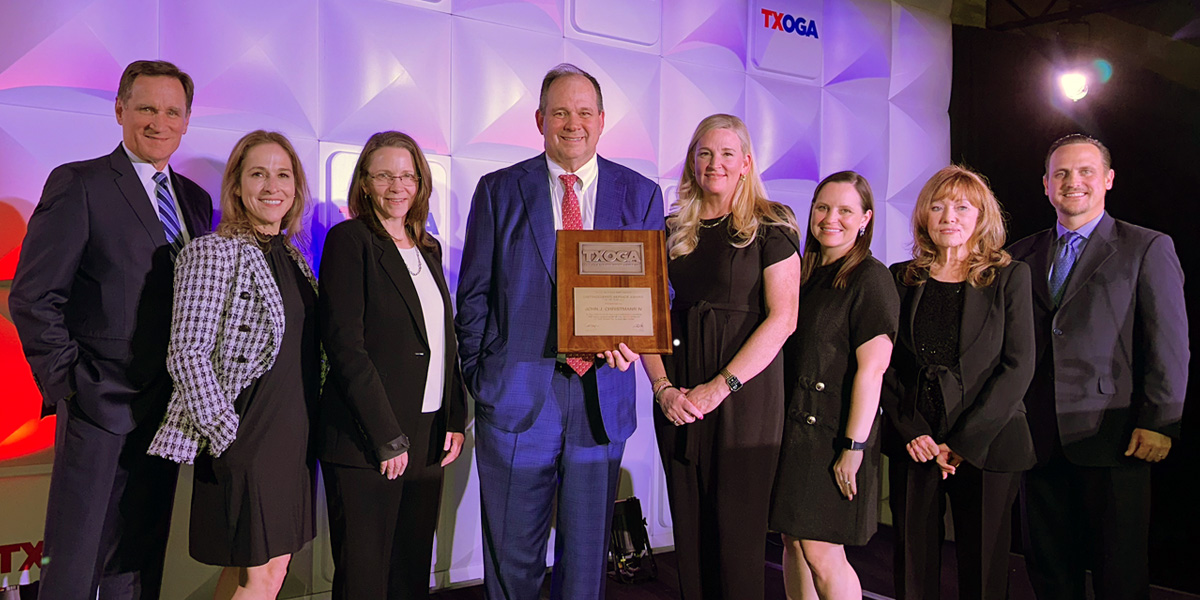
Recognition arrived in Texas in November 2024, when TXOGA honored him with its Distinguished Service Award at the Lone Star Energy Forum in Frisco. Chevron chief Mike Wirth was the other recipient. Christmann’s response credited the mentors, leaders and colleagues around him since he joined Apache. The acknowledgments fit a career built inside an organization over many years.
The next barrel still has to earn its place
The current business continues while the offshore project takes shape. In its second-quarter 2026 results, APA reported U.S. oil production of 123,500 barrels a day and $738 million in free cash flow. Total debt had declined by $2.3 billion since the end of 2024. These are company results produced by an organization, rather than personal achievements belonging to its chief executive.
They nevertheless describe his immediate assignment. APA raised its expected 2026 exit rate of annual cost savings to $500 million. GranMorgu offers a future source of production; the existing business must support the years before it arrives. The tension between spending for later and paying down debt now gives the waiting period its substance.
Christmann’s career has repeatedly brought him back to that interval between committing and finding out. A student commits to an industry. An operator commits capital to a field. Partners commit to an offshore development years before it can produce. In each case, there is work to do after the decision. In Suriname, the next date to watch is 2028.
Continue the conversation
- APA CorporationOfficial biography ↗
- Personal profileJohn Christmann on LinkedIn ↗
- Nasdaq interview • September 2026Built in Texas: Perspectives ↗
- YouTube • AmCham Egypt • November 2016John Christmann on doing business in Egypt ↗
- Oil & Gas JournalThe 2015 appointment ↗
- Mines Magazine • 2019Leading like a boss ↗
- APA • October 2024GranMorgu development decision ↗
- APA • August 2026Second-quarter 2026 results ↗