Paul Goodfellow began his Talos Energy chapter by asking for time. Appointed president and chief executive effective March 1, 2025, he said his first 100 days would be spent understanding the business and working with its leadership on a strategy. After more than three decades at Shell, he had enough experience to offer an immediate opinion. He chose to announce a period of examination. In an industry whose announcements tend to arrive wearing a hard hat and carrying a large number, it was an unusually quiet opening.
There is a practical thread running through his career: look again at something that already exists. A well whose drilling time can be reduced. A mature offshore basin with useful infrastructure. A large organization whose processes need scrutiny. Now, in Houston, an independent producer with assets to operate and choices to make about its future. Goodfellow’s story moves between those scales, from the mechanics of rock to the allocation of capital. The distance between them is smaller than it first appears.
An education in pressure
His preparation began at the Camborne School of Mines in Britain. He completed his undergraduate degree in mining and mineral engineering in 1986 and his doctorate in rock mechanics in 1990. Before Shell, he worked in mining in South Africa and Finland. The early itinerary belongs to a working engineer: different countries, different ground, an education that continued beyond the degree certificate.
He joined Shell in the Netherlands in 1991. By 2000 he was operations manager for deepwater drilling and completions at Shell Exploration & Production Company. In 2003 came responsibility for wells across the Americas. Those are concrete jobs behind the later executive titles. A well has to be planned, drilled and completed before it can contribute anything to a production forecast.
In a Houston briefing in 2001, Goodfellow explained that deepwater well costs depended heavily on rig day rates and drilling time. Faster drilling with smaller, less expensive rigs could change the economics. That observation has survived rather better than many executive slogans. Time spent is money spent; a technical improvement has a financial consequence. The young operations manager was already discussing the relationship that would occupy much of his later career.
A platform small enough for a table
One photograph from his Shell years brings the scale down to furniture. Goodfellow sits beside Duncan Manning, Brent’s decommissioning manager, with a model platform between them. The towers rise above the tabletop. Goodfellow, on the right, rests a hand near the edge. Offshore engineering has briefly become something you could arrange beside the office coffee cups.
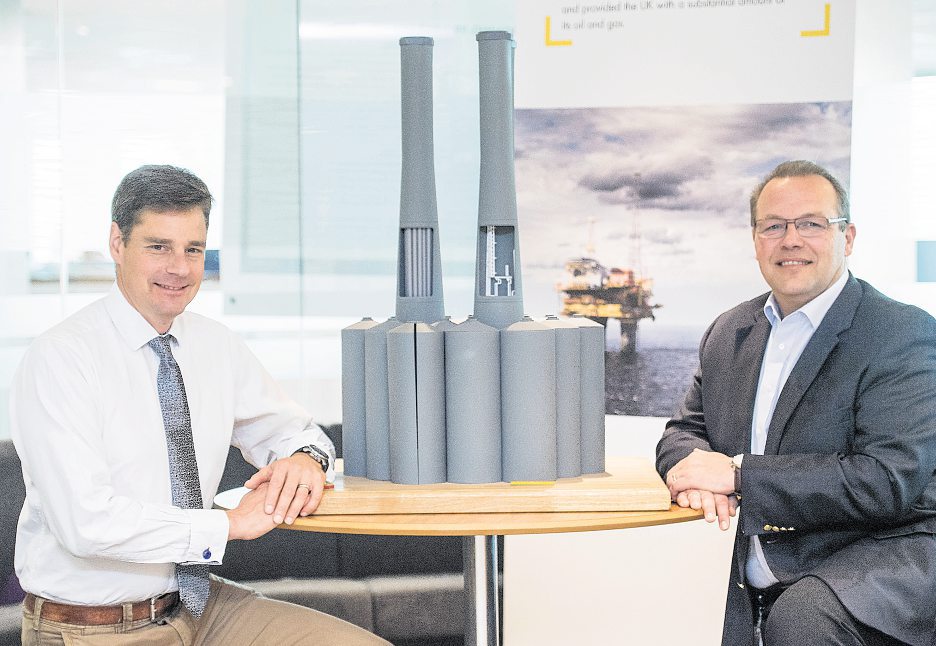
The picture belongs to Brent’s fortieth anniversary in 2016, during Goodfellow’s time leading Shell’s UK and Ireland upstream business. He wrote about the field as both an industrial achievement and an obligation stretching into the future. Production was only part of the story. The platforms and pipelines would eventually have to be decommissioned, a complex engineering task with its own demands on expertise and public engagement.
His anniversary reflection also had a dry domestic streak. He compared 1976 with the present through bread prices, house prices and Abba’s place in the charts. For a moment, the history of a North Sea field shared space with the shopping basket and the record collection. It was a welcome reminder that a forty-year industrial life is also forty years of ordinary life passing around it.
There were harder decisions during that posting. In March 2015, Shell announced reductions of at least 250 staff and agency contractors supporting its UK North Sea operations, alongside changes to offshore shift patterns. Goodfellow’s explanation centred on costs, competitiveness and keeping investment possible. Running an established basin meant dealing with the people affected by its economics, as well as the engineering underneath them.
At the end of the assignment, a 2017 interview caught a more personal detail. Discussing his place near the action during the industry’s difficult two years, he mentioned that he had played in rugby’s front row. The metaphor came with its own sporting footnote. It offers a small glimpse of humour amid a career usually recorded through appointments and operating responsibilities.
The view from the audit chair
The jobs kept widening. Goodfellow had already moved through North American onshore development and the US and Canadian unconventionals business. In 2017 he became executive vice president of Wells. From April 2019 to August 2023, he led Shell’s global deepwater business, covering regions including the US Gulf, offshore Mexico, Brazil, West Africa and Malaysia. His professional map had become a map of offshore basins.
Then came a change of vantage point. From August 2023 until February 2025, he was Shell’s executive vice president and group chief internal auditor. Operations asks how to deliver a plan. Audit examines how the organization works and whether its controls hold up. His record contains both responsibilities. That combination is useful context for the next appointment, without requiring a theory about what he was thinking as he accepted it.
First, take 100 days
Talos announced his appointment on February 3, 2025. Board chairman Neal Goldman pointed to his deepwater experience and judgment. Goodfellow would also join the board. The assignment placed a long-serving executive from a global energy group at the head of a Houston independent focused on offshore exploration and production.
“During my first 100 days at Talos, I plan to gain a deeper understanding of our business and identify the key drivers of Talos’s success.”Paul Goodfellow · February 2025
By June 17, Talos had presented the resulting strategy. It put improvement of the existing business alongside production growth and a longer-lived offshore portfolio. The first ambition carried a target: approximately $100 million of increased annualized cash flow in 2026 from operational, commercial and organizational improvements. It was a target to work toward, rather than a sum already earned.
He also changed the leadership around him. Zach Dailey joined as chief financial officer in August 2025; Bill Langin became executive vice president for exploration and development in September. Megan Dick, who had been with Talos since 2014, was promoted to executive vice president and chief human resources officer. The group combined outside experience with knowledge already inside the company. An offshore strategy still requires people to make it work on a Tuesday morning.
Give the existing business another look
There is an engineering idea behind much of this business: nearby discoveries can sometimes be connected to infrastructure already in place. These subsea connections, known as tiebacks, make the surrounding geography matter. A producing platform can also become a destination for another field’s output. The value of an asset therefore includes the possibilities within reach of it.
On Talos’s February 2026 results call, Goodfellow described prospective drilling opportunities as having to compete for capital. A lease could enter the schedule for consideration without receiving an automatic cheque. That distinction gives the portfolio ambition some necessary friction. Finding possibilities and choosing which ones to fund are separate pieces of work.
The public results provide specific checkpoints. In the first quarter of 2026, Talos reported that Cardona had arrived ahead of schedule and CPN had been drilled and completed under budget and ahead of schedule. By the second quarter, total production averaged 93,700 barrels of oil equivalent a day. These were company and team results under his leadership. They make the daily-improvement language easier to examine than a general promise of better performance.
The next chapter has a closing date
On September 22, 2026, Talos completed an acquisition from Shell alongside an affiliate of Ridgewood Energy. It included a 50% working interest and operatorship in Coulomb, plus a 25% non-operated interest in BP’s Na Kika platform and four associated fields. The final net cash purchase price at closing was $420 million, subject to customary adjustments. Goodfellow’s old employer had become a counterparty in his new company’s expansion.
Final net cash purchase price at closing for the announced Gulf deepwater transaction, subject to customary post-closing adjustments.
A different kind of opportunity was taking shape offshore Mexico. In July, Talos announced an agreement to acquire 50% of Repsol-operated Block 29, containing the Polok and Chinwol discoveries. That agreement remained subject to regulatory approvals, with the partners expecting to progress toward a final investment decision in 2027. Producing assets and future developments occupy different places on the clock; the distinction matters when describing what the new portfolio can deliver.
Goodfellow’s career has given him responsibility for wells coming into service, mature fields moving toward retirement and the machinery of a large company itself. At Talos, those experiences meet in a continuing set of choices: improve what is operating, decide what to add, and determine what can justify the next investment. The platform model on the table remains an apt image. You can see the whole structure at once. Making it work still requires attention to the parts.