Curt Begle won a basketball award for being useful before he was in charge. In 1999, the Missouri Valley Conference named the Evansville forward its Sixth Man of the Year. He played in 32 games that season and started four. There is a particular sort of distinction in that: an award for what happens when the lineup needs something else. The Purple Aces reached the NCAA Tournament. Begle graduated, joined Berry, and began a working life that would keep returning to the question of how people fit together.
Twenty-five years later, he became chief executive of Magnera, a company assembled from businesses with long histories and newly shared obligations. A merger can put factories on the same balance sheet overnight. Getting their people to work as one organization takes rather longer. Begle arrived with a career spent inside the business being carved out, and a fairly explicit opinion about the importance of team chemistry.
The distance between the college reserve and the public-company CEO is considerable. The geography is less dramatic. Evansville remains his base, the place where he studied, played, worked and became a university trustee. His career has grown outward from the city without erasing it.
A useful education in coming off the bench
Begle's college record has the appealing untidiness of an actual apprenticeship. Across four seasons at Evansville, he appeared in 114 games. His scoring average fell from 5.6 points as a freshman to 2.1 as a sophomore, then rose to 7.8 in his final season. His senior year also brought 5.7 rebounds per game. Improvement, in this case, declined to travel in a straight line.
The sixth-man award gives that final season a shape that a job title cannot. It recognizes a contribution made largely outside the starting five. Read alongside his later emphasis on hiring people who improve a team's chemistry, it is an intriguing early detail. It would be too tidy to claim that basketball explains his management career. It does establish that belonging to a successful group was part of his life well before an executive biography entered the picture.
He earned a Bachelor of Science in Business Administration from the University of Evansville and an MBA from the University of Southern Indiana. Both institutions are in the city that anchors his professional life. The educational route has a practical continuity: undergraduate study, business work, further business education. There is no need to supply a dramatic escape from Indiana. The interesting part is how much room he found to grow there.
Twenty-five years inside the machinery
Begle joined Berry in 1999. His progression included sales and leadership work, followed by the presidency of its Rigid Closed Top Division from 2009 to 2014. He then led Engineered Materials from 2014 through 2018. Before Magnera, he headed Berry's division encompassing specialty materials, nonwovens and films, a global business described at $3.4 billion.
The sequence matters more than the vocabulary. These were different operating responsibilities within the same expanding manufacturer. He moved through rigid packaging and engineered materials before taking on the business that would provide much of Magnera's foundation. By the time he became CEO, he had spent a quarter-century learning the organization from within. His appointment paired a new corporate name with considerable personal continuity.
Asked in 2020 about a memorable experience at Berry, he chose its transition from private-equity ownership to the New York Stock Exchange. He remembered the change in ownership structure while emphasizing the continuing obligation to shareholders. That answer now has an additional resonance. Four years later, he would lead another business through a change of corporate identity and into its own life on the exchange.
“My greatest reward has been the cultivation of meaningful relationships both internally and externally.”
Curt Begle, 2020
His hiring preferences were equally revealing. Technical expertise, competitive drive and an ability to work with others all mattered. After those considerations came cultural fit: would the recruit improve the group's daily working chemistry? This is a specific management preference, rather than evidence that every team he has led achieved it. It places the everyday experience of working together near the center of his stated approach.
A company with a birthday and a long memory
Magnera came into existence on November 4, 2024, when Berry's global nonwovens and films business combined with Glatfelter. Trading under MAGN began the next day. Begle became CEO of an enterprise whose products and relationships were considerably older than its name. Calling it a young company is accurate. Imagining a young collection of factories would be misleading.
nonwovens + films+Glatfelter
For Begle, the challenge extended beyond explaining a transaction. Employees inherited a new employer; customers needed confidence in a continuing supplier. Combining capabilities is an attractive proposition on paper. Purchasing, product development and commercial teams still have to turn the proposition into decisions that work across the business.
In November 2025, he described establishing the Magnera culture as daily work and said employee engagement would remain a focus into 2026 and beyond. He also pointed to procurement progress and the work of moving away from services temporarily provided by Berry. Those are useful details because they make integration visible. Independence arrives through arrangements for ordinary operations as well as through a listing and a name.
The first fiscal-year results gave him something concrete to discuss. Magnera reported $3.204 billion in net sales and $5 million in operating income for fiscal 2025. It also reported $354 million in adjusted EBITDA, with a separate presentation of $362 million including $8 million from the pre-merger October period. Keeping those distinctions intact matters. A newly combined company can make even a seemingly simple annual comparison require a second look.
The trophy comes with a shopping bag
One photograph from 2025 offers a less abstract account of what the combined materials portfolio could do. Begle stands beside product director Seth Good and innovation manager Vinit Singh, with a trophy and a Sontara bag. Sontara's EcoRE bags received the IDEA Long-Life Achievement Award. The object looks pleasingly ordinary for something surrounded by so much industrial terminology.
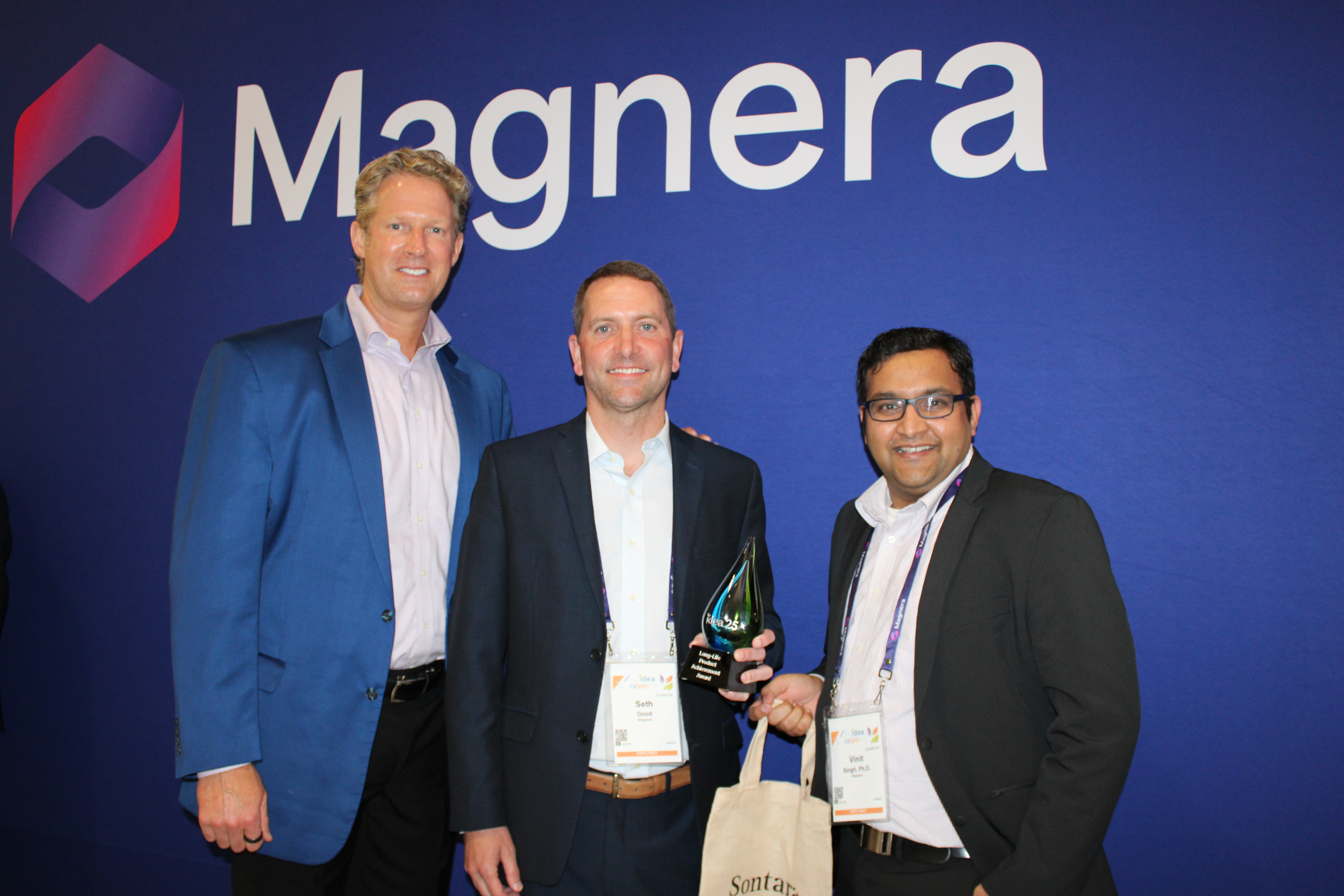
The material uses cellulosic fibers and is certified for home composting. It achieves strength without added binders. The appeal of the example is its specificity: a bag must carry things, and a compostability claim must come with conditions and certification. An environmental ambition becomes more interesting when there is a physical object to inspect.
Another example followed in June 2026. Magnera introduced Universa, an industrial-wiper range combining capabilities from Chicopee and Sontara. The underlying technologies include Airlaid, Spinlace and Sontara. The two established brands continued; the new range filled gaps between them. For a CEO overseeing integration, this is a tangible expression of the premise: capabilities acquired together can be offered together in a form a customer can choose.
The less photogenic part of the job
Begle's public agenda also involves deciding which operations belong in the portfolio. In June 2026, Magnera announced the sale of its Caerphilly business in the United Kingdom to Polyart Group. The operation made metallized paper for applications including labels, gift wrap and food packaging. The sale followed a review of technologies, products and markets. A combined company still needs boundaries.
By the third quarter of fiscal 2026, Magnera reported net sales of $857 million, operating income of $22 million and adjusted EBITDA of $99 million. Begle credited organic volume growth, merger savings and Project CORE, while discussing the response to rising raw-material costs. The company reaffirmed its full-year free-cash-flow outlook and pointed toward the lower end of its adjusted EBITDA guidance. Progress and pressure occupied the same announcement.
October brought two different kinds of investment. A new five-layer blown-film line in Dombühl, Germany, had been commissioned and was undergoing product verification and qualification; commercial production was expected that month. On October 13, Magnera announced a research agreement with the U.S. Army Research Laboratory involving its OmniSep battery-separator platform. The agreement concerned evaluating and advancing technology. Its commercial outcomes remained ahead.
In his 2026 corporate-responsibility message, Begle connected materials performance with more responsible manufacturing. He emphasized measurable commitments and annual transparency. That ambition adds another set of tests to the operating job: material efficiency, supply-chain resilience and the ability to explain progress over time. For a business built around materials other companies use, the consequences travel beyond its own factory gates.
Back where the colors are purple
In April 2026, Begle returned to the University of Evansville for the dedication of the Begle Family Sports Performance Center. He and his wife, Kelley, were recognized for their leadership giving to a privately funded project that had exceeded $800,000. The facility serves 300 student-athletes across 17 Division I programs.
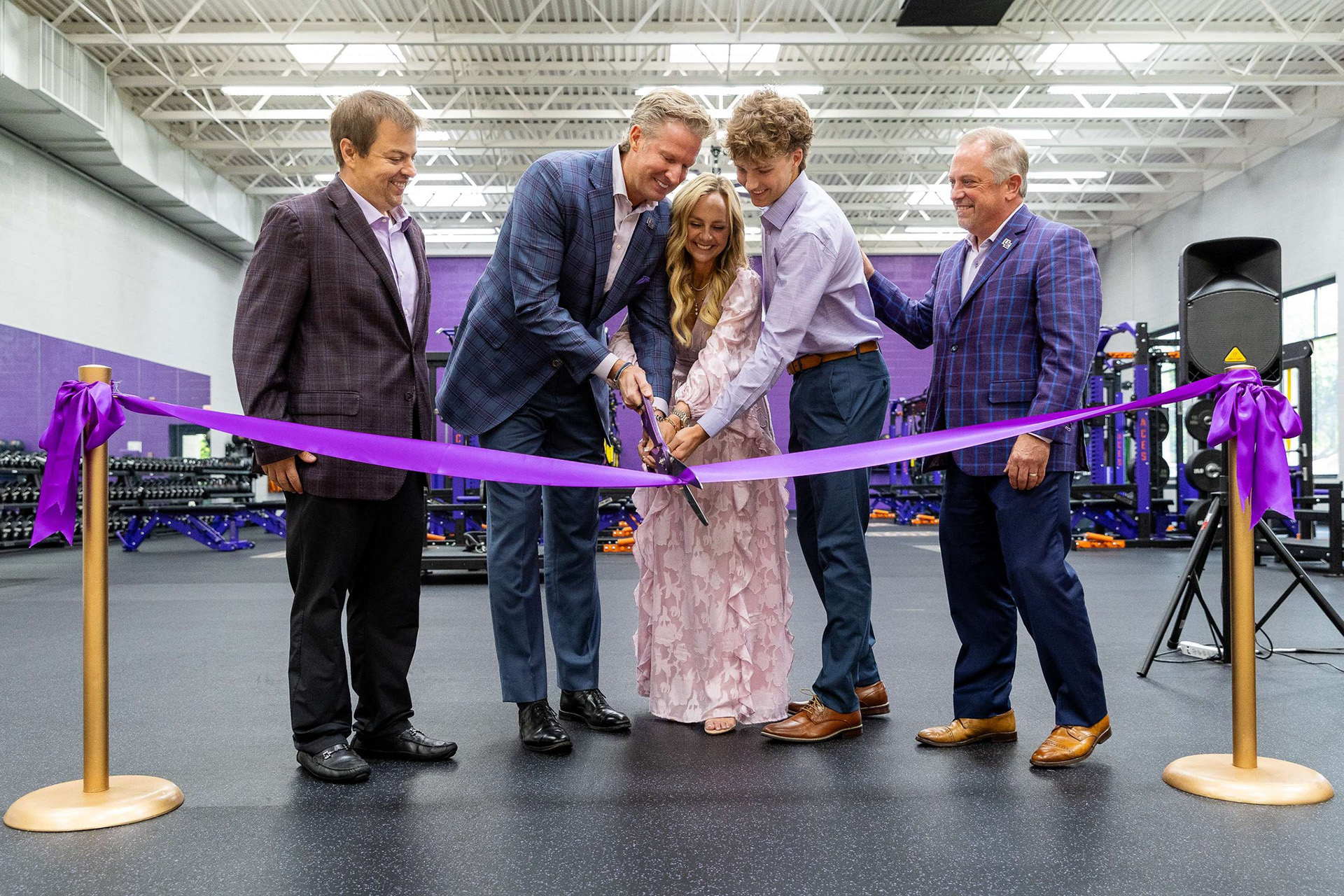
The connection is shared. Kelley graduated in 2000 and participated in the cheer team and Acettes. Curt joined the university's trustees in 2019. He has also chaired the Evansville Regional Economic Partnership, extending his local involvement beyond campus. These commitments give his Evansville address substance: it describes institutions he continues to help, rather than simply a place attached to a biography.
At the dedication, he spoke about the lasting lessons of athletics, including teamwork, perseverance and resilience. The words were familiar; the setting supplied their weight. A former reserve forward was helping provide a space for every university team. After the divisional presidencies, the merger and the quarterly results, there was still a practical way to contribute at Evansville: make room for the next group to get better.
- Magnera ↗Company website
- Curt Begle on LinkedIn ↗Personal profile
- Regional Voices: Curt Begle ↗Watch the 26-minute conversation on PBS
- A Closer Look at Curt Begle ↗The 2020 interview on leadership and the packaging industry
- The Begle family’s Evansville gift ↗University of Evansville / April 2026
- Magnera’s latest announcements ↗Operations, products and company results
- Magnera on YouTube ↗Company videos