In 1938, Roy Plunkett investigated a cylinder of refrigerant gas at DuPont and found something unexpected: the gas had become a solid. The material was slippery and chemically resistant. It became the basis of Teflon. Nearly eight decades later, that accidental discovery belonged to a company that had only just acquired an independent existence. Chemours began trading in July 2015. Its chemistry was considerably older than its stationery.
- Chemours supplies ingredients for cooling, coatings and demanding industrial equipment.
- Its advantage combines chemistry, production plants and help meeting customer specifications.
- Environmental obligations complicate the economics of those useful materials.
This is a peculiar kind of fame. People recognize Teflon without necessarily recognizing its owner. They notice white paint without wondering who supplied the pigment. Chemours operates in that gap between a finished product and the material that makes it possible. By September 2026, it reported serving roughly 2,400 customers in about 110 countries. The customer is usually another business. The eventual user might be almost anyone.
The business inside the business
Start with a wall. Titanium dioxide helps paint hide what lies underneath; Chemours sells it as Ti-Pure for coatings, plastics and laminates. The point is opacity, brightness and consistent performance. A paint manufacturer buys a functional ingredient, then combines it with other ingredients into something the shopper can choose from a color card.
Now open a car door on a hot day. Chemours’ Thermal & Specialized Solutions business sells Opteon and Freon refrigerants. The third business, Advanced Performance Materials, supplies materials under names including Teflon, Viton, Krytox and Nafion. Their jobs include resisting chemicals, lubricating demanding equipment and enabling electrochemical processes. The product list reads less like a shopping basket than a collection of difficult engineering problems.
The business model follows: manufacture chemicals, sell directly or through distribution, and help customers make them work. The expertise includes fluorine chemistry, process engineering and application development. In this market, the sales conversation can turn on a seal, a lubricant or a temperature limit. A recognizable brand helps. So does knowing why a customer’s equipment behaves badly.
A molecule needs a factory
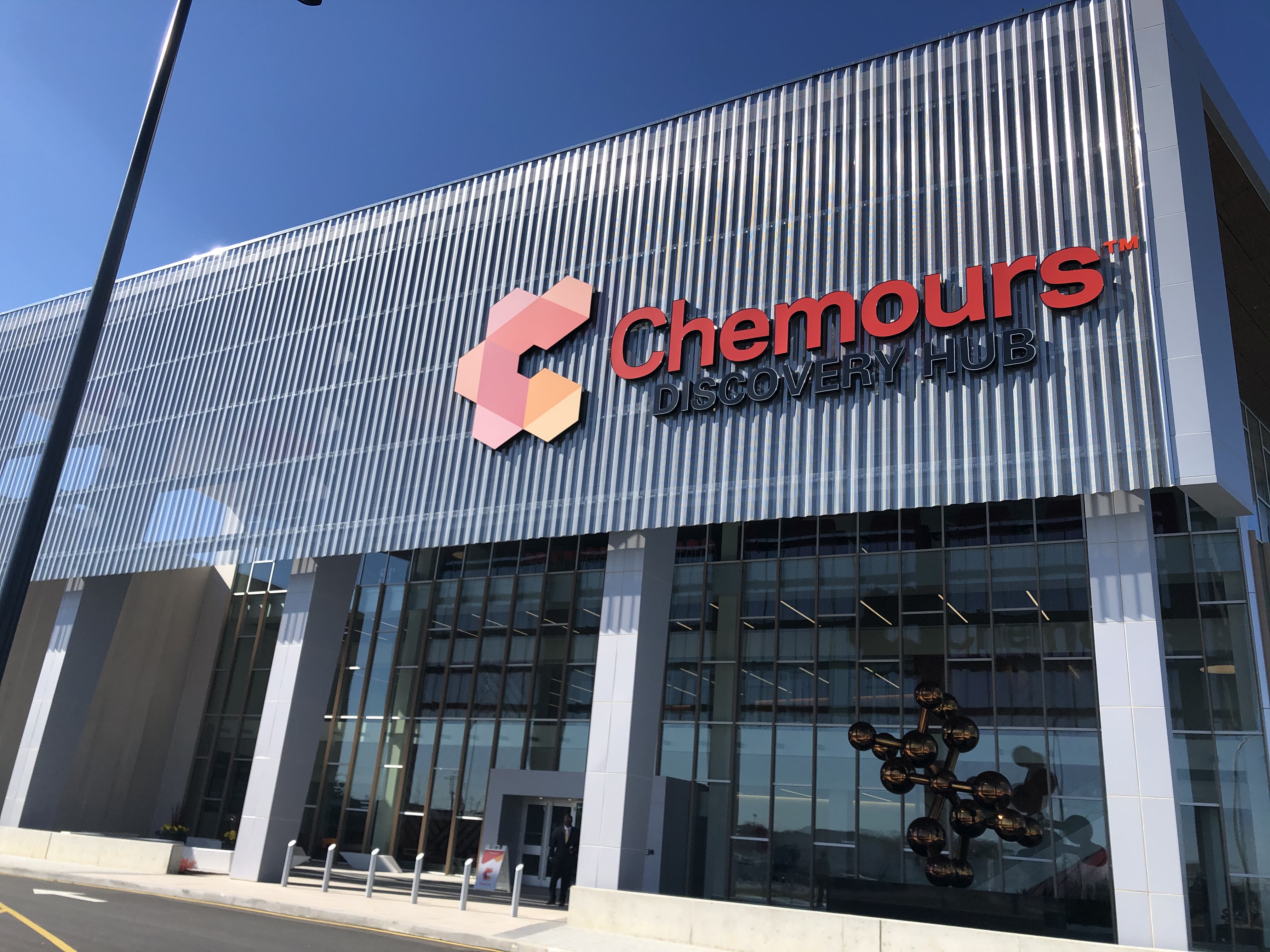
Consider the price of making a laboratory result available at industrial scale. In 2019, Chemours inaugurated its $300 million Opteon refrigerant facility near Corpus Christi, Texas. In 2020, it opened the $150 million Discovery Hub on the University of Delaware’s STAR Campus. Research proximity and manufacturing capacity were two separate purchases. Neither could substitute for the other.
Those choices help explain the competitive position. Chemours faces different opponents in each aisle: Solstice Advanced Materials and Arkema in refrigerants, Tronox and Kronos in titanium dioxide, Daikin and Syensqo in performance materials. Its defense includes proprietary processes, patents and technical relationships. It still has to compete on price and performance. A long history does not excuse an unsuitable material.
“Innovation does not happen by accident”Joseph Martinko · Thermal & Specialized Solutions · October 2026
The new customer has a heat problem
Artificial intelligence gives this old industrial logic a new setting. In May 2025, Chemours announced an agreement with DataVolt to develop and demonstrate advanced liquid cooling for data centers, including two-phase immersion and direct-to-chip approaches. That is a development agreement. It should not be mistaken for evidence that every proposed system is already running commercially.
In August 2026 came two additions for stationary chillers: Opteon ZE and Opteon 515B. Their differences are instructive. ZE has an A2L safety classification, meaning mildly flammable. The 515B blend has an A1 classification, with no flame propagation. Choosing chemistry means choosing among constraints: equipment design, climate performance, safety class and operating conditions. There is no useful universal answer detached from the machine.
The bill follows the molecule
Chemours’ industrial inheritance also includes environmental obligations. In June 2026, federal agencies announced a proposed PFAS settlement valued at approximately $450 million, covering penalties, pollution controls and drinking-water measures. PFAS are the chemical family commonly called “forever chemicals.” The agreement addressed alleged environmental-law violations at facilities in three states. Its headline value was not simply a cash fine.
September brought a separate North Carolina agreement with DuPont and Corteva: $455 million in payments over 15 years, half allocated to Chemours. State officials described a $590 million package including $135 million in financial assurance. Those figures describe different components. They also make the central business problem concrete: selling a material and paying for its environmental consequences can happen on very different schedules.
Revenue measures the business coming in. It does not tell you what remains.
The latest completed quarter offered another complication. In the second quarter of 2026, Opteon refrigerant sales fell 10% from a year earlier. Chemours pointed to weaker North American stationary air-conditioning aftermarket demand against the previous year’s initial channel stocking. The distinction matters: orders can surge when distributors fill shelves for a technology transition, then soften even while the installed equipment still needs the product. A regulatory opportunity does not produce a smooth sales curve.
Even before the recent agreements, the accounts demanded attention. In March 2024, Chemours disclosed that an internal review found inadequate transparency with the board over accelerated receivables collections and delayed supplier payments. The actions inflated year-end cash-flow measures, with an expected reversal in the next quarter. Denise Dignam became permanent CEO that month. The documented issue was governance around the numbers, not a failed chemical formula.
Start with the specification
There is a practical lesson here for builders: find the exact requirement your customer cannot easily solve, then supply the expertise around it. Chemours’ refrigerant tools calculate properties and support diagnostics. That surrounding knowledge makes the product easier to assess and use. Buyers can begin with those tools, technical documentation and authorized distributors rather than choosing a cylinder by a familiar name alone.
The approach depends on fit. It becomes less attractive when equipment cannot accommodate a material, a competing technology delivers better economics, or rules restrict its use. Lower climate impact on one measure does not settle every environmental question. Chemours reported $5.808 billion in 2025 sales and a $386 million net loss. Both belong in the picture. A useful molecule has a price, and the full price can take years to arrive.