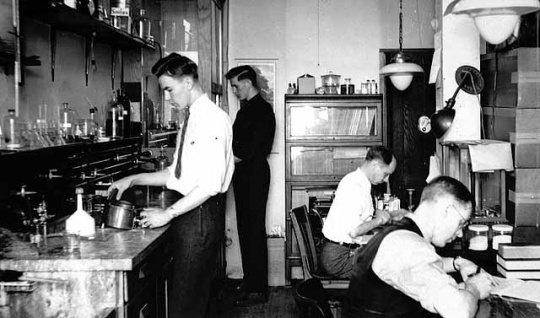
In 1923, Merritt J. Osborn had a carpet cleaner and a problem. His product, Absorbit, let hotels clean carpets without shutting down rooms. Useful, certainly. But the market was limited, according to Ecolab’s own history. The young company needed another reason for customers to call.
- Chemistry, equipment and service for indispensable routines.
- Measure the full cost of cleaning and water.
- A $4.75 billion acquisition takes Ecolab into AI cooling hardware.
The carpet was only the beginning
The following year brought Soilax, a compound that worked in the mechanical dishwashers restaurants were beginning to adopt. Here was a different kind of opportunity: a job that had to happen again tomorrow. By 1928, the company had introduced a dispenser. The offer was becoming a system of chemistry, equipment and service.
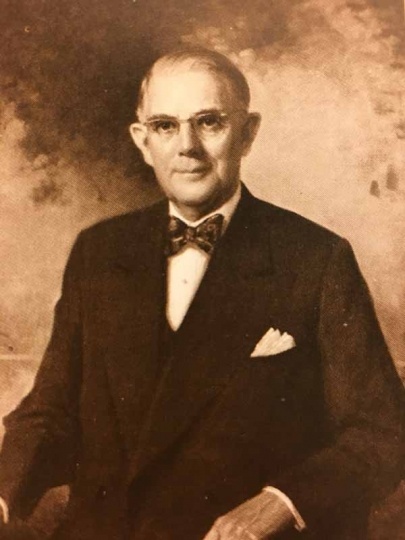
Osborn called the business Economics Laboratory. The name carried an argument: laboratory work should improve the customer’s economics. A century later, that argument connects restaurant dishes, pharmaceutical manufacturing and the liquid running through a server’s cooling system.
The expensive part is everything around the chemical
Ecolab supplies water treatment, cleaning, sanitation, infection prevention and pest elimination to commercial and industrial customers. Its customers include hotels, restaurants, food processors, hospitals, factories and chipmakers. The common feature is an operation that cannot afford to get dirty, contaminated or unexpectedly stopped.
Consider a food factory between production runs. Cleaning equipment consumes water, chemicals, heat and time. Saving a little detergent matters less if the cleaning cycle keeps the production line idle. Ecolab’s clean-in-place programs address that whole operation, including chemistry, system design, monitoring and procedures.
This is where the company’s expertise lives: in the interaction between a formulation and the particular pipe, surface, organism or production schedule it must handle. Field service turns a product into an ongoing working relationship. The customer buys supplies, but also needs somebody who understands what happens after they enter the system.
The original proposition“save customers time, labor and money”
Ecolab’s history, on the Economics Laboratory name
A water sensor earns its keep by changing something
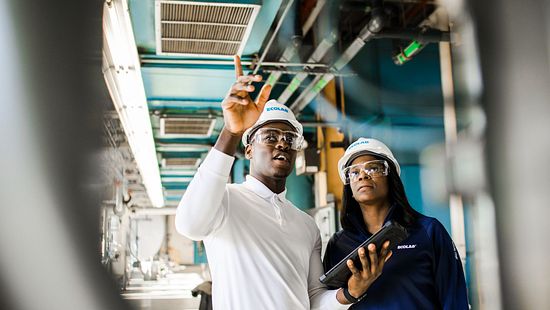
Nalco Water gives Ecolab an industrial water business spanning boilers, cooling systems and wastewater. Its 3D TRASAR technology connects sensors, automated chemical dispensing, monitoring and expert support. Measurements such as pH and conductivity help reveal trouble while there is still time to respond.
The interesting unit of value is the avoided problem: equipment protected from corrosion, cooling kept efficient, water reused safely. Ecolab says more than 50,000 industrial water systems use 3D TRASAR. That installed base gives a seemingly narrow technical task considerable commercial reach.
Solenis, including Diversey, offers competing water and hygiene programs. Ecolab’s case rests on the breadth of its own combination: chemistry, connected equipment, digital analysis and people working at customer sites. Buyers should compare measured operating outcomes and local service capability, alongside the price of the drum.
- 01 Measure
- 02 Diagnose
- 03 Adjust
- 04 Verify
The bill and the benefit are different numbers
Ecolab’s Nestlé case study makes the economics tangible. For work measured during 2025, Ecolab reports 41 million gallons of annual water savings and an estimated $7.5 million in total value delivered. The interventions included colder clean-in-place processes, water-system optimization and biological waste treatment.
That $7.5 million is an estimate of customer value, not the amount Nestlé paid Ecolab. Nor is it a guaranteed return for another factory. The company explicitly says results depend on the customer’s circumstances. A useful buyer asks for the baseline, the implementation bill and the assumptions behind the savings.
Ecolab’s own accounts show how the model pays. In 2025 it recorded $16.081 billion in revenue: $12.619 billion from products and equipment, and $3.463 billion from services and leases. The business combines repeat consumption with equipment and continuing service. It is an established public company, listed as ECL.
Buying the next difficult problem
Building that range has required serious acquisition spending. The 2011 Nalco merger was announced at approximately $8.1 billion including assumed net debt. Purolite, acquired in 2021 for approximately $3.7 billion, brought purification resins used in pharmaceutical and industrial applications.
Expansion has also produced an expensive wrong turn. The Minnesota Historical Society records that Ecolab’s 1987 purchase of lawn-care company ChemLawn proved unprofitable; it sold the business at a loss in 1992. A recurring service business can still be a poor acquisition. Repetition alone does not establish a fit.
The human continuity is more surprising. Ida Koran, Osborn’s first employee, stayed more than four decades. Her estate established a fund to help employees facing financial hardship. Today’s much larger organization reports employee listening programs and professional development initiatives. Service depends on retaining practical knowledge as well as inventing new chemistry.
The AI boom has plumbing
In May 2025, Ecolab introduced 3D TRASAR monitoring for direct-to-chip liquid cooling. It tracks coolant conditions including concentration, temperature, pH and flow. A powerful server still needs fluids with the right properties, moving through the right places.
The company added Ovivo’s electronics ultrapure-water business in December 2025, extending its capabilities in semiconductor manufacturing. Then, in July 2026, it closed the approximately $4.75 billion CoolIT acquisition, adding direct liquid-cooling hardware. These purchases connect water for making chips with systems for cooling them.
Ecolab has announced a combined cooling platform for introduction in November 2026. As of this profile’s October publication, that is a forthcoming product, rather than a completed launch. The distinction matters: a bought capability and an announced roadmap still have to become reliable equipment in a customer’s facility.
Start with the rinse cycle
The useful lesson travels beyond water treatment. Pick a repetitive task, measure its full cost, and change one controllable part. Count labor, heat, downtime and waste alongside the consumable. Then check that the improvement survives normal shifts, normal operators and normal production pressure.
The conditions matter. Food safety and product quality set limits on how far a cleaning cycle can be shortened. Water chemistry varies by site. Sensors need trustworthy readings and a response when something changes. A factory that installs monitoring but never acts on it has purchased a better description of its problems.
For a buyer, the practical starting point is a site assessment with a defined operating goal. Choose a process, agree on what success means, and establish who will act on the readings. A dashboard becomes useful when the operator, maintenance team and supplier share a procedure for responding to the condition it reveals.
Ecolab gives operators a way to connect those measurements to chemistry and action. Its enduring commercial idea is unusually concrete: make an indispensable routine work better, demonstrate the benefit, and be there when the customer has to do it all again tomorrow.