A chemistry degree is one way into a chemical company. Patrick Hawkins also took the longer route through its working parts: technical direction, quality, plant management, food-ingredient sales. By the time he became president of Hawkins, Inc. in 2010, he had spent more than seventeen years inside the business. The surname was familiar. The apprenticeship was substantial.
That combination makes his career interesting. A company carrying your name offers an obvious connection to its past. Running it asks a more awkward question: what, exactly, will you change? Hawkins has answered over fifteen years as chief executive by expanding the business around water treatment, assembling local operations and adding technical capabilities to a company founded in 1938.
By fiscal 2026, annual sales had passed $1 billion. Water Treatment accounted for half the total. Those are large numbers attached to rather practical activities: delivering chemicals, supplying equipment, helping customers operate their systems. In this corner of business, a truck arriving as promised can be a more persuasive statement than a speech.
A chemist learns the other jobs
Hawkins holds a bachelor’s degree in chemistry from the University of St. Thomas in St. Paul. He joined the company in 1992. His early responsibilities included plant manager, quality director and technical director, roles that put production, specifications and the performance of products within the same career.
From 2002 to 2007 he worked as a sales representative in food ingredients. He then became business manager for food and co-extrusion products, followed by business director in 2009. The sequence matters because it crosses the internal boundaries that can make a manufacturing business difficult to run. A product has to work, be produced consistently and find a customer willing to buy it.
His appointment as president was announced in February 2010 and took effect on March 29. The position was newly created as part of the board’s succession planning. John R. Hawkins, then chief executive, credited Patrick’s work in growing food ingredients and contributing to strategic sourcing. The promotion followed years of operating responsibility inside the company.
In March 2011, Patrick became chief executive and joined the board. John Hawkins was his uncle. Family continuity therefore belongs in the account, alongside a work history that had already taken Patrick from technical responsibilities to selling and managing businesses. Both facts help explain the succession; neither needs an invented childhood scene to make it interesting.
The family business already knew water
Hawkins did not have to discover water treatment on his first morning as CEO. The company had acquired Feed-Rite Controls, a water-treatment chemicals and equipment business, in 1976. Its history also includes river terminals, bulk handling and manufacturing facilities. The present strategy has roots considerably older than his tenure.
That inheritance gave him something concrete to extend. In 2011, the company acquired Vertex Chemical, adding sodium-hypochlorite manufacturing and facilities with barge access. The Rosemount, Minnesota, plant opened in 2013 with rail access, a warehouse and tank storage. These are the physical details behind a chemical supplier’s ability to serve more customers.
The geography kept widening. The Dumont acquisition added seven Florida facilities in 2014. Subsequent purchases brought operations in Tennessee, Louisiana, Alabama and Texas. Read together, the transactions describe a business growing outward through places where customers already had a supplier, a service relationship and a reason to expect the next delivery.
There is an appealing lack of theatre in that method. The work involves warehouses and routes, customer lists and technical knowledge. Acquiring a local operation can add all of them at once. Whether the enlarged company earns the same loyalty is the continuing test. A signed purchase agreement does not deliver the next order.
The award came with a team attached
In June 2023, Hawkins was named a winner of the EY Entrepreneur Of The Year Heartland Award. An independent regional judging panel selected the winners. It was a personal recognition for an executive who had spent three decades inside an established company, making it a useful reminder that entrepreneurial work can happen long after a business is founded.
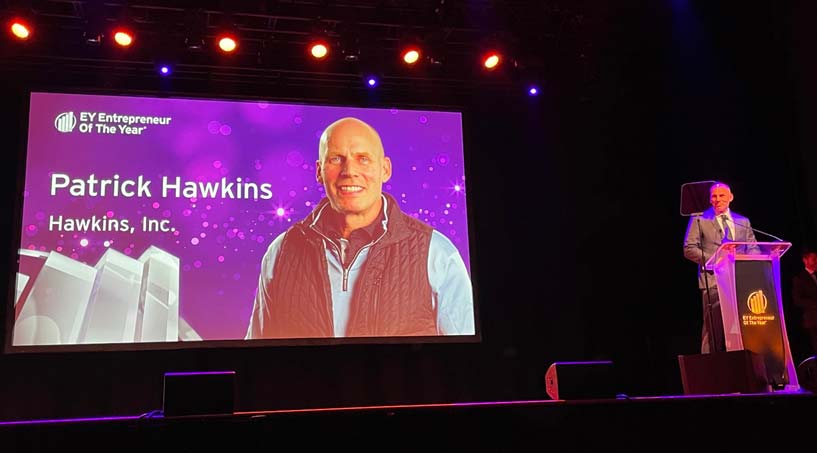
His response credited the work and dedication of the Hawkins team and emphasized service to customers and communities. The emphasis was consistent with his later explanation of the business. In his 2024 CEO letter, he put relationships at the center of the company’s role connecting customers and suppliers.
“At Hawkins, relationships are at the heart of everything we do.”
Patrick H. Hawkins · 2024
That letter also described investment in rural water systems through grants, apprenticeships and donations. For a chemical-company CEO, the subject follows naturally from the customer base. Equipment and chemistry require people who know how to use them. Supporting the workforce serving those systems connects the company’s commercial interests with the communities buying its products.
Buying a different kind of expertise
The April 2025 acquisition of WaterSurplus widened the proposition. The business brought membrane separation systems, engineering and design services, filtration equipment and rental capabilities. Hawkins could combine those offerings with the chemistry, service and technical knowledge already inside the company. The purchase expanded what its people could offer a water-treatment customer.
For Hawkins personally, this was a consequential choice about the company’s direction. His career began inside a chemical business. Now he was adding more of the equipment and engineering around the chemical application. A customer’s operating problem can involve several pieces of a system, and the acquisition gave the company more pieces to work with.
A February 2026 milestone made that expansion tangible. WaterSurplus completed a multiyear pilot of its NanoStack-coated membranes at the Orange County Water District’s Groundwater Replenishment System. Hawkins announced plans for 1,050 coated membranes to be installed in a reverse-osmosis train treating approximately five million gallons a day.
The reported pilot results included a reduction of more than 15% in reverse-osmosis energy consumption and a cut of more than half in cleaning requirements. These were pilot findings, with a planned installation to follow. They show the sort of capability Hawkins had acquired: technology whose value could be assessed in operating demands, energy use and maintenance.
of company revenue came from Water Treatment, now Hawkins’s largest reporting segment.
A billion dollars has expenses
Fiscal 2026 closed on March 29 with sales of $1.084 billion, up 11%. Water Treatment generated $543.3 million, an increase of 22%. Most of that segment’s dollar increase came from acquired businesses. The result makes the acquisition strategy visible in the accounts, while keeping the distinction between purchased revenue and growth in existing operations clear.
Expansion carried costs. Full-year diluted earnings per share fell from $4.03 to $3.91. The company attributed the decline primarily to added amortization, interest and earnout-related expense associated with its six acquisitions during the year. A larger business can produce more sales while reporting less profit per share. Hawkins’s results supplied a useful example.
The next quarter kept that tension in view. In July 2026, Hawkins reported $315.7 million in sales for the quarter ended June 28, up 8%, with approximately 5% organic revenue growth. Net income declined 3%. The company also reported higher freight costs that it had not fully recovered from customers. Even a billion-dollar enterprise still has to reckon with the delivery bill.
“The first quarter brought raw material volatility,” Hawkins said. His explanation focused on employees staying close to suppliers and customers while managing input costs. It was a practical description of leadership in this business: maintaining the flow of products while the economics underneath them move.
His public comments repeatedly return to the people doing that work. The pattern is visible in his award response, his discussion of supplier relationships and his explanation of the latest quarter. It makes sense alongside his earlier jobs. A CEO can allocate capital from a distance; a salesperson or plant manager encounters the consequences much closer to the customer.
There is a limit to what a growth figure tells us about that experience. Revenue describes the amount sold. It does not describe the conversation that kept an account, the work required to integrate an acquired operation or the choices made when costs rise. Those responsibilities are part of the position Hawkins now holds across a much larger business.
Seven stops in Texas
September 2026 supplied two further examples of his approach. The acquisition of Dave Symonds & Associates expanded the Florida customer base with a business supplying blended phosphates for corrosion control and sequestration. Hawkins said the companies had known each other for years. Familiarity preceded the transaction.
Later that month, the Eagle Labs acquisition added two Dallas–Fort Worth locations. Together with a new Hawkins facility in the area, the expansion brought the company’s Texas Water Treatment network to seven facilities. Hawkins highlighted Eagle Labs’ coagulant and polymer expertise and its longstanding local relationships.
The stated ambition remains to invest in higher-margin businesses, pursue acquisitions that add to earnings and serve customers while reducing debt. Those objectives will have to coexist. Buying another operation creates opportunities and obligations; the same CEO must explain the purchase and manage what follows.
Hawkins’s career offers a grounded way to read that task. He has occupied several of the jobs that sit between a chemical specification and a satisfied customer. His next chapter will be measured across a wider network, but the familiar questions remain: does the product perform, can the team supply it, and will the customer call again?
Continue the conversation
Explore Hawkins, Inc., its management biographies and financial updates. Patrick’s supplied professional profile is on LinkedIn.
Watch the company’s investor overview or Water Treatment video. Company accounts: X, Facebook and LinkedIn.