A clean floor is a peculiarly unforgiving product. People rarely congratulate it. They walk across it. The compliment, when it comes, is usually that nobody noticed anything at all. Dave Huml has made a career in businesses whose equipment earns its keep in precisely this practical world: something has to move, spray, pump, scrub or arrive on time. The consequences are visible when it doesn’t.
Now president and chief executive of Tennant Company, Huml is asking that world to make room for more robots. There is an appealingly modest destination for all the computing power involved. The machine must negotiate the space, do its work and be ready to do it again. The floor remains stubbornly unimpressed by the presentation.
His own route to this assignment has been long and geographically consistent. Graco. Pentair. Tennant. Three Minnesota-based industrial companies, with increasingly international responsibilities. The interesting question in that progression is how someone trained to understand equipment customers comes to lead a business trying to change how those customers work.
An education in things that have to work
Huml earned his bachelor’s degree at Wittenberg University, graduating in 1991. The following year he began a fourteen-year stretch at Graco. His roles included worldwide marketing responsibility for the Contractor Equipment Division. Graco’s business involves moving, measuring, controlling, dispensing and spraying fluids and coatings. These are tangible tasks, with customers who have tangible reasons for wanting them done properly.
During those years he added an MBA in marketing from the University of Minnesota’s Carlson School of Management, completed in 2004. Then came Pentair, where he worked from 2006 until 2014, eventually serving as vice president of its Applied Water Platform. Across the two employers, his experience accumulated around industrial products and the organizations that sell them.
That background helps explain the kind of executive Tennant recruited. He joined in November 2014 as senior vice president of global marketing. It was a commercial entry into a company whose relationship with a buyer could extend well beyond delivery. Equipment has a working life. Understanding that life gives marketing something more demanding to do than find an attractive adjective.
The job gets wider
At Tennant, the remit expanded in stages. Asia-Pacific was added in January 2016. Europe, the Middle East and Africa followed in January 2017. Global operations came in June 2018. The organizational chart was effectively giving Huml a succession of wider lenses: the product, the region, the way the whole enterprise operates.
- 2014Marketing
- 2016APAC
- 2017EMEA
- 2018Operations
- 2020COO
- 2021CEO
When Tennant created a chief operating officer position for him, effective April 1, 2020, the brief gathered sales and service organizations, research and development, operations, IT and marketing. Predecessor Chris Killingstad credited him with helping shape the enterprise strategy and integrate IPC. This was preparation through responsibility, with plenty of opportunities for an abstract plan to meet a specific difficulty.
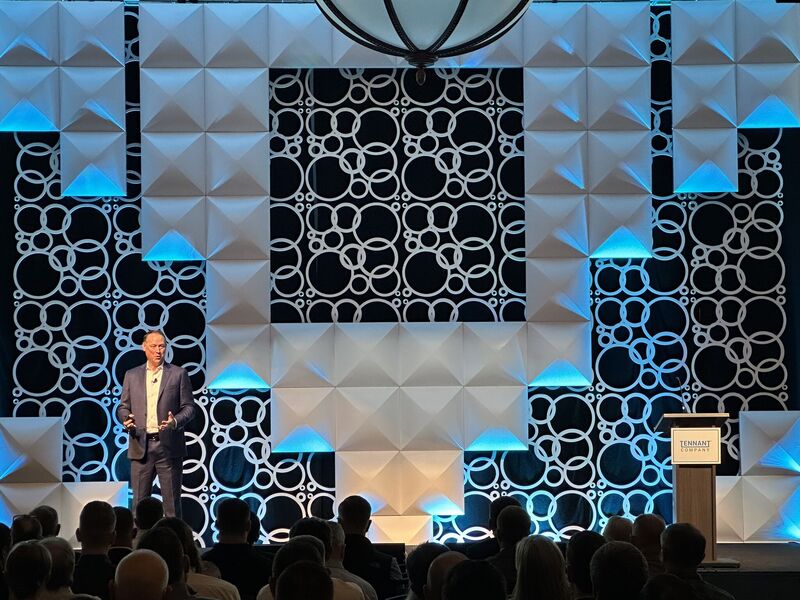
The succession to president and CEO took effect on March 1, 2021. Huml also joined the board. By then, his knowledge of Tennant included both the customer-facing organization and the machinery of the company itself. The new title put the consequences of those interconnected decisions on his desk.
A startup inside the established business
Robotics at Tennant predates his chief executive appointment. The company dates its first autonomous scrubber to 2018. Subsequent machines addressed different kinds of space, including tighter commercial environments and logistics and manufacturing facilities. Huml inherited an existing effort and now has to decide how quickly, and in what form, it should grow.
In April 2026, Tennant and Brain Corp announced a three-year extension of their exclusivity agreement for next-generation robotic floor care. The plan included ten new products within twenty-four months. Tennant also set out its ambition to build autonomous equipment into a $250 million business by 2028. Those are commitments about the future, with the work of delivering them still ahead.
The organizational change is as revealing as the product schedule. A dedicated robotics venture brings together sales, development, product management, customer success and technical support. The arrangement concentrates people around a shared assignment. For Huml, who spent years acquiring responsibilities across functions, it puts those functions together around a particular market.
Several jobs to get right.
There is a practical logic here. Selling an autonomous scrubber requires decisions about the machine, the software and the help available once it reaches a customer. A floor-care buyer is purchasing an outcome over repeated shifts. The venture’s structure suggests an attempt to make those related decisions travel together, rather than queue politely outside separate departmental doors.
The other software problem
Huml’s technology agenda has also brought a less photogenic assignment. In November 2025, Tennant went live with a new enterprise resource planning system in North America. The transition disrupted order management, production scheduling and fulfillment. Customers encountered delays and uncertain shipment information. Software intended to help run the business had constrained its ability to operate.
The company estimated an approximately $30 million adverse effect on fourth-quarter sales. Its full-year results described recovery teams, temporary workarounds and additional support. For a leader talking about autonomous equipment, this was a reminder that the internal systems behind an ordinary shipment deserve the same seriousness as the technology mounted on a machine.
By the second quarter of 2026, Tennant was reporting two stories at once. Robotics revenue grew approximately 37 percent year over year. Residual North American ERP inefficiencies and pressure in Europe, the Middle East and Africa were weighing on profitability. The company raised its full-year sales guidance while reducing its adjusted earnings outlook. A growing order book and an easier operating day are separate accomplishments.
robotics revenue growth
across Tennant
Sales guidance rose. Adjusted EBITDA guidance fell. Demand and profitability were moving differently.
That tension makes his position more interesting than a smooth succession story. Huml has to encourage a developing business while repairing processes in the established one. The investor conversation can move between robots and production bottlenecks in a few minutes. Inside the company, both demands persist after the call ends.
The people behind the operating plan
Huml has a useful qualification attached to his leadership philosophy. He describes servant leadership as an ideal and readily acknowledges falling short. In his account, the executive’s work includes listening, supporting teams and clearing the things that prevent people from doing their jobs well. It is a view that makes the operating problems particularly relevant: obstacles are quite literal when an order cannot move.
“Servant leadership is my ideal”
Dave Huml · October 2026
His public posts offer smaller examples of what receives his attention. He has celebrated the retirements of Bill Ruhr and Barb Quist, whose combined Tennant service amounted to ninety-one years. Quist’s half-century at the company puts a five-year strategic plan in rather bracing perspective. A chief executive inherits relationships and experience that were being built long before the appointment.
He has also met summer interns through Tennant’s series of conversations with business leaders. The students get to question people responsible for different functions; the leaders get an audience still deciding what kind of work interests them. It is a modest format, but a useful one for a business whose range of careers may be less immediately apparent than its machines.
Recognition extends to the people using the equipment. In 2024, Tennant’s Custodians Are Key contest received more than 1,700 nominations and selected a Missouri school custodian from twelve finalists. Huml praised the winner’s contribution to the school. Amid a conversation about automation, the program keeps attention on the individuals responsible for the spaces everybody else uses.
A global business with a Minnesota address
There is also the question of who notices Tennant in its home region. In 2024, Huml discussed the challenge of a long-established industrial company that is not a familiar household name. Partnerships with Carlson’s 1st Tuesday program and Women’s Leadership Conference helped connect employees with peers and ideas while putting the business in front of potential future recruits.
For an executive whose career has moved among Minnesota manufacturers, that connection has a practical significance. The company needs people who can imagine working there. A student may know a consumer brand before knowing the employer behind a piece of industrial equipment. Showing the work, and the opportunities around it, takes deliberate effort.
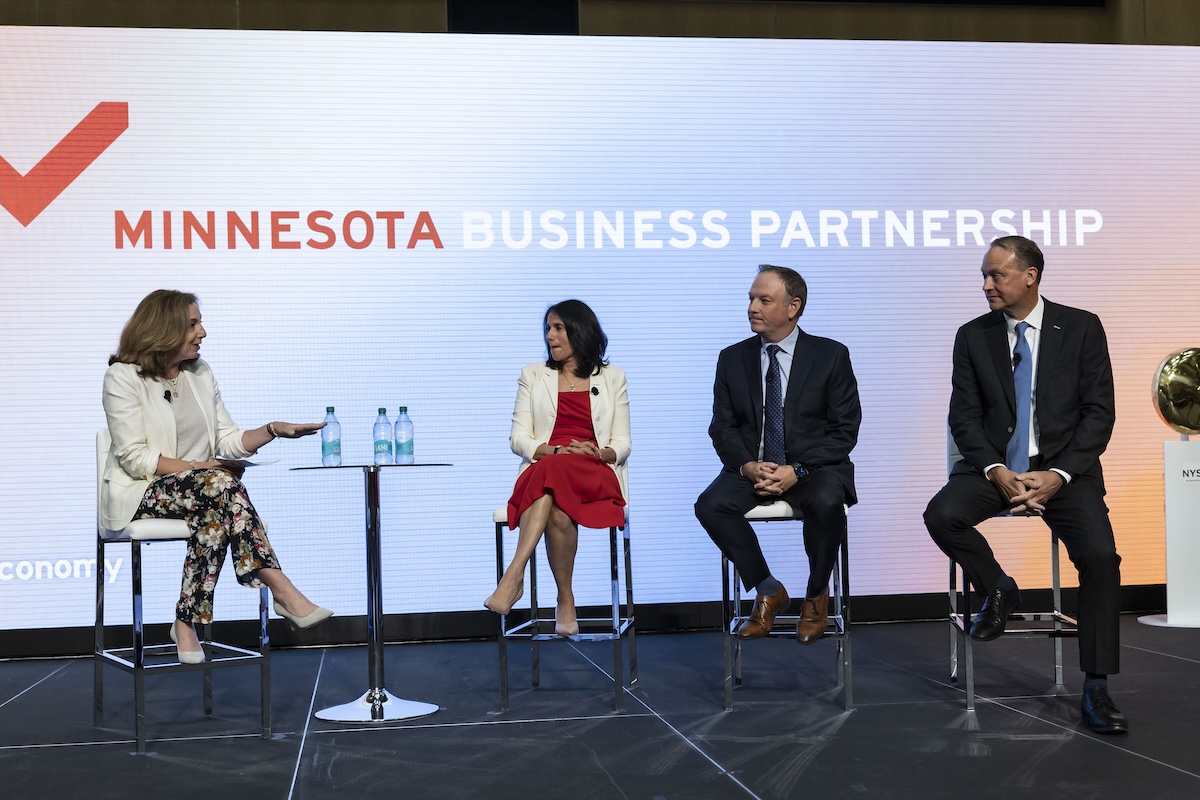
At a July 2025 gathering of Minnesota business leaders, Huml joined a panel with Gunjan Kedia and Mike Happe, moderated by Allison Kaplan. He urged executives to think about sustaining the region’s business ecosystem and to discuss it when speaking publicly. The focus widened beyond his own company to the environment in which other companies could grow.
Another industrial connection followed in September 2026, when The Toro Company elected him to its board. The appointment recognized experience spanning marketing, operations, product management and robotics. His accumulated roles had become relevant to a business working in a different set of physical spaces, with its own equipment customers and operating demands.
The next clean floor
The product range continues to change. On October 20, 2026, Tennant announced its first autonomous robotic vacuum, the P1 VAC, adding vacuuming and dust mopping to its expanding autonomous portfolio. That is a concrete step in the direction Huml has described, though an additional machine is only one part of the larger commercial assignment.
The test ahead is whether product development, customer support and operating performance can advance together. The $250 million robotics goal is still a target. The recent software disruption shows how readily a plan can acquire an uninvited complication. Huml’s earlier experience across regions and functions now has to prove useful under those simultaneous demands.
There is something fitting about the scale of the ambition and the ordinariness of the result. A great many people, systems and decisions must work together so that someone can walk into a building and think about something else. Huml’s robots may attract attention. The clean floor, if everything goes well, will carry on receiving very little.
Follow the work
- Tennant executive biography
- Huml on leadership and judgment
- The robotics venture and Brain Corp agreement
- Tennant’s second-quarter 2026 results
- The October 2026 P1 VAC announcement
- The Toro Company board appointment
- Dave Huml on LinkedIn
- Tennant Company website
- Tennant Company on YouTube · equipment and training videos