A dishwasher full of bubbles looks industrious. To a cleaning formulator, it can look like trouble. Too much foam can interfere with rinsing and equipment operation. The ingredient that makes a shampoo feel convincing may need to behave very differently inside a machine. This small distinction opens a door into Stepan Company, an Illinois manufacturer whose work usually reaches us wearing somebody else’s label.
- Stepan supplies the chemistry behind cleaning products, polyurethane insulation, and specialty oils.
- Formulation support helps customers turn ingredients into products.
- A $265 million Texas plant puts the economics of manufacturing under the microscope.
Founded in 1932 by Alfred C. Stepan Jr., Stepan occupies an easily overlooked position between raw materials and finished goods. It sells to the companies making the things we buy. Its customer’s problem might be a stubborn oily deposit, an unstable agricultural formulation, or a foam insulation system that needs particular properties. The common thread is performance inside someone else’s product.
01A bubble is a design decision
Surfactants help liquids wet surfaces, disperse materials, or bring otherwise reluctant ingredients together. Stepan manufactures several families of them, including anionic, cationic, nonionic, and amphoteric chemistries. These names matter to formulators because changing the ingredient can change cleaning, foaming, compatibility, and feel. The same broad chemical toolbox serves household cleaners, body wash, crop protection, and oilfield applications.
APPLICATION SCHEMATIC
That is why a September 2026 Stepan webinar on low-foam surfactants is more revealing than a glamorous advertisement. Its subject is the compromise among foam control, wetting, detergency, and solubility. A customer cannot simply order “better chemistry.” Better has to mean something specific. Stepan’s expertise lies partly in helping define it, then supplying an ingredient that meets the brief.
02The recipe helps sell the molecule
The company’s website offers a Product Finder and a separate formulation library. The latter supplies starting recommendations for applications including hard-surface cleaning, laundry, and personal care. A biocidal finder covers antimicrobial formulations available through regulatory subregistration. These are useful entry points for a manufacturer facing a blank development bench. A catalog tells you what exists; a starting formulation suggests how the pieces might work together.
For a development team, this changes the first conversation. Instead of starting with a chemical name, it can start with an application, a performance requirement, and a sample to evaluate. The library narrows the search. It does not remove the experiments: ingredients still have to behave together at the intended concentration and under the customer’s processing conditions.
The commercial logic is straightforward: helping a customer develop a successful product creates an opportunity to supply its ingredients. Stepan sells chemicals directly and through distributors, with technical support attached to the relationship. BASF, Dow, Evonik, and other suppliers overlap with its markets. Stepan’s pitch combines a broad ingredient range, application knowledge, and regional production. Those capabilities must earn their place in each customer’s formulation.
Agriculture makes the approach especially clear. A promising mixture still needs evaluation and a path through regulation. In August 2025, Stepan partnered with SynTech Research Group in North America. An October agreement with Staphyt extended a similar approach in Europe. Stepan contributes formulation expertise; its partners add field, laboratory, and regulatory capabilities. The useful lesson for other suppliers is to follow the customer’s problem beyond the part your own factory makes.
03Three businesses, very different jobs
Surfactants generated about 71% of Stepan’s $2.33 billion in 2025 sales. Polymers contributed roughly 25%, including polyester polyols used in polyurethane insulation and coatings, adhesives, sealants, and elastomers. STEPANPOL is one of the relevant product families. These materials sit upstream of the finished building product, where their properties influence what the next manufacturer can produce.
Share of reported segment sales. Percentages rounded.
The smaller Specialty Products segment includes nutritional oils. NEOBEE medium-chain triglycerides are used in food, flavor, and pharmaceutical applications. Their functional appeal can be wonderfully unshowy: oils processed to have essentially no odor or flavor. Across these businesses, Stepan’s vision connects chemical innovation with cleaning, health, and energy efficiency. The actual product brief remains much narrower: make this formulation do this job.
04The $265 million reality check
Then there is the factory. In 2021, Stepan initiated a $220 million alkoxylation project in Pasadena, Texas. Its April 2025 presentation listed the investment at $265 million and the plant as operational. Annual capacity was 75,000 metric tons. Located near Gulf Coast raw materials, the facility adds ethoxylation and propoxylation capabilities for ingredients serving several of Stepan’s markets.
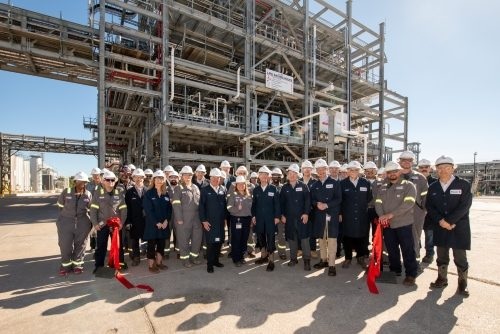
The schedule slipped. A Pasadena city report had described a late-2023 opening. Operation arrived in 2025. Costs followed capacity into the accounts: third-quarter 2025 pre-tax earnings suffered an $8.6 million combined headwind from higher startup costs and lower capitalized-interest recognition. Engineering capability had arrived before the investment stopped weighing on earnings.
The difference between the announced investment and the later figure was $45 million, or about 20%. That arithmetic matters because every additional dollar invested raises the earnings required to justify the project.
By 2026, Stepan was reorganizing the wider network through Project Catalyst. It planned to close Fieldsboro, New Jersey, and decommission selected assets at Millsdale, Illinois, and Stalybridge, Britain. The Millsdale alkoxylation transfer would primarily feed Pasadena. Management cited weaker commodity laundry demand and inefficient assets. That explains the public shift in emphasis toward consolidation, without inventing a private boardroom conversion.
“margin recovery and Project Catalyst savings”Luis E. Rojo, President and CEO, on second-quarter 2026 adjusted EBITDA growth
Second-quarter 2026 reported net income reached $22.9 million. Yet the first half still showed an $18.5 million reported loss after restructuring charges. About 100 salaried-role reductions were announced in July. Stepan describes a People First culture; this transition puts a human cost beside the efficiency targets. A recovering quarter and a difficult restructuring can occupy the same balance sheet.
05Start with the application
For a prospective customer, the practical route is to search the intended application, inspect technical literature, request samples, and test the formulation under real conditions. A library recipe needs validation. A regulated application needs the appropriate approvals. For Stepan, the model depends on sufficient plant use, reliable operations, and pricing that keeps pace with raw-material costs. Everyday demand provides opportunity. Turning that demand into a dependable margin remains the work.
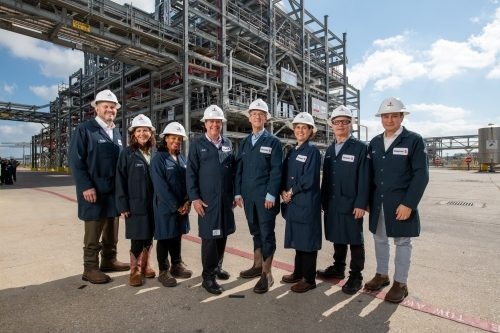
The chemistry comes with people. Colleagues at Pasadena, where laboratory ideas meet industrial equipment.
Explore the ingredients, try the formulation tools, or see the plant for yourself.