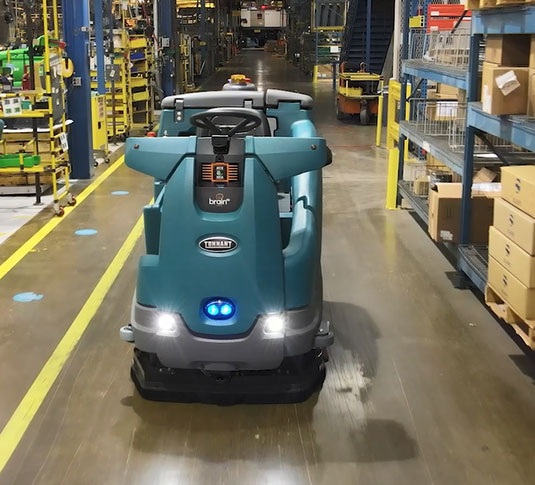
At CNH Industrial’s parts distribution center in Lebanon, Indiana, the problem was a person sitting on a floor scrubber. Cleaning occupied more than forty hours of an employee’s week. The building needed clean floors. It also needed people doing other work. A machine that moved under its own power offered an intriguing possibility: the floor could get its attention without monopolizing somebody else’s.
- Tennant sells floor-care equipment, robots and the services that keep them working.
- Its useful promise: give cleaning teams time for other tasks.
- The catch: autonomy still needs clear routes, trained people and dependable support.
CNH chose Tennant’s T16AMR. Employees eventually named it GhostRider. That small act of workplace comedy contains the larger story: an unfamiliar machine became ordinary enough to acquire a nickname. The interesting question is how it earned one.
01 / First, there was the floor
George H. Tennant opened his Minneapolis woodworking business in 1870. The company made wooden flooring before making machinery to maintain floors. In 1932, it began producing motorized cleaning equipment. Seen from a distance, this looks like a change of industry. Seen from floor level, it is a business following the same surface through its working life.
Today, Tennant’s customers include contract cleaners, warehouses, manufacturers, retailers, schools and healthcare facilities. They buy walk-behind and ride-on scrubbers, sweepers, vacuums and carpet equipment. They also buy brushes, pads, replacement parts and repairs. The expertise is stubbornly physical: remove soil, recover dirty water, manage dust, keep the equipment running.
That puts Tennant in competition with companies such as Nilfisk and Kärcher. Its case to buyers combines cleaning engineering, autonomous navigation and service coverage. A clever robot is more useful when somebody can maintain its squeegee. The service business belongs in the technology discussion.
02 / A robot needs a route
Tennant’s account of CNH’s deployment describes careful preparation. Routes were planned before installation. Staff were told to put things where they belonged and keep aisles clear. The result was fewer occasions when the machine needed assistance. That is a useful operational detail for anyone considering automation: the surrounding habits affect the machine’s performance.
“We had an operator tied up on the machine all day”Neil Dellinger, facility manager, CNH Industrial
In the company-published case study, CNH says the robot ran autonomously for 38 to 44 hours a week, and the former scrubber operator moved into packaging. Employees who initially regarded the technology apprehensively came to accept it. Cleaner floors and a functioning routine supplied a more persuasive introduction than the novelty alone.
A buyer can copy the sequence: measure existing cleaning work, test the intended routes, count interventions and identify the work freed staff will do. These are practical deductions from the example, rather than a promised return. Robot runtime and money saved are different measurements; the second requires an actual change in how labor is used.
Another Tennant case study, at Performance Food Group, reports more than 110 hours of autonomous operation and 2.4 million square feet cleaned. Maintenance technicians gained time for equipment care. These are supplier-published examples, so treat them as demonstrations of a possible workflow. The numbers to test are the ones inside your own building.
03 / Buy the brain. Keep the brushes.
Tennant’s collaboration with Brain Corp began in 2018, the year it launched its T7AMR autonomous scrubber. In 2024, Tennant invested $32 million in Brain Corp. The division of responsibilities is straightforward: Tennant brings cleaning equipment and customer support; Brain brings the autonomy platform that helps the machine navigate.
The X4 ROVR, unveiled in 2024, was Tennant’s first scrubber designed specifically for autonomous operation. Its compact format addressed smaller commercial spaces. The buying model changed too: equipment and autonomy services could be bundled through Tennant, giving the manufacturer recurring autonomy revenue alongside its established equipment and aftermarket business.
In April 2026, the partners extended next-generation floor-care exclusivity by three years. Tennant announced plans for ten products within twenty-four months and a $250 million autonomous-equipment business by 2028. Those are ambitions. The X16 SWEEP, launched that month for industrial environments, is a concrete addition, with dust containment and an optional autonomous charging dock.
For a facility manager, the bundle raises a useful procurement question: who answers when something stops? Navigation software, mechanical wear and staff training meet in the same machine. Tennant’s arrangement puts a familiar equipment supplier in front of the customer. That may simplify accountability, but a buyer should still establish what the service agreement covers and how quickly help arrives.
04 / The software inside the factory
Meanwhile, Tennant encountered a less photogenic technology problem. Its North American enterprise software rollout disrupted production in late 2025. Order management, production scheduling and fulfillment needed stabilization. The company estimated a fourth-quarter impact of roughly $30 million on sales and $22 million on adjusted EBITDA. Those figures describe disruption, rather than the system’s purchase price.
By its August 2026 results, Tennant reported approximately 37% year-over-year robotics revenue growth in the second quarter, while margin recovery remained slower than expected. Both facts matter. Customers can want more automation while the supplier struggles with its own operating systems. Successful navigation around a pallet does not settle every problem inside a manufacturing business.
05 / Read the dirt, then the brochure
There are limits at floor level, too. Tennant’s ec-H2O NanoClean technology electrically converts water for detergent-free cleaning. Its own qualification excludes some soils, including heavy concentrations of fats and oils, which may require conventional chemicals. A trial should use the building’s actual mess.
The same discipline applies to autonomy. A cluttered route or frequent rescue calls can consume the time a robot was meant to release. Smaller jobs may offer fewer hours to recover the investment. The sensible comparison includes training, servicing, consumables and autonomy charges, alongside equipment cost.
Tennant’s stated stewardship philosophy is to leave things better than it found them. On a warehouse floor, that idea can be examined without much ceremony. Is the floor cleaner? Does the machine finish its route? Can the person who used to drive it get on with something useful? GhostRider has a job. The rest of the building still has work to do.