Most of Paul Harmon's products perform their best trick when nobody notices them. A layer breathes. A filter catches. A fabric absorbs. A film keeps one thing away from another. The object earns no applause, only continued use. This is the strange bargain of advanced materials: the more elegantly they work, the more ordinary the day feels.
Harmon has spent more than three decades learning how to explain that hidden work. He is now Chief Innovation and Marketing Officer at Magnera Corporation, the Charlotte-based materials company formed in November 2024 from the combination of Glatfelter and Berry Global's nonwovens and hygiene-films business. His remit joins two departments that companies often keep at a polite distance. Innovation asks what can be made. Marketing asks why anyone should care. Harmon sits where the answers must agree.
It is tempting to place his story in a laboratory. It actually begins at a support desk. In 1992, Harmon went to work as a support executive at LSI Computers. He moved to Computer Resources, then into information systems and marketing at industrial-equipment maker Geith. The titles trace a useful education: hear the complaint, locate the fault, learn the system, explain the fix. Before he was responsible for possibility, he was responsible for getting things to work.
A career in five translations
He learned the machine before selling the future
Harmon's early path zigzagged through roles that are usually presented as different species. He was an information-systems manager and a marketing manager. He ran operations at Geith and led AttachmentsExpress.com. He worked in product marketing at Ingersoll Rand, then returned to systems management at Doosan Infracore. On a tidy résumé, these may look like detours. In an industrial business, they are an unusually complete tour of the premises.
Operations teaches the price of an elegant idea that cannot be made reliably. Systems work teaches how a small change travels through an organization. Marketing teaches that technical superiority without a clear customer benefit is merely an expensive private opinion. By the time Harmon entered AVINTIV in 2009, first in pricing and later in hygiene and technical-specialties marketing, he could speak several dialects of the same company.
Two recommendations on his LinkedIn profile describe the resulting style with striking consistency. One colleague notes his ability to rationalize complex business situations into winning strategies. Another says he breaks complex problems into smaller tactical pieces and addresses challenges before they grow. Both mention listening, adaptation, ownership and delivery. The picture is less of a grand-gesture executive than of a mechanic with a map.
“Corporate responsibility is not a separate initiative; it is integrated into how Magnera operates.”Paul Harmon, Magnera Corporate Responsibility Report
The vocabulary is obscure. The products are everywhere.
Nonwovens sound defined by an absence, like a club organized around not playing tennis. The term describes engineered sheets or webs of fibers bonded without traditional weaving or knitting. Their uses range across filtration, wipes, food packaging, construction, agriculture, electrical applications and protective textiles. They can be soft or structural, disposable or durable, absorbent or repellent. The category refuses to stay in one aisle.
That breadth is why Harmon's dual title matters. A manufacturer may possess spunbond, meltblown, spunlace, airlaid and film technologies, yet customers do not arrive asking for a glossary. They arrive with a problem: reduce weight, improve comfort, strengthen a barrier, use less material, clean more effectively, filter more precisely. Someone has to turn the request into a specification, then turn the specification back into a benefit that makes sense outside the plant.
The translation loop
Harmon has been rehearsing this translation in public for years. At the 2019 World of Wipes conference, his subject was industrial-wipes innovation. The agenda stretched beyond chemistry and fabrics into packaging, cleaning mechanisms, robotics and information technology. In 2020, he was scheduled to speak on plastics and a socially responsible future. By 2022, as Berry's vice president of product development and management, he was explaining how certified circular polymers could give brands more transparent material choices.
The sequence reveals a widening frame. A wipe is not only a substrate. It is chemistry, delivery, user behavior, equipment and disposal. A circular material is not only resin. It is certification, bookkeeping, supply-chain trust, manufacturing consistency and customer willingness to change. Each problem becomes more manageable once its boundaries are drawn honestly.
A new company needs a story sturdy enough for a factory
Harmon's rise through Berry accelerated after its acquisition of AVINTIV. He became vice president of global specialties, then an executive vice president overseeing North American commercial work and product development. In 2022, his portfolio expanded to product management, innovation and sustainability. Two years later, Berry separated its global nonwovens and hygiene-films business and combined it with Glatfelter. Magnera emerged with a new name, a broad technical portfolio and more than a century of inherited industrial history.
Corporate combinations create an awkward editorial assignment. Leaders must describe something new without pretending its factories, customers and accumulated expertise appeared overnight. They must give coherence to different technologies and cultures while everyone is still learning the new organizational chart. As innovation and marketing chief, Harmon is charged with connecting the promise to the machinery.
Magnera's corporate language emphasizes “possibilities made real.” Harmon gives that phrase its least decorative interpretation. In the company's first corporate responsibility report, released in 2026, he calls the document a baseline for the coming decade. He organizes the work around product, production and people, and stresses transparency, execution and long-term resilience. A baseline is deliberately unromantic. It tells you where you are before anyone starts narrating the journey.
When the supply chain is the problem, the room must get larger
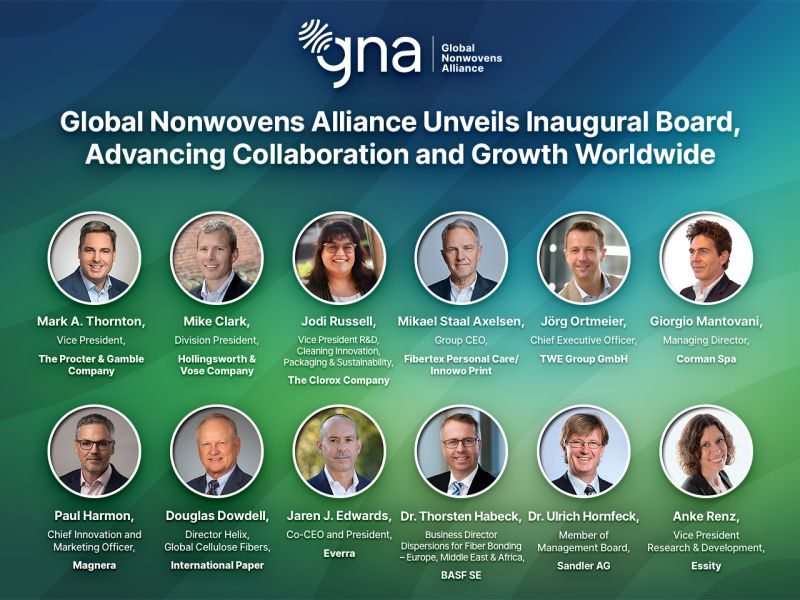
In October 2025, Harmon joined the inaugural board of the Global Nonwovens Alliance, a joint initiative from North American trade association INDA and European association EDANA. The alliance was created to coordinate advocacy, education, networking, innovation and sustainability across the international value chain. Its first board gathers executives from manufacturers and suppliers on both sides of the Atlantic.
The appointment fits Harmon's habit of working at seams. Circularity cannot be solved by a product manager alone. Neither can traceability, common standards or industrial education. Suppliers, converters, brands, trade groups and policymakers carry different pieces of the answer. The practical skill is not consensus for its own sake. It is locating the decision each participant can actually make.
His career contains a quieter version of the same instinct. Since 2017, Harmon has listed volunteer service as a court-appointed Guardian ad Litem in Iredell County. The role, as he states it publicly, sits far outside materials strategy and is best left without imaginative embroidery. Yet it adds one verified detail to the portrait: alongside global commercial work, he has continued a local civic commitment in the North Carolina community where he lives.
The object looks simple because the complexity has already been handled.The industrial promise behind Harmon's work
Make progress visible before making it fashionable
The most revealing word in Harmon's recent writing may be “baseline.” It resists the temptations of both corporate triumph and corporate despair. A baseline allows measurement. It gives partners something to question and operators something to improve. It also admits that a ten-year commitment will outlive many campaigns, presentations and product launches.
This preference for the workable over the theatrical runs through his public record. Colleagues describe a leader who listens, adapts and keeps line of sight to business goals. His conference appearances connect broad trends to specific technologies. His comments on certified circular materials focus on transparency and customer choice. Even his career architecture suggests steady accumulation rather than reinvention: support became systems, systems met operations, operations informed marketing, and marketing widened into innovation.
There is a lesson here for anyone asked to lead innovation in a mature industry. Novelty is only one ingredient. The harder work is alignment: a material that performs, a line that can make it, a customer who understands it, a claim that can be supported, and a supply chain willing to participate. Miss any one of those and the future remains a sample in a meeting room.
Harmon works in Statesville, close to the manufacturing geography that shaped much of his career, while his current mandate stretches across a global company. In 2026 he joined Magnera's CEO in Washington to present a battery-separator platform to policy leaders. The setting had changed from factories and trade conferences to Capitol Hill, but the task was familiar: take a technical material, explain the problem it addresses, and help a new audience see why it belongs in the conversation.
The materials economy will probably remain invisible to most of us. Its invisibility is often evidence that someone has done the imaginative work upstream. Harmon's contribution is to make those upstream choices legible long enough for engineers, operators, customers and institutions to act together. Then the film seals, the filter catches, the layer breathes, and daily life proceeds without a press release.