A paper mill needs something that sounds almost unnecessary: a little less paper. Fibers alone do not deliver every property a sheet needs. Mineral fillers help control brightness, opacity, and printability. For the supplier, the conventional arrangement is straightforward. Make the ingredient somewhere else. Send it over. Minerals Technologies helped change the arrangement by moving the factory to the mill.
- Get close. MTI makes paper filler at customer sites, often under contracts initially lasting 10-15 years.
- Sell the result. Its minerals help paper, litter, furnaces, and filtration systems perform specific jobs.
- Count the dependencies. Customer closures and legacy legal costs complicate a clever industrial model.
A pipeline beats a truck
The first satellite plant opened in Wisconsin Rapids in 1986, before MTI became independent of Pfizer in 1992. It made precipitated calcium carbonate, or PCC, at a customer’s paper mill. The material could travel as slurry through a pipeline to the paper machine. Drying and transporting it from a distant factory became unnecessary steps.
This was a manufacturing decision with consequences for the relationship. MTI owned and operated the equipment. The customer received a mineral tailored to its production needs. Today, the company describes satellite supply agreements that generally begin with 10-15-year terms and continue on an evergreen basis. Making an ingredient and helping run a process become closely connected.
There is a useful detail in MTI’s account of a 2001 installation at Great Northern Paper in Maine. Before committing to the plant, its commercial and technical staff ran trials on the customer’s paper machine using PCC made elsewhere. First came proof on the actual equipment. Then came the capital commitment. Anyone selling a complicated business product can borrow that sequence.
The idea still travels. In 2023, MTI announced agreements with Andhra Paper in India, Nine Dragons Paper in China, and Zhejiang Zhefeng New Materials in China. Together, the announced plants represented more than 180,000 metric tons of annual PCC volume. Andhra’s project included NewYield LO, which repurposes a pulp-process waste stream to make filler. The customer’s disposal problem becomes part of the production recipe.
The clay gets a bigger job
Paper explains the intimacy of the model. Bentonite explains the breadth. MTI acquired AMCOL in 2014, paying $1.519 billion in cash for its shares. The filing puts consideration to debt and equity holders, after acquired cash, at $1.802 billion. Those are different measures of the same acquisition, and the distinction matters. This was an expensive expansion of what the company could do.
Bentonite brought a material suited to an unusually varied working life. MTI supplies litter ingredients and finished private-label formulations, foundry blends, and environmental products. A retailer wants a litter customers will buy again. A foundry wants reliable casting performance. A construction buyer wants water kept outside. Different purchasing departments, different specifications, related mineral expertise.
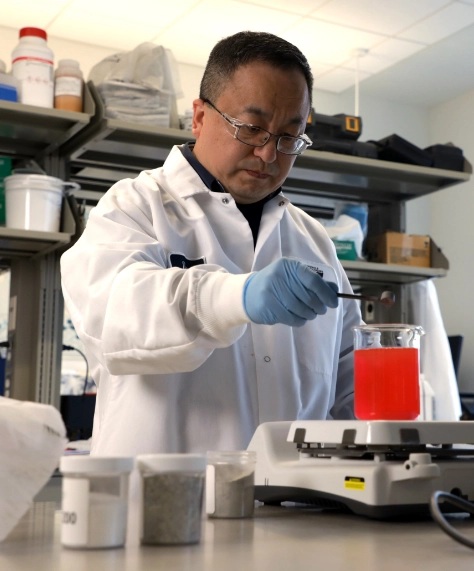
Its technical vocabulary makes the connection clearer: crystal engineering, functional additives, engineered blends, and particle surface modification. Adjusting a crystal’s shape can change what it contributes to paper. Changing a particle’s outer surface can change its behavior in filtration. The expertise sits between the mineral deposit and the customer’s production headache.
“They have properties, natural properties that lend themselves to specific things.”Douglas Dietrich, chairman and CEO, on Inside the ICE House
CETCO’s FLUORO-SORB is a telling example. The bentonite-based adsorbent captures PFAS from contaminated water and other media. It received a Water Environment Federation technology award in 2026. Capture is the operative word: removing contaminants into treatment media should not be confused with destroying them. A useful product still belongs inside a complete treatment and disposal process.
Competition follows the application. Omya offers calcium-carbonate fillers for paperboard; RHI Magnesita supplies refractory and steelmaking solutions. MTI’s argument combines its mineral reserves with formulation, equipment, logistics, and technical service. A buyer should compare the performance and total cost of the resulting process. The cheapest bag of material may answer a different question.
For customers, the practical entry point is a measurable production problem: a paper specification, a litter formulation, a furnace lining, or a contaminated water stream. Useful purchasing questions follow from that specificity. What changes on the customer’s equipment? What must be tested? Who operates the system? What costs remain after the material arrives?
The customer can disappear
A factory beside a customer has an obvious vulnerability. The customer must keep making things. MTI’s 2001 filing reported three announced paper-mill shutdowns at satellite sites, following three disclosed in 2000. It also described mill bankruptcies and closures. The weakness was visible long before today’s discussion of industrial supply chains: proximity exposes a supplier to the host’s fortunes.
That history puts a boundary around the lesson. A satellite makes sense when demand, site economics, and the relationship justify dedicated assets. It becomes harder to defend when the host closes, consolidates production elsewhere, or declines to renew favorable terms. MTI has expanded into other markets, but a longer product list cannot make those individual plant economics disappear.

Read the bill, too
In 2025, MTI recorded $2.073 billion in sales. Its reported operating income was about $47 million; excluding special items, about $287 million. A $215 million talc-related reserve provision was a major reason for the gap. In the second quarter of 2026, another $290 million reserve charge helped turn a quarter with growing sales into a reported operating loss.
Capital has its own price. In October 2026, MTI priced $400 million of senior notes at 7.5%, intending to refinance existing 5% notes and pay related expenses. Later that month it raised the quarterly dividend to 13 cents. Investment, debt service, legal obligations, and shareholder payouts all compete for the cash this industrial portfolio generates.
The next proposals return to familiar skills. At its September 2026 investor event, MTI presented high-purity calcium metal for rare earth metallization and an extension of its waste-repurposing technology to steel slag. These are announced opportunities, with commercial forecasts still to prove. The enduring question is practical: can knowledge of an ordinary mineral solve a costly problem at the customer’s plant?