Milind Tavshikar remembers winning Hawaiian Airlines partly because the work took his team to Honolulu. There were serious reasons to celebrate: it was SmartKargo’s first North American airline customer, an opening into a new market. Still, the setting made an impression. Even enterprise software occasionally arranges a decent view.
That recollection gives a useful scale to his story. A customer won, a team excited, an installation completed somewhere beautiful. The founder and CEO of SmartKargo works in a business whose achievements tend to disappear into somebody else’s successful day. A shipment is booked. A parcel arrives. Nobody feels obliged to applaud the software.
His career has followed the complications behind those ordinary events. It began in consulting, passed through MIT, and led to a company that had to change its original idea before it found a durable job. The interesting part is how much he was prepared to change while continuing to build.
The tag was only the beginning
At MIT in 2006, Tavshikar’s class project focused on radio-frequency identification, or RFID. The ambition was to give logistics providers technology comparable to the tracking capabilities associated with express delivery companies. The project became a finalist in the MIT $100K Entrepreneurship Competition. A classroom exercise had acquired an audience beyond the classroom.
The business began as QuantumID Technologies. RFID offered a way to identify and track objects; finding a market that would sustain the company proved harder. The team explored air cargo and found work that extended beyond the tag. Airlines needed software to run their cargo operations. SmartKargo developed around that need, using cloud infrastructure from Microsoft.
This is an awkward turn in any founder’s biography. The clever thing that gets a company started may become a smaller part of what customers will actually buy. Keeping the original invention at the centre can feel consistent. Following the customer can require explaining why the centre has moved.
Tavshikar’s pivot gave the company a wider set of responsibilities: reservations, capacity, cargo operations and the financial records around them. Co-founder Prasanna Gogwekar helped shape the transition from RFID systems to cloud software. The work required airline knowledge as well as engineering. A tracking tag could identify a box. A cargo platform had to help an organization decide what to do with it.
A business plan still has bills
A promising project did not make international expansion easy to finance. By 2010, Tavshikar and the QuantumID team had competition awards and angel backing, but were struggling to secure the money needed to introduce their technology in India. The obstacle was concrete: getting a working business into another market required cash.
He learned about the Overseas Private Investment Corporation at an Expanding Horizons small-business workshop. A $3 million loan supported expansion into India. Additional financing for the Philippines followed in 2015. A separate public project summary described the Philippine effort as development, operation and support of SmartKargo for airlines, freight forwarders, ground handlers and other cargo participants.
That list of customers is a reminder of what enterprise software commits its makers to do. Selling the product begins a relationship with people whose operations will depend on it. Development sits alongside support, training and the work of making systems fit together. The invoice pays for a continuing obligation.
In March 2021, SmartKargo announced a strategic growth investment from Boston firm M33 Growth. Fontinalis Partners was already involved. Tavshikar connected the investment to reaching more customers and extending the product. The financing story had moved from entering a market to supporting a broader rollout. Neither stage could be completed with a good pitch alone.
OPIC loan financing supported QuantumID’s expansion.
The CEO finds a blog post
One of the more revealing episodes in Tavshikar’s working life involves a content management system. In spring 2021, he came across an older blog post about Orchard Core written by a Cloud Construct architect and contacted the agency. It was a rather specific trail for a chief executive to follow.
The contact grew into a relationship covering product branding, user experience, visual design and engineering. Projects touched offerings associated with Azul, Delta and Emirates. The detail matters because it places Tavshikar close to the materials of the business: which platform to use, how an application looks, and whether another team can build at the required pace.
His company biography describes a similarly broad working remit. He works with product architecture, customer support, accounting and sales, and spends time with customers in the field. Those are different conversations. A feature request and a financial reconciliation rarely arrive speaking the same language. He participates in both.
The resulting portrait is of an operator who keeps crossing departmental boundaries. That has practical consequences in a product where the commercial promise, the interface and the underlying process have to agree. An attractive screen cannot repair a missed handoff. A reliable system still needs to be understandable to the person booking the shipment.
“We just kept trying till we found one!”Milind Tavshikar, on finding a market for the product
Fifty milliseconds, and a box has gone
In a 2025 conversation with Reji John, Tavshikar described how e-commerce changes the demands placed on cargo technology. He compared API response times measured in hundreds of milliseconds and explained how a delay of fifty milliseconds could matter when a parcel moved past the point where its label had to be printed.
It is a wonderfully small unit of time to place beside an aircraft. The flight can cross a continent; a label can still miss its box. Tavshikar’s example moves attention from the impressive machine to the less conspicuous work that lets customers use it. Software has to keep pace with a physical process.
Delta Cargo’s DeliverDirect, launched with SmartKargo in January 2024, put that thinking into a U.S. parcel service. Its scope ran from warehouse pickup to delivery at the customer’s door. Personalized collection times, shipment alerts, delivery attempts and photographic proof of delivery were part of the offering. The service sold a completed journey.
For Tavshikar, that is a larger assignment than managing airport cargo. A retailer needs to connect an order to a label, a flight and a doorstep. Each transition brings information that somebody else must be able to use. The aircraft supplies movement across distance. The product has to organize the people and processes at either end.
A classroom idea crosses another border
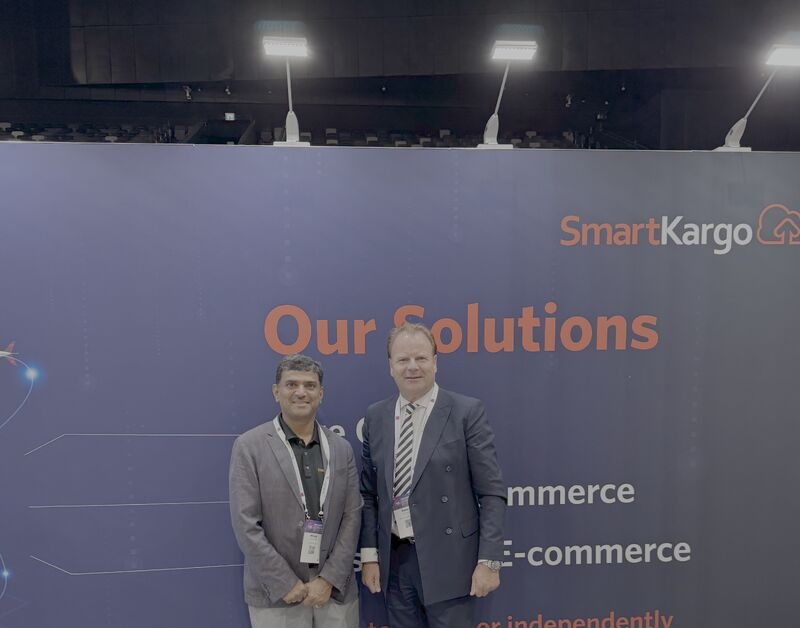
By the time of his Dubai interview in 2025, Tavshikar was discussing the rollout of Emirates Courier Express and the demands of an integrated international delivery platform. The subject brought his MIT origins into the same conversation as the practical requirements of a new airline service. Nearly two decades separated the class project from that discussion.
Another deployment arrived in February 2026. IAG Cargo introduced deliver-e for cross-border e-commerce, initially live between the United Kingdom and the United States. SmartKargo supplied the logistics platform supporting integrations, operations and tracking. IAG brought a network of 12,000 flights a week. The service joined that flight capacity to a parcel delivery offer.
The scale belongs to the airline network, rather than to Tavshikar personally. His company’s role is to help make that network usable by another kind of customer. A retailer needs a rate, shipment visibility and a delivery process it can explain. Tens of thousands of departures become commercially useful only when those smaller questions have answers.
In July 2026, SmartKargo announced an agreement with Vietnam’s Sun Phu Quoc Airways to provide the foundation for its cargo management operations. Here the assignment was to help establish a digitally run cargo business as the airline developed its network. Building the system into a growing operation presents a different task from adapting an established one.
- 2006MIT project reaches the competition finals
- 2021M33 Growth investment announced
- 2024Delta Cargo launches DeliverDirect
- 2026IAG Cargo introduces deliver-e
Still interested in the next problem
The product agenda now includes artificial intelligence. SmartKargo’s AIRCAM addresses cargo revenue and capacity decisions; its Freight Forwarder AI Assistant allows people to ask about schedules and rates, book shipments and track cargo through a conversational interface. The assistant supports workflows with human oversight. These are defined operational uses, with people remaining part of the process.
For Tavshikar, the aspiration follows the same commercial direction as the earlier pivot: make airline cargo easier to operate and easier to buy. A natural-language booking tool changes how someone enters the system. Capacity forecasting changes the information behind a decision. Both still depend on the less glamorous discipline of keeping the shipment record useful.
Away from the software, his early biography contains mountains and friends. He grew up in a small hilly town in India and enjoyed trekking. Later he settled with his family in the Boston suburbs. His public work has taken him much farther afield, but the personal details are pleasingly ordinary beside a business conducted across flight networks.
He once joked that SmartKargo might be the “Smallest Global Company Ever.” The phrase accompanied a serious point about giving people the freedom and responsibility to make decisions across time zones. A company serving flights around the clock cannot make every useful decision wait for one executive to wake up.
That is the thread connecting the classroom project, the financing workshop and the CMS blog post. Tavshikar keeps returning to specific problems that need somebody’s attention. He has allowed the product to change, brought other people into the work and stayed close enough to notice the details. Somewhere in that list, if the customer happens to be Hawaiian Airlines, there may also be a view.