One day in the first year of PackShip USA, Diane Jarrett called her husband with the sales report. She had sold a pen. It cost 98 cents. Mike had imagined the packing and shipping business would produce cash while he prepared to launch a logistics company. The pen offered a rather pointed revision to the forecast.
The couple had opened PackShip in April 1998, behind a Marathon gas station in Orrville, Ohio. Diane ran it while Mike continued working at FedEx, supporting both the family and the venture. They had two young daughters. In January 1999, he launched Jarrett Logistics Systems anyway. Its first customer, Harry London Candies, signed that November.
That beginning gives W. Michael Jarrett’s career a useful scale. Before there were warehouses to fill and complicated shipping networks to coordinate, there was a family waiting for a business to become a business. The distance between a plan and a paying customer could be measured in months. On one memorable day, it could be counted in cents.
A defensive lineman learns where everyone belongs
Long before he was allocating freight, Jarrett was making himself difficult for opposing offenses. A 1983 graduate of Norwayne High School, he went on to play defensive line at Mount Union. He earned three letters, three All-Ohio Athletic Conference selections and two appearances on the conference’s academic team. In his senior season, 1986, he was a co-captain and the team’s defensive MVP.
His final two college teams went through their regular seasons unbeaten before losing in the playoffs. The record contains both satisfaction and a boundary: preparation could take a team a long way without guaranteeing the ending. His later induction into the Wayne County Sports Hall of Fame recognized an athletic career that also included wrestling and baseball in high school.
He has been quite specific about what survived the change of uniform. Coaches Ken Wable and Larry Kehres taught him preparation, organization, attention to detail and accountability. His business education mattered, too: he graduated from Mount Union in 1987 and subsequently earned an MBA at the University of Akron.
When he explains hiring, he reaches for football. An excellent quarterback would make a poor offensive guard. Ability needs a suitable assignment. The observation is funny because it is obvious on a football field; office organizations have considerably more furniture in which to conceal the same mistake.
For Jarrett, recruiting capable people is only part of a leader’s responsibility. They must occupy the right positions and understand the same direction. It is a practical account of management, with less room for the idea that an impressive individual can compensate indefinitely for a confused team.
The habits Jarrett credits to football: preparation, suitable roles and accountability.
The education after college happened on a dock
His first job after college was at Roadway Express, where he became a dock supervisor in 1987. The work put a new graduate in charge of getting trucks loaded, directing people who already understood the physical demands of freight. A degree could get him onto the dock. The trucks still needed to leave.
In 1991 he joined the business that became Caliber Logistics, later FedEx Supply Chain Services. He rose to vice president of carrier operations. Before he became a founder, he had spent years inside the organizations responsible for moving other companies’ goods.
That sequence matters. He was entering a field he had worked in from the operational end, where a missed connection becomes somebody else’s immediate problem. The scale changed between the dock and the executive office. The obligation to make the shipment happen remained recognizable.
The opening he saw was among businesses too small to attract the same attention as the largest shippers. In 2007, the proposition was described in concrete terms: major third-party logistics providers often passed over companies with annual sales below $500 million. Those companies still had freight bills, inventory pressures and limited staffing.
Jarrett’s opportunity was to bring transportation management to customers who needed the capability without being enormous themselves. A manufacturer could be good at making a product and still need help getting it delivered economically. He had found a market in the awkward space between needing specialist help and being large enough to command it.
The invoice that changed his appetite for debt
In 2001, the largest customer stopped paying. Assurances continued for roughly 90 days. Then came a Chapter 11 filing, with more than $300,000 overdue. Jarrett’s company was only two years old. He has described how close it came to failing.
He called a loan officer with whom he had built a relationship. A line of credit kept the business afloat and bought time to find new customers. The rescue left a lasting preference: pay down debt and strengthen the balance sheet before the next surprise arrives.
He said in 2025 that the company had been debt-free for 12 to 13 years. His explanation was rooted in that early scare. Growth is a pleasing number until a customer’s unpaid bill turns it into an urgent conversation with a bank. The person who remembers making that call may read the balance sheet differently afterward.
“We’re still family owned. We have no debt.”
Mike Jarrett · 25th anniversary, 2024
His technological ambition includes a ringing telephone
Jarrett’s account of technology is unusually interested in the person using it. In his 2025 essay on people and digital platforms, he describes logistics as work that needs both automated precision and experienced judgment. Software supplies visibility; people interpret the situation and decide what to do.
Consider a delayed load. A system can report its location or flag a problem. The consequences depend on what the customer needs, which alternatives are available and who can arrange them. His argument gives a place to the coordinator who understands the account as well as the platform that holds the data.
He also writes about less glamorous dependencies: implementation, maintenance and the employees who keep systems useful as a business changes. Buying software does not conclude the work. Someone must connect it to everyday routines, notice when those routines fail and keep it aligned with actual orders.
His earlier description of the fundamentals is wonderfully unornamented. A truck should arrive and deliver on time. The customer should see where the shipment is. A responsive person should be available when something goes wrong. These are modest sentences carrying expensive obligations.
In 2022 he put fast telephone support alongside scalable technology and people able to interpret data. The telephone belongs in the operating model because a customer facing a disruption needs an answer. A dashboard can be handsome company while you wait, but it has limited conversational range.
That view gives his enthusiasm for innovation a recognizable purpose. The machinery has to help people execute the shipment. For a founder whose early career involved supervising loaded trailers, a system’s value eventually comes back to what happens outside the screen.
A million square feet, with an Ohio address
In April 2026, Jarrett announced the opening of a 408,000-square-foot warehouse at Wooster’s Innovation Park. The addition took its warehouse footprint beyond one million square feet, spread across Ohio, Pennsylvania and Utah. The company that began without a customer now had a substantial amount of floor to organize.
The geography expresses a national distribution business with its headquarters still in Orrville. The new facility works with the company’s round-the-clock routing center, joining storage capacity to shipment visibility and execution. A warehouse is useful space; its usefulness grows when the next movement has been thought through.
In his March 2026 conversation with Bloomberg Intelligence’s Lee Klaskow, Jarrett described family ownership as a way to make decisions over a longer horizon. He also continued to emphasize the company’s debt-free position. These are his explanations for how he wants the business to behave through a volatile freight market.
He discussed managed transportation, brokerage, international forwarding, warehousing and fleet services. That breadth suggests the practical ambition of his enterprise: customers can bring connected problems to one organization. His continuing challenge is to make those connections work without losing the responsiveness he associates with a family business.
Two Jarretts, a race track and a reason to gather
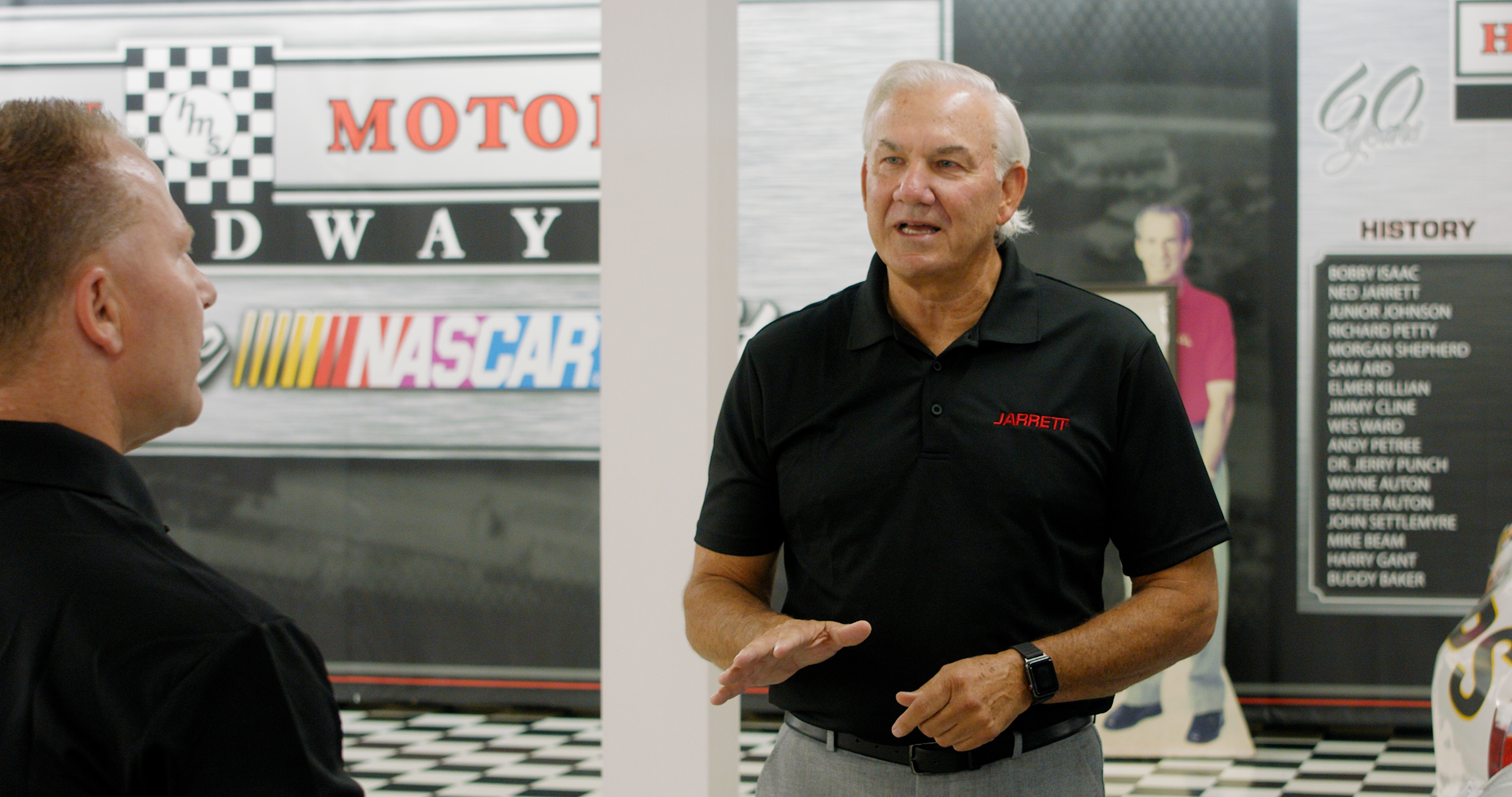
There is room in this working life for considerably louder machinery. In 2021, the company named NASCAR Hall of Famer Dale Jarrett its spokesperson. Mike’s explanation centered on trust, character and integrity, qualities he wanted associated with his own business. A shared surname made the introduction economical.
Sport also became part of the company’s community gatherings. The 2023 Racin’ for a Reason fundraiser brought together Dale Earnhardt Jr., Dale Jarrett, Josh Berry and football coach Jim Tressel. Mike participated in a discussion about building a winning culture. Tracy Byrd supplied the concert afterward.
The beneficiary was Heartland Education Community, an Orrville organization supporting educational opportunities. Racing, football and a local cause occupied the same event, a fairly accurate diagram of Jarrett’s interests. His professional network had become a means of assembling people for something beyond the next shipment.
His current company biography lists him as chair of Heartland’s board of trustees, a Wayne County Community Foundation trustee and a University of Mount Union trustee. Orrville is also where he and Diane live. The institutions recur: the town where they started, the university where he played and studied, the community where they built the company.
What he wants to keep
At the company’s 25th anniversary in 2024, Jarrett returned to the bare beginning: no customers, revenue or employees. He spoke about remaining family-owned and retaining the values established at the start. His preferred version of growth keeps an identifiable connection to that first business.
The ambition contains a tension worth watching. More services and more locations require coordination; personal attention requires time. A founder can celebrate both. An organization has to make them fit together on an ordinary workday, when several people want help at once.
Jarrett keeps returning to people, preparation and financial staying power. Those interests make sense together. The football captain wants the right assignments. The former dock supervisor wants the freight to move. The entrepreneur who needed a bank’s help wants room to absorb the next shock.
And somewhere near the beginning is Diane’s sales report. Ninety-eight cents did not validate the plan. They kept working on it. Years later, the warehouses provide one measure of how far that work traveled. The pen remains a rather good reminder of where the counting began.