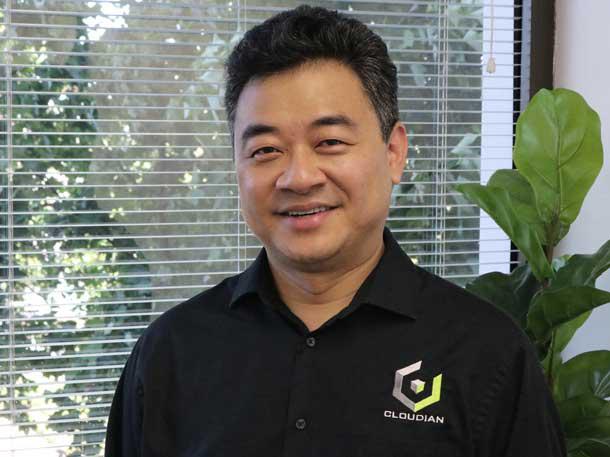
Before Michael Tso was asking where the world should keep its data, he helped give the mobile phone something to sing about. At Intel, his collaboration with Nokia on SmartMessaging enabled SMS ringtone downloads. A small tune, delivered through a small pipe. Years later, the co-founder and CEO of Cloudian would be dealing with datasets large enough to make the word “download” sound rather optimistic. The recurring problem was already there: how do you get useful information to the place that needs it?
Follow that question through Tso’s career and the apparent changes of direction begin to look related. Web acceleration. Search engines. Mobile messaging. Object storage. AI infrastructure. Different products, different buyers, the same awkward business of getting computers and their information to cooperate. His current argument has a pleasing physical quality for an industry fond of clouds: at sufficient scale, moving the data becomes the problem. The computers may have to do the travelling.
A different kind of architecture
Tso’s route into computing began with another profession in mind. He wanted to be an architect. A compulsory week of school work experience changed that ambition; the civil engineers doing design calculations interested him more. There is something reassuring about a career choice tested against an actual working week. A building can look splendid from the pavement. Spending Monday through Friday on its paperwork is a more demanding courtship.
Born in mainland China, Tso grew up in Shanghai and Hong Kong and finished secondary school in Melbourne. He went to the United States to study at MIT, graduating in 1993. His qualifications include bachelor’s degrees in computer science and electrical engineering, a master’s in those fields, and a minor in economics. That last subject would eventually have plenty of practical applications.
At MIT, he worked on parallel computing with William Dally and Greg Papadopoulos. With David Clark, he studied distributed systems operating over disconnected or intermittent networks. These were questions about cooperation under imperfect conditions: many machines, incomplete connections, work that still needed doing. Decades later, he would recognise the same questions inside modern AI infrastructure.
Ringtones, search engines and crowded networks
At Intel, Tso led web-acceleration development and worked on the mobile messaging specifications behind those downloadable ringtones. At Inktomi, he led engineering for an e-commerce search engine and designed a congestion-control system for KDDI. His company biography lists 36 patents. The number is useful chiefly because it puts some substance behind a familiar executive adjective: technical.
The work also brought him into contact with Hiroshi Ohta. They met in 2000, when Ohta was contending with bursts of traffic in photo messaging. Tso had experience building stable search systems. In 2001, Gemini Mobile Technologies began, with Tso, Ohta and fellow MIT alumnus Joseph Norton among the people involved in its origins.
Gemini built messaging infrastructure for telecommunications companies, including the platform behind Vodafone Live. That is an instructive place to learn about scale. A messaging system has to accommodate people arriving together, sending things together and expecting the service to work anyway. Its operators cannot politely ask the public to stagger its enthusiasm. The company was processing and storing the material of ordinary mobile life, while discovering how extraordinary its accumulated volume could become.
The pivot had customers waiting
The financial crisis interrupted Gemini’s plans for a public offering. Telecom operators pulled back on capital spending. Tso has described a company that had to survive on support and maintenance while new business stalled. A technology business can have working software, capable engineers and customers who depend on it, and still find the market’s door firmly shut.
His account of what followed is unusually uncomfortable. Gemini cut two-thirds of its staff. Tso, the hands-on CTO who became COO, had to decide which skills the business could retain. Then came the customer conversations. The people who had bought the system needed confidence that the smaller team could continue looking after it.
“It’s messy. It’s very messy.”
Michael Tso, on the transition from Gemini
There was a reason to work through that mess. Customers had chosen Gemini when they could have bought from larger suppliers. Tso felt an obligation to continue supporting them. In his account of the pivot, the existing team, technology and customer relationships were assets worth carrying forward. A clean start would have made a tidier origin story. Existing customers still had systems to run.
Cloudian took shape in 2011; its launch out of Gemini followed in 2012. With Ohta, Tso carried the experience of storing huge quantities of messages into a broader market for distributed object storage. The product changed. The accumulated engineering experience could travel with it.
Why the cloud needed a local address
By 2014, Tso was describing a storage opportunity measured in a decade. Cloudian had spent its early period developing the system, then begun expanding its sales and marketing. Its proposition was specific: companies could build storage compatible with Amazon’s S3 interface on their own infrastructure. Familiar software conventions could operate in places outside an Amazon data centre.
The distinction matters. A cloud interface describes how software asks for and retrieves information. It does not, by itself, require every byte to live in one provider’s buildings. Tso’s business was built around making that separation useful. An enterprise could adopt an established way of accessing data while retaining choices about its location.
In 2018, he was already arguing that some workloads would return from public clouds. By 2023, he was explaining the appeal in terms of cost, control and the practical difficulty of transporting growing datasets. His position allowed for different answers in different circumstances. He described a range of deployment locations, including public-cloud regions, local facilities and equipment at customer sites.
This is where the phrase “data gravity” earns its keep. Moving a photograph on a phone feels effortless. Moving an organisation’s growing archive introduces transfer time, network capacity and expense. Add work that must happen near the equipment generating the information, and geography begins attending the software meeting.
Give the data less travelling to do.
A storage engineer meets the AI queue
AI gave this argument a new audience. In 2024, Tso explained Cloudian’s integration with NVIDIA GPUDirect as a way to simplify the journey between stored data and processing. Separate layers can require copies, transfers and more administration. His aim was to let the same pool of information serve more of the AI workflow, with fewer intermediate stops.
There is a small indignity hidden in an expensive computer waiting for something to read. Buying faster processors does not remove that wait by decree. Storage and networking still determine how promptly the material arrives. For Tso, those supporting systems have become central to the AI conversation.
The work also produced an unexpected reunion with his student years. Dally became NVIDIA’s chief scientist. The parallelism and interconnect questions Tso had encountered at MIT were visible again in the hardware and software around him. “It’s like my whole life is playing back,” he said in 2025. The point was a continuity of engineering problems, across technologies that looked very different on the surface.
He has also described using supervised AI inside Cloudian. During work on a GPU server, the team asked an AI system about a configuration problem and used its suggestions to get unstuck. The anecdote has the scale of real engineering work: something is configured badly, people investigate, a tool helps. Even the future occasionally needs its settings checked.
From keeping a document to asking it a question
Tso’s next ambition extends beyond holding information safely. He wants the storage platform to help make that information usable by AI. In July 2025, he described converting incoming material into formats that different AI tools can process, including vector representations used in retrieval. The archive would acquire another job.
By October, he was arguing that inference offered opportunities across a wider range of businesses than the costly training of foundation models. A company need not build its own general-purpose model to want answers from its internal information. That distinction puts ordinary enterprise documents closer to the centre of his story.
Cloudian announced general availability of its HyperScale AI Data Platform on November 18, 2025. The platform combines compute, storage and software for enterprises using AI on their own infrastructure. Its document application provides a conversational route into material such as reports, contracts and manuals. The familiar organisational problem is finding knowledge already paid for and filed away.
The subsequent releases make the direction concrete. On March 16, 2026, Cloudian announced Foundation-level NVIDIA-Certified Storage designation for HyperStore 8.2.6. In June, HyperScale AIDP v1.1 added broader ingestion from file and object sources and support for document and video AI blueprints. In September, the company announced validation of Samsung PM1753 enterprise SSDs for HyperStore. These are the less theatrical ingredients of putting AI into everyday operation: compatible components, usable inputs and fewer integration chores.
The engineer still has customers to answer to
Tso has turned his experience at Gemini into an explicit set of company values: ownership of the product, client and company, alongside hunger, humility and honesty. He has personally taught that history to new employees, with investors and advisers attending the same sessions. The uncomfortable part of the company’s past is included in the induction.
His more recent account of leadership is similarly concerned with work that continues after the announcement. In an interview shared in early 2026, he described partner-product problems affecting customers around the world and requiring months of effort to resolve. The company still had its normal responsibilities to fulfil during that effort. Infrastructure earns its reputation on precisely those inconvenient days.
For a founder who once expected to design buildings, this is a recognisable kind of responsibility. People occupy what you make. They put their work inside it. Tso’s products have changed from messaging systems to platforms intended to serve AI, but the obligation is familiar: keep the structure working while the people using it get on with their lives.
Read, watch & follow
Continue with Tso’s conversations, technical work and public profiles.