A useful idea can travel a surprisingly short distance. At Lift12, the retail business Arka Dhar built with Andrew Wolf, the pair could tell brands which inventory to stock and which trends deserved attention. Getting those recommendations carried out across stores proved harder. The analysis had arrived. The execution was still somewhere in transit.
It is an unglamorous place to find a company’s origin: the space between an instruction and its completion. Yet that space became the subject of Dhar’s next business, Zinier. With Wolf, he went looking at the people who install connections, maintain equipment and keep services running. Their work was physical. Much of the friction around it was administrative.
Dhar’s career has since taken him into OpenAI and Google DeepMind. The scale of the technology has changed considerably. A question from the retail years remains useful: once a system knows something, how does that knowledge reach the person who needs to act?
A smartphone, and a rather old problem
In Singapore, Dhar and Wolf noticed a peculiar imbalance. Smartphones were transforming consumer life, but businesses seemed to be getting much less from the sophisticated devices their employees already carried. A technician could have a small computer in a pocket and still spend the working day negotiating cumbersome instructions and disconnected processes.
The founders did something more revealing than another presentation: they arranged to shadow service technicians for several days. Watching the work exposed the distance between a software diagram and a working day. A customer’s problem had to pass through scheduling, coordination and execution before anyone could reasonably call it solved.
There is a pleasing lack of ceremony to this sort of discovery. The future of enterprise software, on this occasion, involved accompanying someone else to work. It also gave Dhar and Wolf a way to test their idea against inconveniences that would never volunteer to appear in a pitch deck.
They incorporated Zinier in October 2015 and began building out the business in late 2016. Telecom became the initial focus. Electricity, utilities and other industries offered further applications for the same underlying problem: coordinating people and equipment beyond the office.
The engineer who had already tried a few things
Dhar came to that problem with an engineering education and experience in market development. At MIT, he studied aeronautics and astronautics. His early ventures included work on reducing the cost of RFID tags and a nonprofit that helped children in India learn photography. The interests were varied; the urge to make something useful was already visible.
After MIT, he worked at TripAdvisor, managing market-development programs across Asia Pacific. He also worked as a venture partner at Rocket Internet. In 2012, he and Wolf co-founded Singapore-based Lift12. Retail supplied a practical education in how information moves through a business, and how easily it can stop moving.
The photography project offers a small counterweight to a biography otherwise crowded with systems and software. Teaching someone to use a camera is a very different undertaking from organizing inventory, but both put a tool in another person’s hands. The person still has to do something with it.
He would later complete the Sloan programme at London Business School, joining its 2022 cohort of graduates. By then he had experience as a founder twice over. Returning to a classroom after running a company gives the familiar question about practical experience a rather different direction.
The appointment behind the appointment
For Zinier, an ordinary service visit contained a chain of decisions. Which technician had the skills? Who was nearby? Were the necessary parts available? Had something similar happened to this equipment before? A booking on a calendar represented only the visible end of that chain.
Dhar described software that could compare a new issue with previous work and match it with a suitable technician. ISAC, Zinier’s Intelligent Service Automation and Control platform, brought machine learning into those operational decisions. Mobile workflows could then guide the technician through the assignment. The point was to connect the back office with what happened outside it.
This was a specific ambition for AI: fewer routine decisions made manually, and a clearer path from a reported fault to completed work. It also explains why Dhar talked about a workforce combining people with automation. The installation or repair still required someone to arrive and perform it.
In March 2020, he discussed that future with Dave Simmons of Black & Veatch. Their conversation considered the whole service-delivery process, including how to remove mundane tasks from technicians’ days. There is little glamour in eliminating a form. There can be considerable relief.
Ninety million dollars, and a lesson in doubt
In January 2020, Zinier announced a $90 million Series C led by ICONIQ Capital, bringing its total funding to $120 million. Tiger Global participated alongside existing investors. The business was attracting backing for a problem that most people notice only when a connection fails or a service appointment goes astray.
Led by ICONIQ Capital.
$120 million raised in total at that point.
Telecom accounted for 80 percent of Zinier’s customers at the time. The coming work of deploying 5G gave the company a concrete reason to expect demand. New networks still needed installation, coordination and maintenance. The discussion about faster wireless connections came with a substantial amount of work on the ground.
Dhar was less triumphal when describing what he had learned about founding. His first venture with Wolf had involved more confidence in their ability to solve everything themselves. At Zinier, he said, they were more willing to acknowledge weaknesses and bring in people who could help.
“The more you know, the less confident you are.”Arka Dhar
It is an inconvenient sentiment for the conventional founder biography, which tends to award points for certainty. It is a useful one for anyone hiring a team. A founder who can name a weakness has at least begun writing a sensible job description.
Leaving the CEO chair
In March 2021, Prateek Chakravarty succeeded Dhar as Zinier’s CEO. Dhar became an advisor and evangelist. Wolf was the company’s chief product officer. The business they had built would continue with a different person responsible for leading it.
Chakravarty brought experience that connected directly with Zinier’s purpose: he had begun his career as a field service engineer at Schlumberger, working with drilling crews in Europe and Asia. He knew the kind of coordination the software was meant to improve. His arrival put an experienced practitioner at the head of a company founded around observing practitioners.
Dhar welcomed the appointment and expressed confidence in his successor’s understanding of customers and their industries. Founding a company and remaining its chief executive are separate commitments. In this case, the transition gave Dhar a continuing relationship with Zinier while opening space for another chapter.
His writing also showed an interest in the absurd side of complicated systems. In a 2020 essay, he used Rube Goldberg machines as a way to examine field operations. A contraption that performs a simple task through an extravagant sequence of steps makes an entertaining video. As an operating model, it has rather expensive comic timing.
A larger audience, a harder question
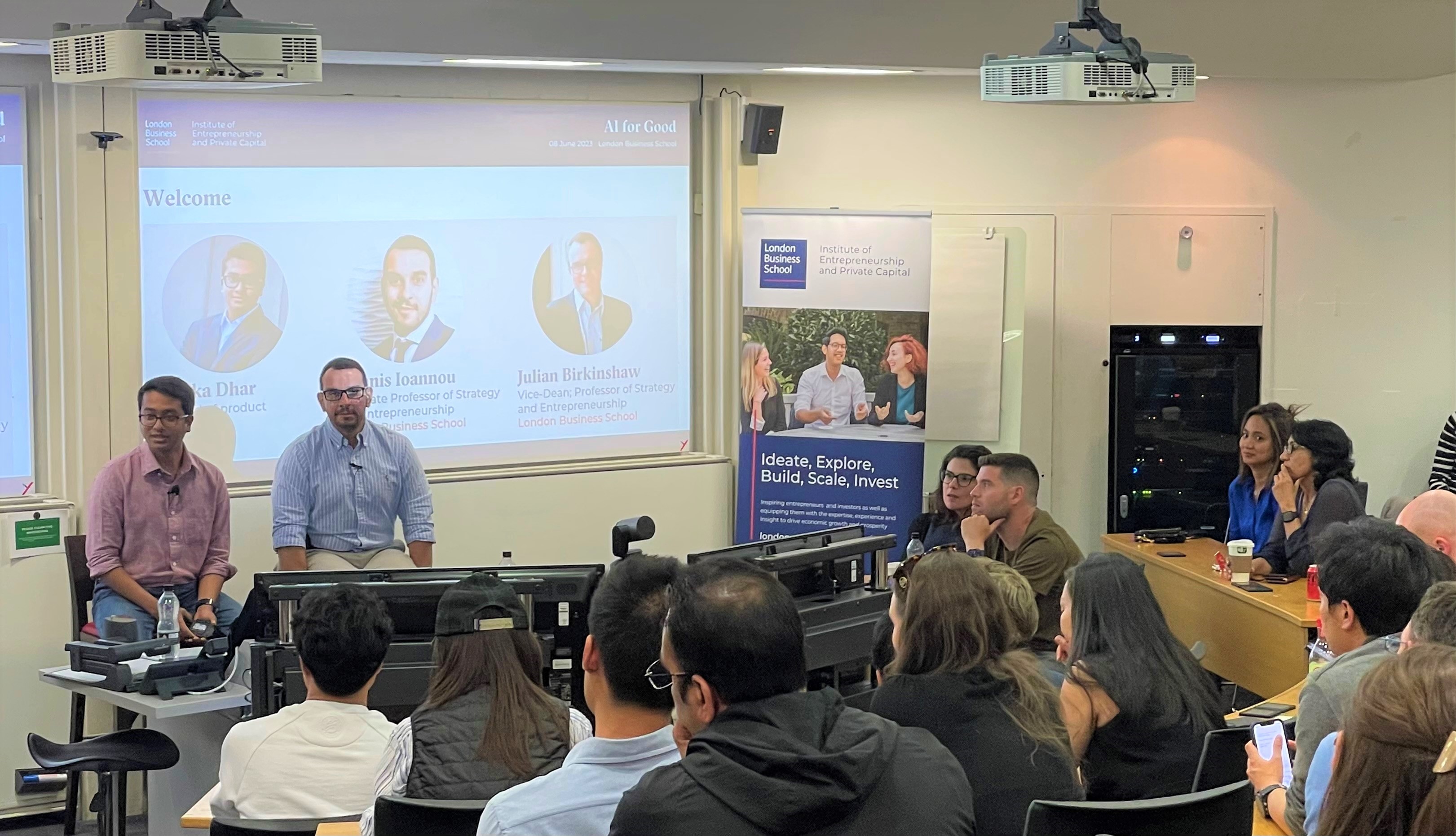
By 2023, Dhar was a product lead at OpenAI. At London Business School that June, he fielded questions about generative AI and the work it might replace. His answer focused on jobs in which an adequate, ordinary result was sufficient. It was a pointed challenge to an audience accustomed to being rewarded for producing polished work.
That spring, he also joined OpenAI co-founder Wojciech Zaremba and Imperial’s Mary Ryan for a discussion on generative AI. The questions had expanded beyond enterprise efficiency to how society should decide what to do with the technology. Dhar and Zaremba emphasized the importance of a democratic process in those decisions.
A public conversation with Audrey Tang shows Dhar working through the practical details of participation. He asked how broad agreement changes when statements become more specific, and described trying the deliberation platform Polis internally. Even in a discussion about public input, he wanted to understand the mechanism: what happens when actual people start using it?
At a Platform Leaders event in July 2024, his concerns included access. He wanted the benefits of AI distributed widely, rather than concentrated among people and organizations already able to obtain powerful tools. The old execution problem had acquired another dimension. A capability cannot help someone who cannot reach it.
The work after the prediction
In 2026, Dhar’s public role is Product Management Director at Google DeepMind, focused on Gemini’s enterprise uses. The Delivery Conference listed him for a February opening keynote with Mary Portas and Al Ko about technology and human connection in commerce. Retail, the setting of his early business, had returned to the conversation.
In July, he co-authored a DeepMind announcement about ATL Saathi, a Gemini-powered assistant being piloted for educators in India’s Atal Tinkering Labs. Its functions include helping teachers plan projects and prepare experiments, with multilingual support. Here was another attempt to put technical capability into the routine of a working day.
Away from work, Dhar enjoys travel, unfamiliar food and identifying constellations. Astronomy is a fitting interest for someone who has moved through several kinds of technology. It also offers a modest corrective to the urgency of product development: the night sky is under no obligation to respect a launch schedule.
From retail recommendations to field-service instructions and AI assistants, Dhar keeps encountering the same practical test. Someone has to take the next step. The interesting part of a good idea begins when it leaves the screen.