A dashboard can be very good at keeping a person busy. There are numbers to inspect, trends to follow, another chart just below the fold. Eventually, though, somebody has to choose. For Anas Alfaris, that small, stubborn interval between seeing the information and deciding what to do became the basis of a company. It also offers a way of understanding a career that has passed through architecture, university laboratories and the leadership of Saudi Arabia’s national science agency.
He co-founded Intelmatix in 2021. Its subject is enterprise artificial intelligence, a phrase that can sound remote until it reaches an ordinary working question: what needs attention, what might happen next, and which action makes sense? Alfaris has approached those questions from several directions. Before he was selling technology to organizations, he was studying complicated systems and helping build the institutions that researched them.
The architect before the algorithm
His education began with architecture and building engineering at King Saud University. At the University of Pennsylvania, he pursued building technology and computational design. Then came MIT, where he completed both a master’s degree and a doctorate in 2009. The master’s concerned computation for design and optimization; the doctorate concerned design and computation. Even his degree titles appear to have been holding a conversation.
There was a physical side to that preparation. An MIT lecture biography describes him as a licensed architect with completed projects in the Gulf. It also records work with research and design teams, including Arup’s advanced technology group in London. The person who would eventually discuss a digital brain for an enterprise had experience of the less metaphorical business of making things stand up.
Architecture provides a useful lens on what followed. A building brings together constraints that do not politely take turns: space, performance, engineering, cost. Computational design gives those competing requirements a mathematical language. His later work widened the scale of the problem. The object of study could become a city, an infrastructure network or an organization, with more relationships to account for and more people affected by a choice.
MIT records both his MSc and PhD in 2009. His route into AI began with architecture and computation.
Building places where disciplines meet
At MIT, Alfaris worked as a research scientist in the Engineering Systems Division. His research affiliations included the Strategic Engineering Group and the Media Lab’s Smart Cities Group. The subjects ranged across systems engineering, integrated simulation, optimization and decision support. Those are different tools for examining a familiar difficulty: changing one part of a system can alter the behavior of several others.
Back in Saudi research, his work included establishing the Center for Complex Engineering Systems with MIT and the Decision Support Center with Boeing. He also founded the Joint Centers of Excellence Program, linking KACST with universities and companies. The partnerships brought institutional structure to work that crossed technical boundaries. A shared research problem needed somewhere for its participants to meet.
The responsibilities grew. He served as KACST’s vice president for research institutes from 2013 to 2019 and became its president in 2019. He chaired Saudi Arabia’s Science20 during the country’s 2020 G20 presidency. He also became founding director of Riyadh’s Fourth Industrial Revolution Affiliate Center. In October 2021, he joined the scientific board of UNESCO’s International Basic Sciences Programme.
Read as a list, the appointments are rather formal company. Read as working environments, they show how often he moved between research and its wider organization. Who sets a question? Which institutions can answer it together? How does technical knowledge enter a decision? His subsequent startup put those issues into a different setting, where customers would expect the connection to work in practice.
A dashboard with an unfinished job
When Alfaris explained Intelmatix’s origins in 2022, he began with information overload. Organizations had data, charts and indicators. The decision maker still faced what he called the “last mile” between the information on the screen and the choice ahead. His diagnosis included tools that were difficult for non-specialists, expensive to adopt and too narrowly confined to particular business functions.
“We want to find a way to democratize AI to enterprises of all sizes,” he said. The proposed business had two routes: custom solutions for particular clients, and subscription products for recurring problems. That distinction mattered to the ambition. A bespoke project can address a specific need; a product has to turn a repeated need into something more organizations can use.
That is a demanding design brief. A recommendation has to arrive in terms that somebody can act on. The technology may be sophisticated underneath, but the user already has another job. Requiring that person to become an AI expert would add a considerable item to the morning’s to-do list.
“We want to find a way to democratize AI to enterprises of all sizes.”
Anas Alfaris · 2022
The business behind the recommendation
Alfaris founded Intelmatix with Ahmad Alabdulkareem and Almaha Almalki. All three are MIT alumni. The company established operations in Riyadh, London and Boston, giving the venture a geography that echoed the international research relationships running through his earlier work. Its platform, EDIX, brings organizational and contextual data into forecasting, recommendations and coordinated action.
In July 2024, Intelmatix announced a $20 million Series A led by Shorooq Partners. Participants included Saudi Venture Capital Company, Saudi Technology Ventures, Olayan Financing Company, Sultan Holdings, Zain Ventures and Rua Growth Fund. The announcement emphasized making AI usable across an organization, including by people without specialized technical training. That was a product ambition as much as a financing story.
Intelmatix’s announced round, led by Shorooq Partners.
The examples on Intelmatix’s product pages are deliberately recognizable: forecasting demand, managing inventory, scheduling staff, selecting sites and planning dispatches. These activities share dependencies. A change in demand can create an inventory question and a staffing question at the same time. Treating them as connected work is the central appeal of the company’s approach.
One decision has company.
What might change?↓Inventory + staffing
What must respond?↓Coordinated action
What should happen next?
An illustrative relationship between the business functions addressed by EDIX. This is a conceptual diagram, not a performance chart.
A digital brain, in public
By 2025, Alfaris was describing the larger ambition in terms of a cognitive enterprise. At TEDx Riyadh Beyond Boundaries, he posed a question: “What if your enterprise had a digital brain?” It is a compact image for a sprawling organizational problem. Companies have many ways to collect information; getting the relevant parts to work together is a separate undertaking.
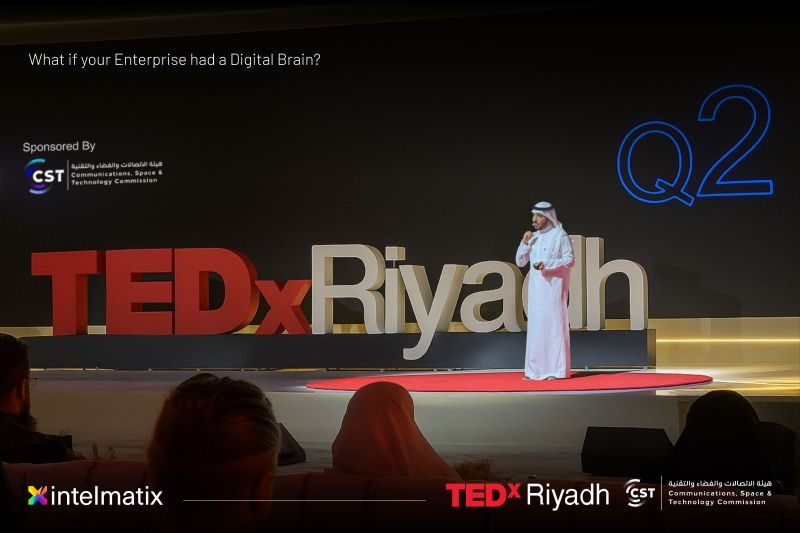
In June 2025, he published an essay describing AI agents that inform, predict, execute, create and recommend. He argued for coordinating them across functions and considered a future workforce combining people and intelligent agents. He also raised the implications for human work and purpose. It was a statement of his view of the future, with organizational design occupying as much attention as the technology.
That month, Intelmatix announced its selection as a World Economic Forum Technology Pioneer. Its account of EDIX described a modular system of agents and included UrbanX, developed with Riyadh Municipality, as an example of urban applications. For Alfaris, the city had reappeared in the story: an earlier research subject had become part of the company’s product world.
Teaching the people who will use it
There is another revealing piece of the business. Intelmatix unveiled an AI Academy at LEAP 2025. The training was aimed at organizations and non-specialists, with online and in-person courses, practical work and an emphasis on applying AI to business operations. Alfaris described understanding AI’s effect on a business as a first step toward using it effectively.
The academy fits the problem he had identified at the company’s beginning. Making software available does not automatically make an organization ready to use it. People need to recognize where it belongs and what they are asking it to do. Training addresses that part of adoption. It also gives his earlier experience building research connections a recognizable counterpart inside the company.
From pilots to departments
The next turn was explicit in his listed LEAP 2026 keynote, scheduled for September 2: moving from piloting agents to building departments. The session description referred to his forthcoming book, The Rise of the Cognitive Enterprise, and questions of organizational structure, governance and leadership. The scale of the design problem had widened again.
That progression gives his career its continuity. The architect studied how parts fit together. The researcher examined complex systems. The institutional leader helped connect organizations. The founder now asks how intelligence can operate across a business. Each setting gives the question different constraints, and a different test of whether the answer is useful.
A dashboard can end with a beautifully presented account of what happened. Alfaris has chosen to work on the awkward moment that follows, when someone must decide. After the degrees, research centers, appointments and financing announcements, the practical question remains refreshingly short: what do we do next?
Follow the question further
Public profiles, writing and conversations.