The safest place at a conference booth is behind the table. The table gives your hands somewhere to go. It offers the psychological protection of branded fabric and a bowl of something wrapped in cellophane. Paulina Xu discovered that the useful place is in front of it.
At Agentic Fabriq's first run of conferences, Xu and her co-founder, Matthew Xu, spent three days talking to visitors. They adjusted the pitch as they went. A pause meant the language had snagged. A nod meant the problem was familiar. The questions revealed more than a polished monologue could. Her advice afterward was brisk: step forward, listen first, write everything down immediately. Also, buy the materials before the night preceding the event. The team had printed hundreds of flyers at the last minute and distributed stickers wherever wandering conference-goers might notice them.
It is a revealing founder story because Agentic Fabriq itself is about what happens when something crosses a boundary. The company builds identity and governance infrastructure for AI agents. Those agents can read files, query databases, send messages, and trigger workflows. They are leaving the cozy booth of the chat window and stepping into the busy corridor of a company. Xu wants someone checking their badge.
A third kind of identity
Traditional identity systems know two broad characters. There is the human being, with a login, a job title, a manager, and a bundle of permissions. Then there is the service account, a predictable software identity built to perform a known job in a known corner of the stack. An AI agent is the awkward dinner guest seated between them.
An agent may act on behalf of a person, but it does not inherit that person's judgment, obligations, or context. Treating it as the employee can hand it more authority than the task requires. Treating it as a service account is not much better. Agents can choose among tools, interpret new information, chain actions, and move from Gmail to Slack to a database in one workflow. They are software, certainly, but they are not especially still software.
Xu's product thesis is that each agent needs a distinct identity. The system should know which user it is acting for, which resources it may reach, which actions are permitted, and whether a sensitive step requires approval. Every move should leave an audit trail. The question after an incident cannot stop at a human username or a generic production account. A company should be able to ask which agent acted, for whom, with which delegated authority, and under what policy.
The permission slip, translated
The clever bit is not merely connecting an agent to a tool. It is deciding whether this agent, acting for this person, may take this action now.
This is why the company's shorthand, “Okta for agents,” lands quickly. It turns an abstract stack of token exchange, credential vaulting, policy enforcement, approval flows, and logs into an office ritual everyone understands. Show ID. State your business. Go only where the badge opens the door.
From the sky to the control plane
Xu arrived at the problem by an uncommon route. At MIT she studied AI and physics. Her computer science and machine learning research connected her with MIT Kavli Institute, MIT Haystack Observatory, and INAF Padua. Public records also mark earlier signs of the same technical appetite: USACO Gold Division in 2022 and qualification for the National Astronomy Competition in 2023.
The temptation is to make astronomy a neat metaphor for everything that followed. Reality is usually less obliging. Still, there is a shared discipline in studying systems through traces. An astronomer cannot walk over to a distant object and ask what it has been doing. A security operator cannot sit beside every autonomous process. Both need reliable observations, histories, and models of behavior. In Xu's writing, visibility is not decoration. It is the beginning of control.
Xu and Matthew met at MIT's admitted-students weekend and became friends before they became business partners. They both left before their second year to work on Agentic Fabriq. One of Xu's later posts compresses the change in scenery perfectly: a year before Y Combinator Demo Day, the pair were pulling late nights on course 6.1210 in MIT's Building 45. Demo Day brought a different room and the same nocturnal habit.
Begins studying AI and physics and works across computing and astronomy research environments.
Leaves MIT at 19 and co-founds Agentic Fabriq with Matthew Xu.
Builds through Y Combinator, reaches Demo Day, and takes the product onto conference floors.
Expands the thesis from authentication into identity, governance, visibility, ownership, and lifecycle controls.
Good shoes, sharper sentences
The first conference exhibition turned theory into muscle memory. Xu noticed that standing in front of the booth began conversations. The pitch evolved after only a handful of exchanges. The best discussions started when the founders asked visitors what they were building and what frustrated them. Notes captured names and context before dozens of encounters blended together. Scrappiness took the form of flyers, stickers, and a willingness to use every available surface.
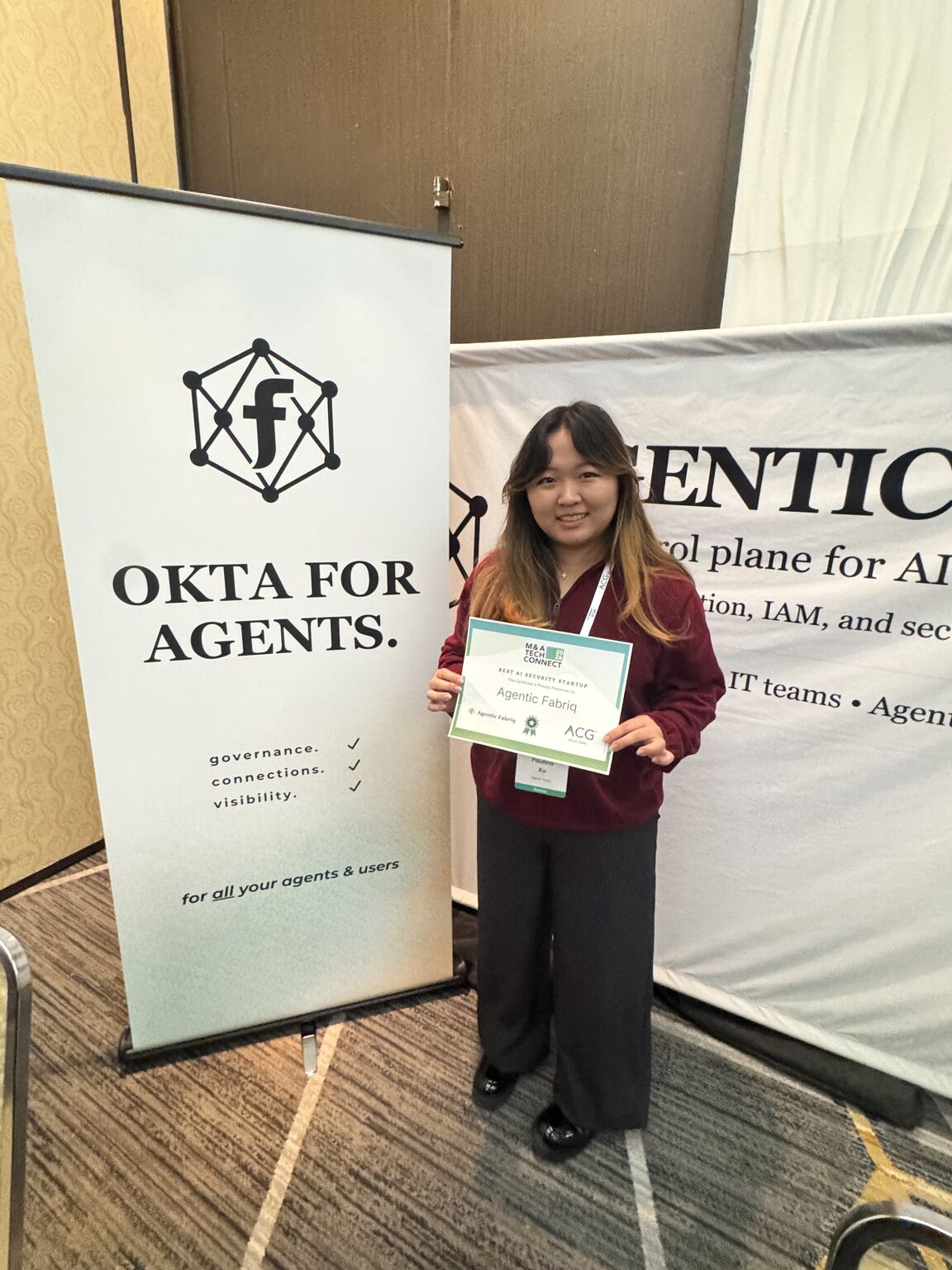
There is a small, stealable operating system in that account. Put yourself where conversations can happen. Treat confusion as product data. Ask before you explain. Record the particulars while they are still particulars. The details sound almost insultingly obvious, which is the fate of most useful advice. A founder can spend weeks adjusting a deck in private. Twenty strangers can edit the story by moving their eyebrows.
For a young company selling unfamiliar infrastructure, vocabulary is part of the product. “Agent identity” is becoming legible, but many buyers first experience it as a discomfort without a name. They know an agent should not quietly borrow an employee's full access. They know a shared API key is a poor substitute for accountability. They recognize the pause Xu saw on the conference floor: yes, this is something we are thinking about.
The founder as manual writer
Xu has built a substantial library around that emerging language. Her essays move from OAuth and context sharing to agent inventories, registries, authorization, audit trails, credential management, accountability, and lifecycle discipline. In August 2026 alone, her byline appeared on guides to trustworthy autonomous systems, production authorization, tool design, and the latest Model Context Protocol specification.
The writing does more than attract search traffic. It draws the borders of a category. An inventory tells you what agents exist. A registry identifies which ones are approved. Visibility shows what they are doing. Governance decides what should be allowed. Lifecycle management follows an agent from proposal to retirement. Each term takes a vague worry and gives an operations team a handle.
Her most useful sentence about trust is also the least mystical: “Trustworthy autonomy is the product of deliberate engineering and governance, not optimism.” The distinction matters. A confident demo is not evidence that a system will behave properly inside a company. A polished model cannot substitute for scoped credentials, enforced limits, named owners, and records that survive after the screen goes dark.
This emphasis also keeps the founder story pleasantly free of robot theater. Agentic Fabriq is not promising digital colleagues with perfect manners. It is building controls for software that will sometimes misunderstand, overreach, or encounter a task its designers did not predict. The product assumes intelligence can be useful while authority should remain conditional. Even clever software needs a manager, or at least a very stern turnstile.
A social layer around the security layer
Xu's public activity is not limited to code and policy. She has helped convene founder gatherings, including an evening on San Francisco Bay for Y Combinator founders. Her earlier volunteer record spans animal welfare, education, youth service, and conversation sessions with Ukrainian students through ENGin. One entry has the satisfying specificity of real life: she helped teach children to fold origami frogs, supplied frog facts, and ended with a contest to see whose paper frog could jump farthest or highest.
That social instinct appears in her founder lessons. She pays attention to rooms, not only systems. She notices where people stand, when they lean in, how a question changes the conversation. For an enterprise security founder, this is not incidental charm. Adoption depends on translating invisible infrastructure into consequences a developer, buyer, or security leader can feel.
The company is still early. Its public profile is that of a two-founder team, formed in 2025 and built through Y Combinator's Winter 2026 batch. The ambition, however, is architectural: become the layer between agents and the tools, data, and people they reach. Xu frames the historical rhythm plainly. SaaS needed single sign-on. Cloud needed identity and access management. APIs needed OAuth. Agents, in her view, require their own control plane.
Whether that analogy becomes a category is a question the market will answer. Xu is doing the less glamorous work required to find out: writing the vocabulary, building the product, listening on conference floors, speaking with security leaders, and turning each puzzled pause into a clearer sentence. “Even though our product has come a long way in the last few months,” she wrote before Demo Day, “this space is just starting - and so are we.”
There will be more capable agents and more impressive demonstrations. There will also be ordinary Tuesday mornings when one of those agents tries to open a file, send a message, or change a record. In that moment, spectacle yields to administration. Someone needs to know who it is, why it is there, and whether the door should open. Paulina Xu has chosen the badge office. It may be one of the busiest rooms in the building.