A name can cross a border without its owner moving an inch. Write it in Arabic, render it in Latin letters, enter it into another database, and the same person may acquire several administrative lives. For Malik Alyousef, a Saudi engineer turned technology executive, that apparently modest problem belongs near the centre of a much larger one: how a financial institution decides whom to trust.
Alyousef is co-founder and Deputy CEO of Mozn, the Riyadh-based enterprise AI company. Its financial crime platform, FOCAL, works in the territory between a customer's ordinary activity and an investigator's suspicion. His public conversations return to the details that make this work difficult: language, disconnected systems, changing behaviour and the people who must make a decision after the software has finished its calculations.
There is little glamour in a correctly cleared customer. Nobody gives a standing ovation because an innocent payment proceeds on time. Yet this is an unusually revealing way to understand Alyousef's work. Preventing a bad transaction matters. So does avoiding needless trouble for the person whose transaction was perfectly reasonable. A system that regards everyone as suspicious would be easy to build and exhausting to live with.
The engineer takes the long route
His route to Mozn ran through industrial engineering, American business school and consulting in Dubai. Alyousef earned an electrical engineering bachelor's degree at the University of Maryland in 2010. Between 2011 and 2015, he worked in automation and control at SABIC. The first professional chapter concerned the machinery and controls of an industrial business, before his later work brought him into financial technology.
He attended MIT Sloan from 2015 to 2017, completing an MBA. His career also included supply chain analytics at Tesla. From 2017 to 2020, he was an engagement manager at McKinsey & Company in Dubai, working across strategy, operations and organisational design. These are substantial changes of setting, even when the recurring subject is how an organisation actually runs.
Mozn was established in 2017. Alyousef joined the team in 2020 and is identified as a co-founder. Keeping those two dates separate helps explain his path: the company's beginning and his own move out of consulting were distinct events. In a later public session on life after consulting, he was invited to discuss building and scaling the business, and the transition from advising organisations to operating a technology company.
Antler also lists him as a venture partner in MENAP, its Middle East, North Africa and Pakistan region. That gives his working life another connection to company building. His biography there describes experience across four continents. The geography is varied; the problem he now discusses is specific. An institution needs technology that fits the environment in which its staff and customers operate.
A very consequential spelling problem
Mozn's founding team includes Mohammed Alhussein, its founder and CEO; Khaled Al-Ghoneim, co-founder and chairman; and Abdullah Alsaeed, co-founder and chief strategy officer. The business developed around enterprise AI and regional needs. Alyousef's part in that story is especially visible in financial crime prevention, where a local detail can become a material operating problem.
FOCAL's name-matching engine supports Arabic and Latin scripts. Alyousef has described multilingual phonetic matching as one of its differentiators. The task is to recognise relevant similarities without treating every resemblance as evidence. Names are a fine illustration of the difficulty: databases prefer tidy categories, while language has never signed an agreement to be tidy.
The product's wider design combines fraud prevention, anti-money laundering and know-your-customer processes. Those labels refer to related work, but the information can be separated across different systems. Alyousef has called out “fragmented, siloed systems that create blind spots in fraud and AML detection.” A complete customer relationship can become a collection of incomplete views.
His argument for bringing them together concerns what investigators can see. Account activity, a device, a login and a payment each provide a piece of the picture. FOCAL's approach connects those signals across the customer journey. The value of regional knowledge appears here in practical form: names, language and operating requirements belong inside the product's design.
“FOCAL is designed to be extended.”
Malik Alyousef
From the watchlist to the login
Alyousef dates the beginning of FOCAL's development to 2020. Its initial work concentrated on core anti-money laundering functions, including customer screening, watchlists and transaction monitoring. It subsequently expanded into fraud prevention, beginning with device risk analysis and adding device fingerprinting, behavioural biometrics and transaction fraud detection.
The expansion widened the field of attention. A payment is one event; the activity around it supplies context. Alyousef describes a financial crime intelligence layer that brings multiple systems into one interface for investigation and reporting. Institutions can consolidate their view while retaining existing infrastructure. The design acknowledges that a bank has a working history, including technology it cannot casually discard.
At LEAP in February 2025, he discussed three additions to FOCAL's fraud prevention suite: device fingerprinting, fraud analytics and fraud management as a service. The last of these put specialists into the offering alongside software. Organisations could have FOCAL's experts manage fraud risk while their own teams continued with the rest of the business.
In that conversation, Alyousef singled out account takeover as a difficult risk. A compromised account can be used for unauthorised transactions and other financial crimes. His description connects an apparently narrow event, someone gaining control of an account, with a broader set of consequences. The product's attention to the surrounding activity follows that chain.
A handshake with operational consequences
One concrete application came in February 2025, when Mozn and D360 Bank signed a partnership to strengthen digital banking security and compliance in Saudi Arabia. Alyousef attended alongside Osama Al-Shathri, D360's head of retail banking. The agreement would bring FOCAL into the bank's work on financial crime prevention and anti-money laundering compliance.
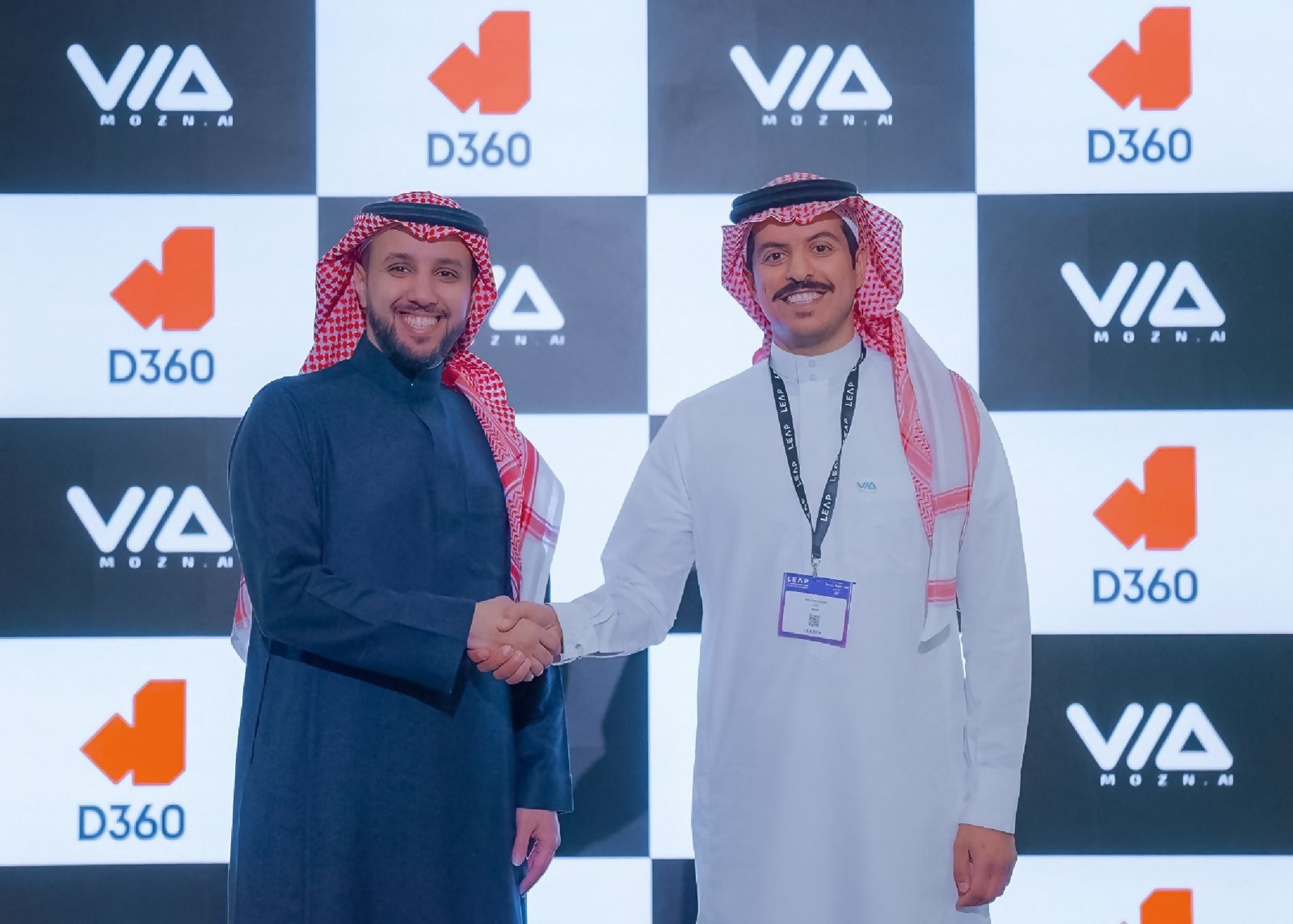
The announcement connected security with a faster, more efficient customer onboarding experience and fewer false alerts. Those aims belong together. A digital bank needs to welcome legitimate customers while checking risk. Alyousef described compliance as foundational to a resilient digital banking system, and the platform as a way to adapt to changing regulatory challenges.
This partnership gives the abstract discussion of AI a useful address. There is a customer trying to join a bank, a team responsible for checking that application and software intended to make the process work better. The photograph records the ceremonial part. The agreement concerns the less photogenic work that follows: integration, checking, monitoring and decisions.
The expensive distance between a demo and a working day
Alyousef's discussions of adoption make room for obstacles. In May 2024, he identified insufficient awareness of AI's capabilities, the limited success of implementation efforts and the cost of acquiring technology and recruiting skilled people. Enthusiasm, in this account, does not settle the question of whether an organisation can put a system to work.
By May 2025, his public product discussion had moved to AI-assisted investigations and financial crime analytics. He described an approach that could surface connections, anomalies and recommendations, while combining information from financial crime systems. Explainability, transparency and responsible deployment were part of the account, alongside the desire to improve speed and accuracy.
In September 2026, Mozn expanded its governed agents for data analysis and fraud investigation. The Data Analyst Agent was presented as a way for business, compliance and operations teams to ask questions in Arabic or English. The Fraud Investigation Agent examines signals across transactions, devices, networks and IP activity to help investigators prioritise suspicious cases.
The same announcement kept responsibility for consequential decisions with human users. That distinction deserves attention. An investigator needs help gathering and examining evidence; the institution still needs someone accountable for what it does with the result. Faster preparation is useful when it leaves room for judgement.
More customers, the same question of trust
In August 2026, Alyousef said Mozn worked with more than 150 clients across several sectors, with particular attention to financial institutions and the public sector. He described its work across financial crime prevention, enterprise intelligence and compliance and governance. He also discussed the partnership with HUMAIN as a way to move AI from experimentation into wider institutional adoption.
Alyousef's reported client count, August 2026. His emphasis: safe, reliable use of AI.
September brought partnerships with NourNet, MDS and Ejada, covering infrastructure, integration and enterprise delivery. In October, Mozn announced a rise of 13 places in the Chartis RiskTech100 2027 ranking and a Middle East regional leadership award. These are company milestones within the business he helps lead, rather than individual prizes.
His current Deputy CEO role includes shaping strategy, growth and the product portfolio. At LEAP 2026, his scheduled talk concerned moving from AI experiments to AI at scale. The question in that title has followed him through his interviews: what does it take for technology to become dependable enough to use?
“Financial institutions don't experience risk in silos,” Alyousef said in October. It is a compact description of the work ahead. The customer has one life, however many systems record it. The investigator needs enough of that life in view to make a fair decision. Alyousef's professional story now turns on helping those two realities meet, one institution and one working day at a time.