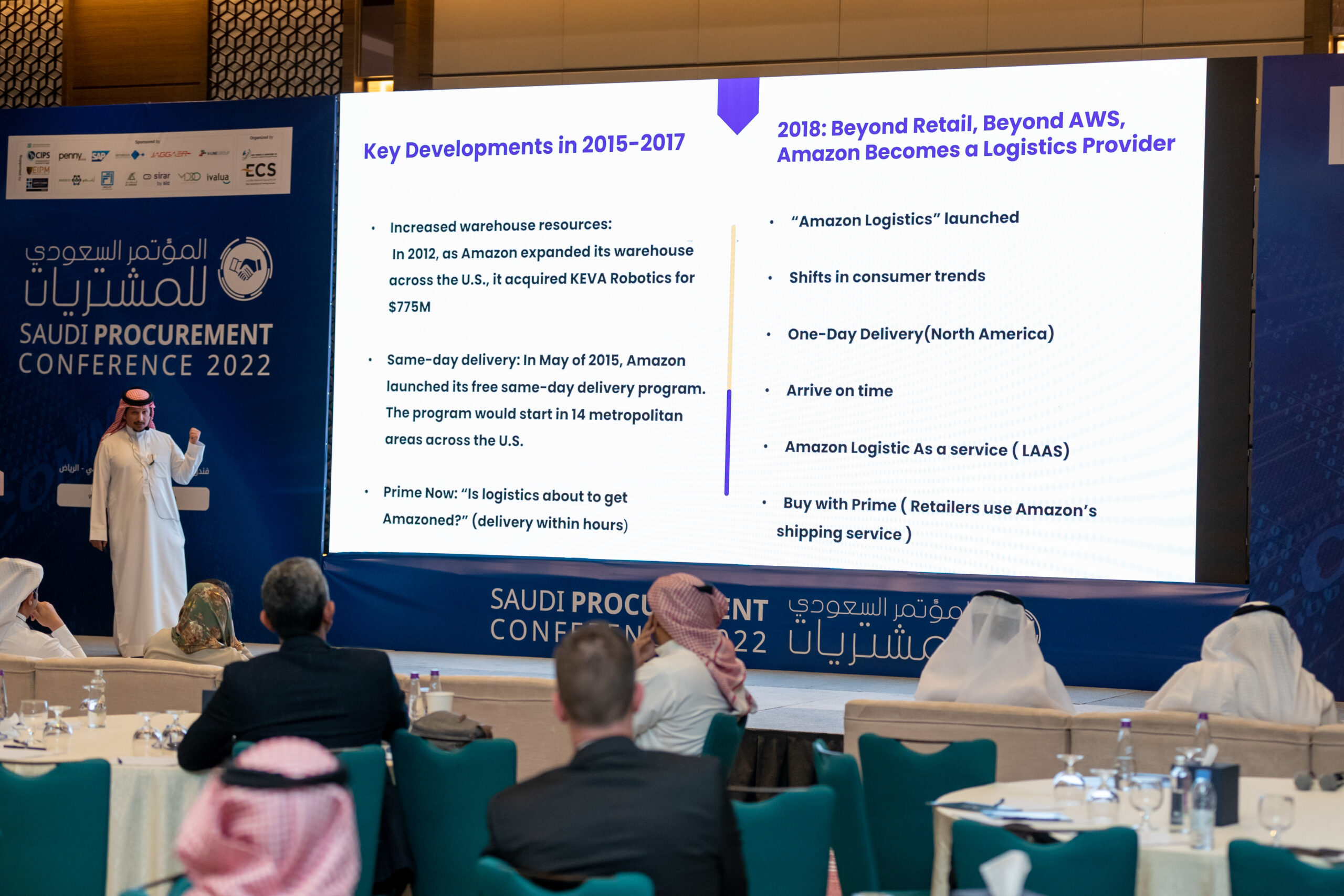
In the photograph, Faisal Almaklas is standing to the left of a very large screen. The slide is about Amazon: warehouses, delivery promises, the steady expansion of a retailer into the business of moving things. It is the Saudi Procurement Conference of 2022. Almaklas, wearing a white thobe and red-and-white head covering, has one hand raised. The subject on the screen is enormous. The business he is building starts with a smaller, stubborn question: how does an online merchant choose someone to deliver an order?
A successful sale leaves behind a surprising amount of unfinished business. A parcel needs a carrier. A customer needs information. A returned order needs a way home. The merchant who has just persuaded someone to buy now has to organise a miniature transport operation. There are more glamorous rewards for making a sale than becoming its traffic controller.
Almaklas is the co-founder and CEO of Torod, the Riyadh-based company that brings shipping providers and post-order management into one interface. The problem beneath the software is easy to recognise: having choices and having the time to evaluate them are separate privileges.
The sale ends. The decisions begin.
When Almaklas talks about shipping, he keeps returning to the merchant’s work. At Biban in November 2025, he described a Saudi market with roughly 250 active shipping companies, compared with about 30 in an earlier period. Those were his figures, and his explanation for why reaching the right provider needed to become an automated process.
The distinction matters. A larger collection of providers offers more possibilities, but someone still has to sort through them. A shop selling locally may want a different service when it begins sending orders across borders. An urgent shipment poses a different question from an ordinary one. A list of companies is only the beginning of an answer.
His company occupies that space between availability and usefulness. Torod connects an online store with courier services and brings selection, tracking and returns into a common working environment. Its proposition rests on a fairly unromantic ambition: let the merchant spend less of the day managing the journey of a box.
Two students, with working lives already attached
Almaklas met Ammar Almaatouq while they were attending King Saud University. The meeting became the beginning of Torod’s founding partnership. Their shared project would take them through development, funding, launch and the revisions that followed. The university connection is a useful corrective to the familiar image of a startup arriving fully formed with a logo and an investor presentation.
Almaklas brought a working career to the partnership. His professional record includes sales and marketing management and an executive role at Ercon Group, as well as general management at Maxil Group. His later education included a master’s in Management Information Systems and E-Business at King Saud University. Commerce and technology had already become neighbouring subjects in his life.
The pair brought complementary experience in e-commerce and logistics. That combination fits the business they chose. A shipping platform has to make sense to the person selling an item and the organisation moving it. Each side has its own vocabulary, priorities and reasons for wanting the other side to be more reasonable.
There was another part of that working life which had little to do with raising capital. In April 2021, Almaklas wrote about helping people looking for their first jobs. He described a training programme developed with engineers, combining theory with practical experience, and recalled the satisfaction of passing on what he had learned in industry and business.
He also remembered being the person who needed to ask questions. In describing an earlier learning experience, he emphasised listening carefully and being willing to ask about anything he did not understand. His message to employers was equally specific: people need an opportunity and room to demonstrate what they can do. He wanted businesses to take a role in developing capable people alongside pursuing profit.
That is a more personal detail than a funding total. Before Torod’s name appeared beside venture investors, its future CEO was already writing about the obligation to make an introduction, share some experience and give somebody a start.
An idea learns to leave the room
Almaatouq later recalled Torod as an idea on scratch paper in late 2021. His account places the Techstars accelerator in that year, followed by the seed round in 2022. It is a chronology with room for the preliminary work: an idea, a programme, a product, then customers. The platform’s public launch came at the beginning of 2022.
Almaklas and his partner sought out support and reached CODE, the digital entrepreneurship centre. There they found workspace, mentors, experts and introductions. An accelerator backed by the communications ministry helped move the project towards a product and its first investment round.
By June 2022, Torod had announced SAR 5 million in seed financing, led by IMPACT46, with Hala Venture and Seedra Venture participating. Later that year came the procurement-conference appearance. Almaklas was explaining the last mile to a room of industry people while his own company was finding its place within it. The photograph catches a founder doing a necessary part of the job: making a complicated business legible.
The price of a decision
The mechanics of Torod explain the choice of problem. A merchant can compare shipping options, arrange delivery and follow shipments through the platform. Courier partners named in the early announcement included SPL, J&T, SMSA and DHL. Returns were included too. The journey back to the seller was part of the product from the outset.
Consider the ordinary questions this puts together. Has the order left? Which company has it? What does the customer need to know? If it comes back, where does the merchant start? Treating those questions as one connected process gives the platform its logic. The shop’s product catalogue may change completely; the need to answer them remains.
At LEAP in February 2025, Almaklas described using artificial intelligence to automate shipping operations and connect service providers. His explanation stayed close to the merchant: receiving orders, finding providers, comparing prices and communicating with customers. In that account, the technology earns its place by doing work a business already needs done.
The appeal is practical enough to survive the conference vocabulary. A dashboard is useful when it helps someone make a decision and see its consequences. Otherwise, it is another place to log in, which commerce has already supplied in generous quantities.
- 01ChooseCompare courier options
- 02FollowTrack the shipment
- 03ResolveManage the return
Forty-two million reasons to keep building
At LEAP 2025, Torod announced a SAR 42 million Series A. Wa’ed Ventures and Elm led the round, with IMPACT46, Hala Venture, Suhail Ventures and other strategic investors participating. The company said the money would support expansion and further development of its digital logistics services.
The financing gave Almaklas and Almaatouq a new set of partners as well as capital. Wa’ed publicly congratulated the founders. Hala also confirmed its participation. For a company built around connecting different organisations, its own circle of organisations was widening.
A round provides a clean number and a convenient date. Operating a platform supplies a less tidy calendar: the next integration, the next merchant, the next shipment requiring an answer. The announced purpose of the investment points to that continuing work. Expanding the business means carrying the product into more situations while keeping it useful in the situations that brought customers there.
“help the merchants control and monitor the whole process”
Faisal Almaklas · June 2022
The suitcase joins the conversation
Almaklas’s public discussion of logistics also extends to Hajj and Umrah. Ahead of LEAP 2025, he wrote about live tracking, the movement of pilgrims’ luggage and reaching shipping providers. The belongings accompanying a traveller had joined the parcels travelling from shops.
The connection is easy to miss if a logistics business is understood only through its original customer. A suitcase has an owner, a destination and a sequence of handovers. A pilgrim has an itinerary and other things to think about. Information needs to move along with the belongings. The object changes; the coordination problem remains recognisable.
That is the significance of this part of Almaklas’s work. His stated ambition reaches into the experience surrounding delivery. A merchant wants an order to arrive as promised. A traveller wants belongings to arrive where they are needed. In both cases, the person waiting has little interest in how many separate organisations had to cooperate.
Back in the room, with something to teach
Alongside running Torod, Almaklas has made time to explain its development. In June 2023, a Saudi Electronic University entrepreneurship programme scheduled him to present the platform’s story. A 2026 appearance on Richter Talk returned to founding, investment, team building and the lessons of developing a technology company.
There is a wider industry role too. Torod confirmed his selection for the Logistics National Committee at the Federation of Saudi Chambers. The founder who had been working on a merchant’s shipping decisions now had a place in the conversation about the sector around them.
Return to the 2022 photograph and the scale looks rather different. Amazon fills the screen. Almaklas stands beside it, explaining the movement of goods to a room of people whose working lives depend on it. His own contribution begins at the shopkeeper’s end of that world, where an order has arrived and someone must decide what happens next. A customer is waiting. The parcel is ready. There is work to do.