The useful clue in Mickey Rubin’s career is hiding in the degree. Long before he was marketing life insurance in Toronto, Rubin studied computer design and architecture at Saint Petersburg State University. The program’s name sounds like hardware. His working life would become a study of a different architecture: the arrangement of people, software, images, deadlines and decisions that makes a complicated product usable.
Rubin finished the six-year program in 1995, just as the commercial internet was becoming a place where businesses could be built rather than merely discussed. He entered that world as a senior creative consultant. His public biography describes work with dot-com startups in Israel, then with Canadian technology companies. Design, animation and 3D work sat beside project management. A page was never only a page. It needed a client, a brief, an audience, code and someone willing to say it was finished.
That mixture became his specialty. Rubin was neither presented as the lone inventor nor confined to one craft. He worked in the connective tissue. At ICM Consulting and Media Corporation, his project-management and creative-design work touched more than 500 projects. The number matters less as a trophy than as an apprenticeship in repetition. After enough launches, an operator learns where projects bend: the fuzzy brief, the late dependency, the feature that cannot survive contact with a deadline.
A studio built for the messy middle
In 2003, Rubin founded Synergy Boost Media in Toronto and served as a senior account and project manager. The company’s menu now reads like an archaeology of the early web: websites, applications, content-management systems, 3D components, training programs, storyboards and Flash animation. Its teams worked behind web-design and software-development firms, building pieces for clients that ranged from startups to global corporations.
Agency work is useful training for an executive because it makes trade-offs impossible to avoid. The client sees an outcome. The team sees a queue of unresolved questions. The project manager lives between those views. Every promise has a cost in hours. Every revision moves something else. Every specialist has a vocabulary that makes sense inside one department and may be opaque everywhere else.
Rubin’s next chapter made that coordinating role explicit. At Adlux Agency, he held the paired title of vice-president of platform development and senior project manager, managing complex work across multiple countries. The title combines strategy and delivery in a way that suits his path. “Platform” asks what can be repeated. “Project” asks what must happen next. One points toward leverage; the other toward Tuesday afternoon.
There is a small, revealing detour in Rubin’s record. He helped shape educational material for IBM Big Data University, designing a presentation template, editing slides with images and animation, and creating transcripts for video. It was not the grand strategy of big data. It was the craft of making instruction coherent. The task sits neatly inside his larger career: take expert knowledge, decide how it should appear, and help an audience move through it without getting lost.
The form is part of the promise
Rubin joined Insurance Supermarket International Canada in September 2019 as chief marketing officer and vice-president of project management. The pairing is unusual only if marketing is treated as the production of advertisements. In digital insurance, marketing makes a promise that operations must immediately keep. A customer clicks, reads, answers, waits, asks and decides. The campaign, application and service conversation arrive as one continuous experience.
Life insurance makes this continuity particularly important. The product is intangible at the moment of purchase. Customers must understand a future promise while moving through a present-tense process. Confusing language or a broken handoff is more than an interface problem. It changes whether a person completes the application and whether the company feels worthy of a long relationship.
Insurance Supermarket’s operating thesis has been to remove those barriers with direct distribution and proprietary technology. Its public materials describe machine-learning tools, real-time policy binding and same-day issuance. In 2022, the company announced it would use Verisk’s FAST technology as part of its expansion in the United States. Rubin appeared on the release as chief marketing officer and media contact. The underlying business proposition was recognizable from his earlier work: coordinate many technical components, then present the result as a simpler path.
The company itself spans the sort of boundaries Rubin had learned to manage. It has operated through offices in Toronto, Miami and Brașov, with a global team publicly described as more than 700 people. Its group included Specialty Life Insurance in Canada and DMatrix Soft, a Romanian software-development business. Sales, service, underwriting, product, engineering and marketing were not neighboring boxes on a slide. They were dependencies in the same customer journey.
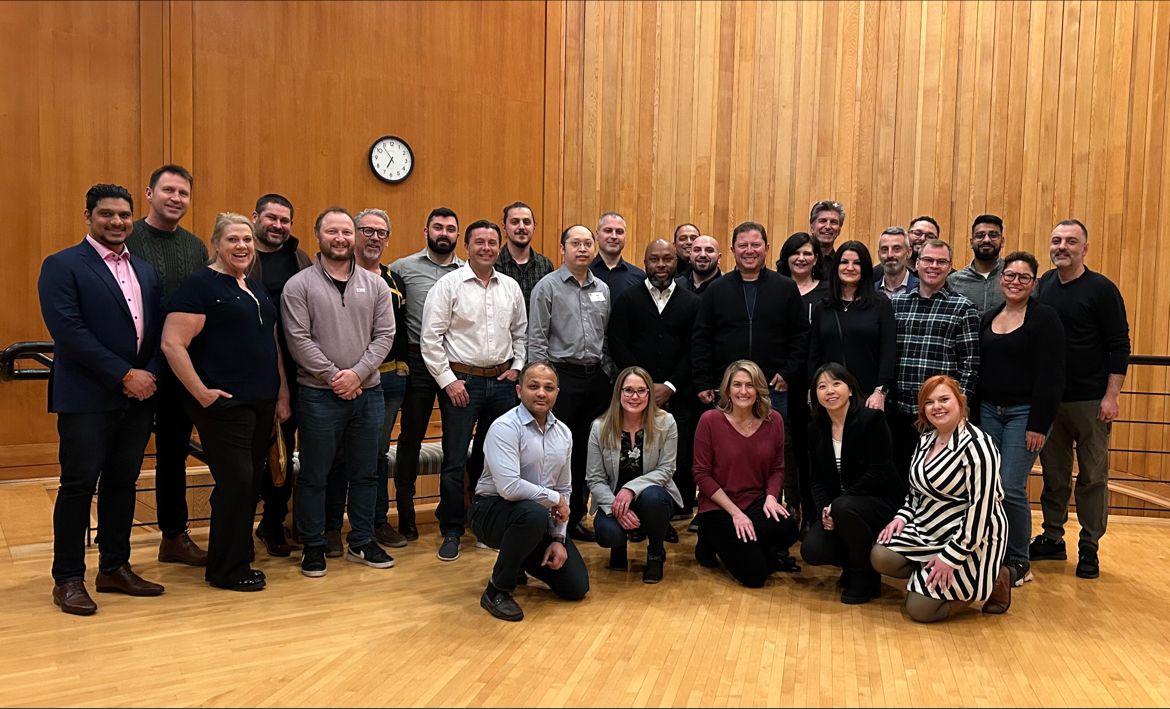
At a 2023 executive offsite at the Kingbridge Centre, the leadership group gathered for strategy discussions, breakouts and departmental presentations. The photograph is an ordinary corporate scene: rows of people, a wood-paneled room, the clock already past mid-afternoon. That ordinariness is the point. Digital businesses are described through interfaces and automation. They are still coordinated by people standing in rooms, comparing plans and discovering where one department’s assumption becomes another department’s problem.
Treat every handoff as part of the customer experience. Give one owner responsibility for the journey across the campaign, form, decision and service conversation. A company feels simple only when its internal sequence is clear.
A harder communications assignment
By June 2026, Rubin was publicly identified as chief marketing officer of Specialty Life Insurance. The context was not a product launch. Ontario’s Financial Services Regulatory Authority had imposed penalties and conditions related to conduct from 2019 through 2023, when the company used an independent third-party distribution channel. The public record said the company had since expanded compliance staffing, stopped using third-party life agents and managing general agencies for distribution, and shifted to salaried, licensed advisors.
Rubin’s response was precise about the boundary the current company wanted customers and partners to understand. “The underlying issue was connected to former external independent advisors and a third-party distribution division that is no longer part of SLI’s current infrastructure,” he wrote. He added that the former model was separate from the present call center and employed-advisor operation.
The distinction arrived alongside a material ownership change. Empire Life had acquired an 80 percent interest in Specialty Life in December 2025. “As of December 2025, SLI has been operating under a new ownership structure and leadership,” Rubin said. New leadership does not erase a company’s history. It does create an obligation to explain what changed, what did not, and how the new operating model works. That is a marketing problem in the oldest and least glamorous sense: making a factual case for trust.
Rubin’s recent LinkedIn activity has focused on recruiting licensed life-insurance advisors, highlighting structured training, coaching, supplied leads and ongoing learning. It is a continuation of the operating reset in human terms. Distribution architecture is not only a diagram. It determines who speaks with customers, how those people are supported and where accountability sits.
The durable job beneath the titles
Rubin’s public career contains no theatrical founder myth. It offers something more reproducible: a sequence of adjacent skills, accumulated over time. Computer architecture supplied a systems frame. Creative consulting added visual judgment. Agency work introduced the discipline of clients and deadlines. Platform leadership required coordination across borders. Insurance made the stakes of clarity and process harder to ignore.
The through line is translation. An operator translates between what engineers can build, what marketers can promise, what a regulated process permits and what a customer can understand. When translation fails, departments may each complete their tasks while the experience still breaks. When it works, the complexity remains inside the company and the customer sees a reasonable next step.
This is why Rubin’s paired responsibilities in marketing and project management make sense. One function shapes expectation. The other organizes delivery. Keeping them close shortens the distance between the story and the system. It also makes the leader answerable when the two drift apart.
Three decades after he began creative consulting, Rubin works in an industry trying to make a difficult purchase feel legible online. The technology is newer. The assignment is familiar. Assemble specialists around a sequence, remove what blocks the audience, and make sure the finished journey says what the organization can actually do.