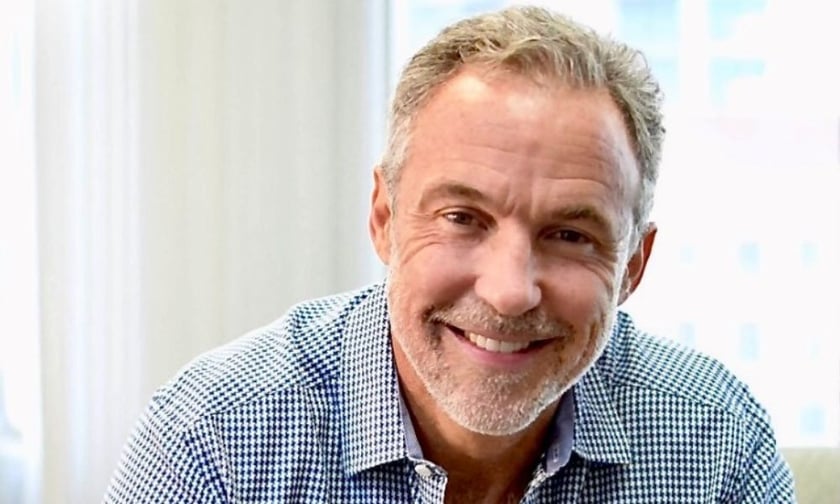
Insurance is a business built around a strange transaction. Money changes hands today in exchange for a promise about a distant tomorrow, one the buyer hopes never needs to be collected. The contract is dense. The stakes are plain. Trust must bridge the distance between them. Michael Carricarte has spent his working life on that bridge.
His latest attempt is Olé Life, the company he founded with his brothers Andrew and Brian. Olé sells US-dollar-denominated life insurance across Latin America and the Caribbean, using software to compress what once took forms, appointments and waiting into a digital application measured in minutes. Yet Carricarte has not treated technology as a magic trick. The company still works through thousands of advisers. Its argument is subtler: remove the friction, keep the human being.
That is an operator's conclusion, formed less by fashionable theory than by repetition. Carricarte has watched this market from inside family companies, international insurers and his own startups since the 1980s. He has seen paper become portals and portals become phones. What has not changed is the weight of the promise.
The family apprenticeship
Carricarte is a second-generation insurance founder. His father was selling insurance in Latin America in the 1970s, and the family's business education was practical, regional and apparently contagious. Michael would lead Amedex and USA Medical Services. Later, his brothers would join him at Olé, Andrew overseeing technology and Brian working across integration and operations.
The brothers' origin story is tempting material for a glossy family-business fable. The more useful version contains a great deal of work. Amedex and USA Medical Services served more than one million customers across 42 countries before Bupa acquired the businesses in 2005. Carricarte then operated within larger institutions, including Bupa and Pan-American Life Insurance Group, where he led the International Private Client division. Scale stopped being an abstraction. It arrived with regulators, distribution networks, local habits and the thousand small exceptions that make Latin America a region rather than a single market.
Begins building his career in the Carricarte family's regional insurance businesses.
Bupa acquires Amedex and USA Medical Services after the businesses reach clients across 42 countries.
Leads Pan-American Life's International Private Client division.
Launches Olé Life with brothers Andrew and Brian.
Closes a $13 million Series B led by PayPal Ventures and adds Swiss Re as a reinsurance partner.
Carricarte also completed Harvard Business School's Owner/President Management program from 2001 to 2003. The name of the course is almost comically accurate for his career. He has repeatedly occupied both halves of that slash: owner and president, founder and executive, impatient builder and custodian of institutions that must remain solvent for decades.
The long view also gave him a useful memory for false dawns. Insurance has spent years promising that each new database, portal or scoring model would finally make buying coverage painless. Carricarte had already seen technology arrive in chapters before Olé put the whole transaction online. His advantage was not simply knowing what software could add. It was knowing where software had previously failed to change behavior.
One answer lay in the currency. Olé's policies were designed in US dollars for customers whose salaries and daily spending may be in pesos or reais, but whose savings ambitions often look north. The stable denomination became part of the product rather than a detail in the fine print. Another answer lay in timing: a customer could apply in a short sitting, while an adviser remained available to explain what the numbers meant. Carricarte was assembling decisions learned across decades into a service meant to feel uncomplicated on first contact.
A room before an app
There is an earlier Carricarte story that says more about his instincts than a cap table can. In 1997, when he was 27 and president of Amedex, his work at St. Francis Xavier School in Miami's Overtown neighborhood entered the Congressional Record. He had chaired the school's building fund since 1992, raising money from friends and companies and supplementing it with a personal bank loan. The result was three classrooms and a playground.
His stated reason was direct: children with fewer advantages deserved a good education because they represented the country's future. Decades later, a former student publicly thanked Carricarte and his family for regularly visiting the school and credited those encounters with influencing his own work as an educator.
It would be tidy to draw a ruler-straight line from the school to the startup. Lives rarely respect such geometry. Still, the rhyme is hard to miss. Carricarte tends to describe ambition in terms of who can get through the door. At Olé, that means customers often encountering life insurance for the first time.
Speed, with a person attached
Olé began selling policies in 2022 as a full-stack carrier, meaning it does more than place another insurer's product behind a bright interface. It participates in designing, pricing and carrying the risk, with large global reinsurers standing behind much of the coverage. That structure is less visible than an app and more consequential. A quick quote is useful; the ability to honor it years later is the point.
The customer-facing proposition is easy to summarize. Applications are digital. Automated underwriting uses data to accelerate a decision. Policies are denominated in US dollars. Advisers can quote, compare and manage business through Olé's tools, while distribution partners can embed parts of the experience. In 2023, the company said it could underwrite certain policies up to $1 million, subject to its evaluation process.
The human adviser remains central because Carricarte's experience tells him that trust in the region does not materialize merely because a screen is elegant. Financial decisions often travel through relationships. Olé's wager is that an adviser equipped with good software can serve more people with less waiting, without turning an important decision into an unattended checkout cart.
Those numbers, which Carricarte shared in a 2026 reflection on the prior year, clarify the business more effectively than the usual vocabulary of disruption. The company is using a digital system to bring first-time buyers into a category long associated with wealth, paperwork or both. The adviser is not a concession to an old industry. The adviser is part of the acquisition model.
Capital for the next border
Investors have financed the expansion in stages. A $12 million Series A arrived in 2023, when Olé reported members in 30 countries, more than 3,000 contracted advisers and close to $1 billion in issued coverage. In January 2025, PayPal Ventures led a $13 million Series B, joined by Mundi Ventures, AV8 and Advent Morro. At that point, Olé reported more than $2 billion in total insured value and over 4,000 distribution partners.
A larger human network behind the digital front door
Capital bought the company room to establish local operations and partnerships. Reinsurance support expanded too: Swiss Re joined RGA, PartnerRe and Munich Re in 2025. The arrangement matters because rapid distribution without durable financial backing would be a rather expensive form of theatre.
By 2026, the map was becoming more specific. In Brazil, Olé paired dollar-denominated policies with Nomad, whose international accounts give customers a way to pay. In Mexico, Carricarte worked with Seguros Patrimonial, met advisers and appeared before local media and industry leaders. His public dispatches from those visits were bilingual and effusive, full of team photographs and thanks. Four decades in, he still writes like someone who enjoys being in the room.
The travel also exposes the unglamorous edge of regional expansion. A product cannot simply be translated and dropped across a border. Licences change. Partners change. The way people pay changes. So does the vocabulary of trust. Carricarte's Mexico updates emphasized training new advisers as much as announcing the alliance itself. In Brazil, the payment relationship helped the dollar proposition make practical sense. The strategy is continental on a slide and stubbornly local on the ground.
The useful tension
Carricarte's career contains a productive contradiction. He wants speed from a product designed to last. He runs a digital company that depends on human intermediaries. He is a serial founder whose knowledge comes from staying in one industry long enough to remember three technological eras. Even Olé's family structure joins continuity to reinvention: the sons returned to the trade, then rebuilt its machinery.
His ambition is measurable. He has spoken of protecting 100,000 families across Latin America, opening more channels through financial institutions and continuing into new markets. Yet the quieter goal is more interesting: make a complicated promise legible to someone encountering it for the first time.
Insurance will never be delightful in the way a song, a meal or a holiday can be delightful. It exists because uncertainty does. Carricarte appears comfortable with that unfashionable fact. His work is to make the route from worry to protection shorter, clearer and sturdy enough to bear weight.
The app may take ten minutes. The judgment behind it took nearly forty years.