At 4:45 on an October morning, Michael Narea tiptoes out of his home, trying to leave his children asleep. Outside, it is dark. An East Coast founder is waiting for a conversation. Narea makes time for a brief moment by the ocean before getting on the call. The scene has the ingredients of a familiar Silicon Valley story: early start, ambitious work, inconvenient time zones. Then the subject turns to a former school principal trying to work out what a decade of purposeful building might look like.
Narea described that morning on October 2, 2026. The founder wanted impact that could survive beyond the latest funding cycle or political fashion. It is the kind of question Narea has made a career of taking seriously. As co-founder, CEO and General Partner at Transcend Network, he supports people building businesses around learning and work. His own route there includes chemical engineering, marine conservation, classroom prototypes and surf clubs. The ocean keeps appearing. So does the impulse to put people in a room together.
A prototype, with its audience present
One photograph from his student years makes a useful starting point. Narea sits at a laptop, showing a prototype of the Cleanup DePue website to local high school students. Several people gather around a long table. There is no stage, no podium and no ceremonial ribbon. The computer is within reach of the people who will have something to say about it.
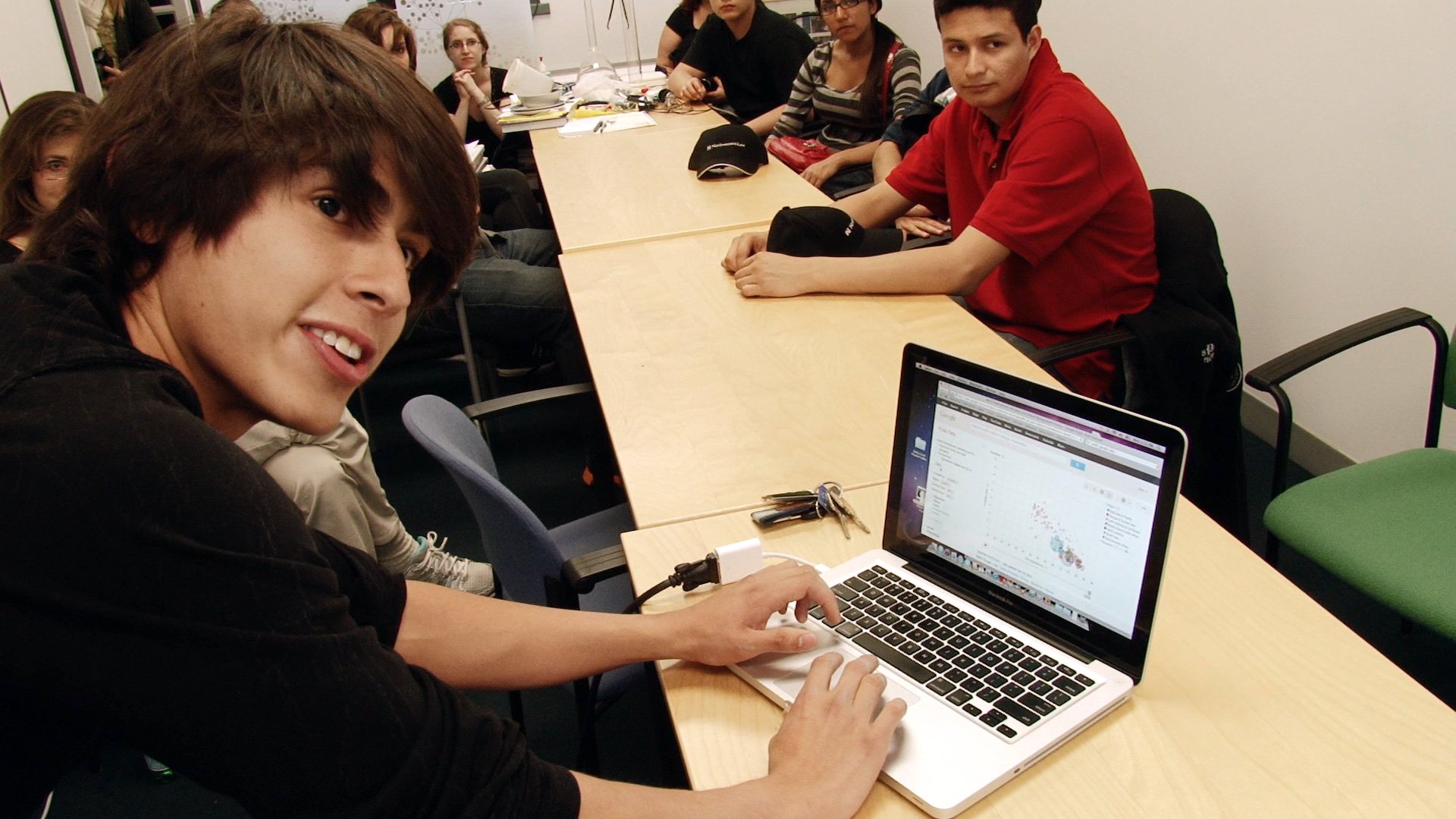
The image records a specific piece of work, rather than an entire philosophy. But it offers an apt introduction to a career that repeatedly brings the intended audience into the process. A prototype lets people react to something concrete. A room full of students supplies questions a designer working alone may never think to ask. Narea would later work with founders facing a version of that same problem: having an idea is relatively straightforward; finding out what another person can actually use requires contact.
At Northwestern, he also helped lead Pura Playa with Megan Scherich. In 2013, the group was tackling plastic across production, consumption and disposal. On campus, its work included education and a push to stop sales of bottled water. In Costa Rica, a partnership with Sea Turtles Forever supported an assessment of a marine plastic accumulation site. The team completed a NOAA plastic accumulation survey and worked with faculty on further research.
There was laboratory work, too, involving Northwestern’s Torkelson Research Group and a plastic upcycling process. The project crossed research, campus policy and community activity. Even the bottled water campaign had a practical theatrical streak: taste challenges between tap and bottled water. Persuasion can occasionally begin with a cup.
The engineer who kept making rooms
Narea studied at Northwestern from 2009 to 2014 and graduated from its McCormick engineering school. Early exposure to human-centered design helped turn his attention from chemical engineering toward education innovation. The question of how people experience a product became part of the work itself.
His student activities included helping establish EPIC, Northwestern’s entrepreneurship organization. By late 2017, when he sat for an alumni interview, he wanted people entering entrepreneurship to understand their own potential and translate it into a business. Asked for an entrepreneurial haiku, he began: “Serve your teammates, yah.” An unusually compact business plan.
“Serve your teammates, yah.”
Michael Narea, 2017
He had expected, as a freshman, to become a chemical engineer working in cleaner energy. His answer about the next career step was less tidy. He said things improved when he paid attention to where he was rather than to what his career supposedly ought to be doing. The alumni interviewer asked the uncomfortable question anyway, which is one of the privileges of being an alumni interviewer.
The subsequent experience is substantial: work with GSVlabs, Moringa School and Sunlight Technologies, followed by bootstrapped ventures including Moonshot Partners, FlightCX and Nareatech. In the archived teaching biography for Transcend’s Validate course, Narea appears as both instructor and coach. That combination matters. A curriculum describes the work; a coach has to meet the person trying to do it.
What he noticed while waiting for waves
In September 2017, Narea and a friend raced across Seoul to catch a train to Busan. Their destination was Songjeong Beach. The trip required a train, a bus and a walk; the evening arrival produced a beach without waves. By morning, monsoon weather had changed the situation considerably.
While waiting, Narea visited Song Jeong Surf Club. Communication with club member Doun Lee and the staff involved limited shared language and Google Translate. They exchanged gifts from their respective surf communities. Later, when conditions allowed surfing, familiar faces made joining the local surfers easier.
His account lingers on the club as a place people use. Boards were stored upstairs. Young students came to do homework and share food at night. He noticed a sign with the words “People are treasure.” A surf club had become a point of belonging, with an activity at its center and relationships growing around it. The journey had supplied considerably more than waves.
A year later, writing about the Culture Conference, he described the value of listening to accounts of diversity and belonging from people with different experiences. He wanted to carry that learning into the teams he worked with. His account also included a return to surfing at Moss Beach. The sequence is characteristic of his public writing: encounter people, reflect on what happened, consider how to bring it into work, get back to the water.
A fellowship before a first check
Narea co-founded Transcend Network with Alberto Arenaza; his co-founder record dates to November 2018. The organization concentrates on the early stages of companies building the future of learning and work. It joins founder programs, a community and an investment fund. For Narea, supporting the person and examining the business happen in the same setting.
The fellowship asks founders to run lean customer experiments and work toward product-market fit. Its bootcamp material uses investor John Danner’s product-market-fit playbook. The practical vocabulary is deliberately small: a customer, a problem, an experiment, something learned. A founder can bring a large ambition into that process, but the next task still needs to be specific enough to try.
- 01Find the customer
- 02Test the problem
- 03Record the learning
- 04Try again
A schematic of the experimentation approach taught in Transcend’s programs.
The archived Validate course made those tasks explicit. Participants identified a narrow customer persona, designed low-cost experiments and kept a track record of their findings. The course is no longer offered on Maven, but its syllabus preserves a useful view of Narea’s teaching. Founders were expected to develop the habit of testing and to continue it after the program ended.
Investment follows sustained contact. Transcend Fund says it backs founders drawn from its community, getting to know them before investing. Its published process considers learning cadence, experimentation and early customer response. Its listed portfolio includes MagicSchool, Kibo, Diffit and PaceAI. These are examples of the fund’s investments, rather than a tally of companies Narea personally built.
Approximate first checks described in the fund’s public FAQ.
That arrangement gives community a concrete place in an investment decision. A pitch compresses a company into an argument. Repeated work lets an investor see what a founder does when the argument meets a customer. The fund’s stated ambition is to learn about people over time, including before they are ready to raise money.
From the lonely cliff to a shared hill
In a January 2026 conversation with Arenaza, Narea described seeking a co-pilot for ambitions that would take decades. The discussion placed user transformation ahead of features and fundraising. Teachers and school leaders appeared as potential founders themselves, bringing lived knowledge of the problems they wanted to solve.
In another 2026 interview, Narea used two geographic images: the lonely cliff and the shared hill. On the cliff, a founder’s original purpose comes under pressure from market expectations and customer demands. The hill allows partners to work toward something together. The distinction gives his current thinking a shape people can picture without needing a spreadsheet.
His argument is especially relevant to products whose features can be copied quickly. He sees deeper partnerships and a clear vision as routes to durable businesses when product differentiation becomes harder. A short pilot can create activity without much commitment. A partner willing to do substantial work over time changes the relationship between a founder and the market.
There is a demanding side to this view. In a public reflection on loyalty, Narea wrote that serving a shared vision may require changing a cherished strategy or admitting that someone else has the better idea. Attachment to a person does not settle every business decision. His emphasis on partnership includes the obligation to ask uncomfortable questions about whether the work still serves its purpose.
A seat at the table
The approach has also taken an organizational form. Muyu Education announced Narea as chair of its board and Transcend Network as lead investor in its funding round. Founder Daniel Crespo described their relationship in terms of purpose and shared work. Narea’s response focused on continuing to build together. A board seat makes partnership more than a pleasant description.
By October 2026, Narea’s writing was following founders as they formed longer relationships with the institutions they served. His published stories included educators building companies and a couple working on learning-system data. The emphasis had moved beyond how to get an initial product in front of a buyer toward how people sustain a commitment once they begin.
Across those years, the recurring scene is remarkably ordinary. Someone brings an unfinished thing to other people: a campus campaign, a website, a business hypothesis, a vision of a school. They explain it, hear something back and return to the work. Narea has built his professional life around making those encounters possible. At a table in DePue, the laptop was open and the audience was close. On a dark October morning, a founder was waiting on the other end of a call.