A bank that is not a bank.
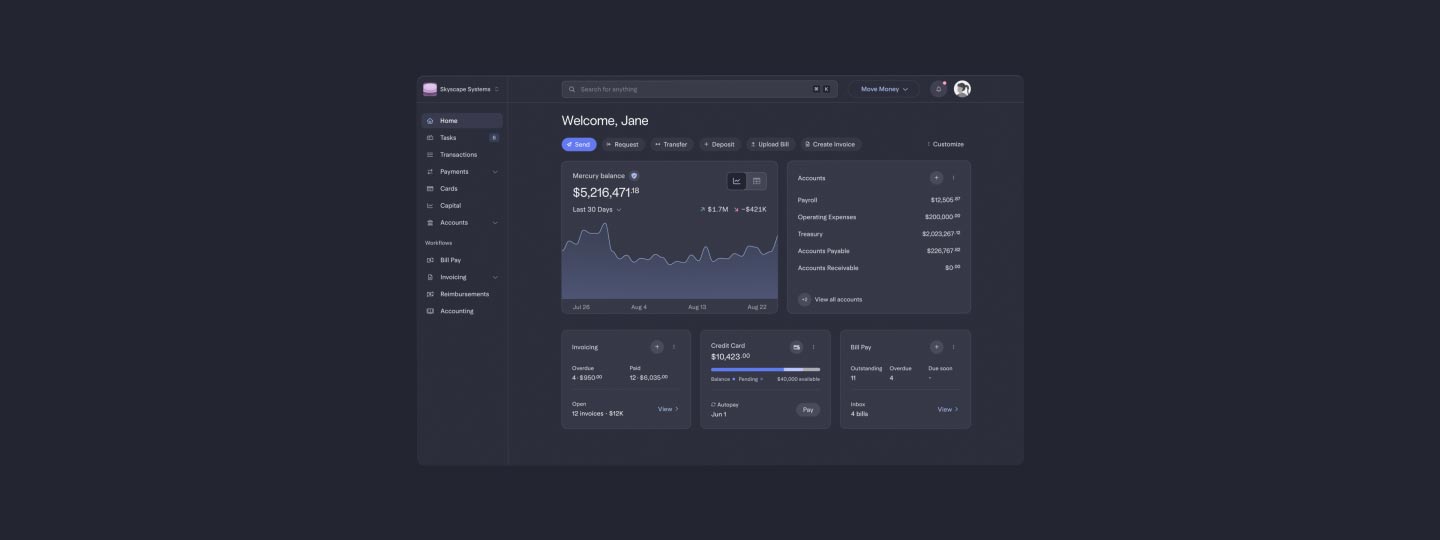
On any given Tuesday in 2026, somewhere between Sunnyvale and Brooklyn, a founder opens her laptop, logs into Mercury, sees a balance, approves a $42,000 vendor wire, issues two virtual cards for a contractor in Lisbon, and closes the tab. The entire interaction takes ninety seconds. No one is on the phone. No one has faxed anything. The thing that used to be called "business banking" has been quietly replaced by something else, and the something else is Mercury.
Three hundred thousand businesses now move money through Mercury's software. Last year they pushed $248 billion through it - a number that would have raised eyebrows at a Federal Reserve hearing a decade ago, and now barely qualifies as a press release. The company brought in $650 million in annualized revenue in 2025. It is profitable. It is growing fifty percent a year. And it operates under a curious legal fiction: Mercury is not a bank. The deposits sit at Choice Financial Group, Column N.A., and a small federation of FDIC-insured partners. Mercury is the interface, the brain, and increasingly, the brand.
That distinction matters less to customers than it does to regulators. To the founder shipping a Series A in Detroit or a coffee subscription in Austin, Mercury is simply where the money lives.
Founders were being punished for moving fast.
The original sin of business banking, as Mercury's co-founders tell it, was that it had been built for the 1985 manager of a medium-sized stationery distributor. The interface was a teller window. The wire confirmation was a phone call. The CFO dashboard was a manila folder. When Immad Akhund ran Heyzap - a mobile ad-tech company that he eventually sold for $45 million in 2016 - his team employed actual humans whose job it was to log into a legacy bank portal and reconcile thousands of payouts to mobile publishers, by hand, every week. He found this absurd. He was not wrong.
Most founders did. They simply assumed that this was the price of running a business. The opening of a corporate bank account routinely consumed two weeks and several notarized signatures. Issuing a debit card to a new hire required couriering plastic across state lines. International wires went out into the void and came back, sometimes, days later, with mysterious deductions. The infrastructure was solid. The experience was Soviet.
Three engineers, one boring industry, one big idea.
In 2017, Akhund teamed up with two former Heyzap colleagues, Max Tagher and Jason Zhang, on a thesis that, at the time, sounded mildly insane: that startups would happily switch banks for a better user interface. Silicon Valley Bank existed. First Republic existed. Chase existed. The category, in venture parlance, was crowded.
The bet was not that Mercury would build a better balance sheet. The bet was that banking was, beneath all the regulation and ceremony, a software problem. If you treated it like one - if you hired designers who cared about typography and engineers who cared about latency - you would, eventually, look up and find that the incumbent's customers had quietly moved their money. This is approximately what happened.
Mercury raised $6 million from CRV and a constellation of operator-angels in its earliest round. It raised another $20 million the following year. By 2021 Coatue had led a $120 million Series B. And then in March 2025, with the post-SVB dust still settling, Sequoia Capital led a $300 million Series C extension at a $3.5 billion valuation. The market had decided.
Eight years, in receipts.
The revenue line, briefly
What you can actually do with it.
The instinct, with a fintech profile, is to list features and surrender. Mercury's catalog has grown enough that this is genuinely the most efficient option:
Checking & Savings
FDIC-insured accounts through partner banks. Treasury sweeps move idle cash into money-market funds.
IO Credit Card
A corporate Mastercard with 1.5% cashback, no personal guarantee, no annual fee. Used by 80,000 businesses.
Bill Pay
AP automation with AI invoice matching. The thing that used to be QuickBooks plus three browser tabs.
Venture Debt
Non-dilutive financing for growth-stage startups. Underwritten without spreadsheet hostage situations.
Banking API
Programmatic payments, transfers, and reconciliation. The detail finance bros quietly nerd out about.
Mercury Personal
A consumer product for founders and operators - the bet that "personal" and "professional" finance are converging.
The connecting thread is that each product looks suspiciously like a feature of a single coherent system rather than a stack of acquisitions glued together with marketing. This is unusual. Most fintech ladders are visibly bolted on. Mercury's is not.
Numbers, and the people behind them.
Mercury's customer base is now broad enough to be uninteresting to describe: pre-seed AI labs, Series E growth companies, e-commerce shops, podcast networks, dental practices, micro-VCs. The Y Combinator pipeline famously defaults to Mercury during onboarding, which has produced a kind of demographic compounding: founders who used Mercury at one startup tend to use it at the next.
The 2023 collapse of Silicon Valley Bank - a near-extinction event for the startup banking sector - was, for Mercury, an unexpected acceleration. SVB customers needed a new home in a weekend. Mercury, almost alone, had the onboarding capacity to absorb them. Tens of thousands of accounts opened in a matter of days. Some fintechs would describe this as a tailwind. The Mercury team described it, in writing at the time, as an operational scramble that ended in a lot of cold pizza.
Banking, with the boring parts deleted.
What Mercury is doing is not, strictly speaking, novel. Plenty of companies have wanted to disrupt business banking. What is novel is the discipline. Mercury has shipped slowly enough to keep its product surface clean, but quickly enough to lap the field. It has not, in eight years, tried to also be a crypto exchange, a B2B marketplace, or a payroll provider. It has resisted the gravitational pull of every fintech adjacency that beckons.
The result is a company whose mission - to build the financial operating system for ambitious companies - is finally starting to sound less like a pitch deck and more like a description. Mercury's tooling is opinionated. It assumes that the person using it is competent. It treats accountants and engineers as primary users rather than afterthoughts. The aesthetic is calm, the documentation is good, and the product manager's job is, evidently, to say no to most things.
That this is unusual is itself a comment on the state of fintech.
The bank as software, the company as compounding.
Looking forward, the interesting question is no longer whether Mercury wins the startup-banking category. It already has. The interesting question is what happens when the category itself expands. Mercury Personal, launched in 2024, is a wager that the boundary between consumer and business banking is largely an artifact of legacy regulation. The IO credit card, the AP automation suite, and the increasingly muscular API hint at a financial OS that, if extended even modestly, becomes a serious threat to the legacy enterprise banking stack.
There are risks. Partner-bank relationships introduce concentration. Regulators have grown notably less indulgent of fintech-bank arrangements since the Synapse collapse. Brex and Ramp continue to compete aggressively on cards and spend management. And every fintech in history has, eventually, met its compliance reckoning.
But Mercury has done something most of its peers have not: it has built a real software company that happens to move money, rather than a money company that happens to ship features. That distinction will, over time, prove load-bearing.
The ninety-second wire, revisited.
Return, for a moment, to that Tuesday morning. The founder closing her laptop. The wire approved, the cards issued, the tab dismissed. Ten years ago that sequence took half a day, three phone calls, and a notary. Now it takes ninety seconds, and she doesn't think about it. She also doesn't think about Mercury, because Mercury has, by design, become invisible inside her workflow. Which is, of course, the highest compliment software can earn.
The company is profitable. The category is large. The roadmap is long. Mercury, at the end of its first decade, has somehow managed to be both the obvious incumbent and the underdog story. It is rare to be either. It is exceedingly rare to be both.