An empty shipping container presents an awkward question. The goods have gone. The steel remains. Somewhere nearby, someone needs storage, a workshop or the beginning of a building. Getting the box from its first owner to its next one sounds like a modest administrative task. Maximilian Birner helped make a company out of it.
His career had already taken several turns before containers entered the picture. There was a mobile technology startup in London, a donation platform in the Middle East and work among entrepreneurs who had promised part of their future wealth to charity. Boxhub gave those interests a physical address: the place where a useful object sits waiting for somebody to want it.
It is a pleasingly unglamorous object around which to organize a technology business. A container requires no explanation of what it looks like. Its purchase, however, can require rather more explanation than a buyer expected. Birner’s opportunity lay in the distance between those two things.
Two T-shirts at the long table
Birner was born and raised in Germany and went on to study in London. Entrepreneurship arrived while he was still at university. A friend had a technology idea and asked him to join. In 2012, Birner and Sam Amrani founded Tamoco.
Its early work involved near-field communication, or NFC: tags that allowed a person to tap a phone against a physical object and reach digital material. Trials included business cards and a book-publisher competition. Tamoco’s name was an abbreviation of Tag Mobile Company. The proposition was quite literal: put a connection into something you can touch.
A later BMW campaign in Der Spiegel used the company’s platform to connect print advertising with digital content. What appeared on the phone could depend on its operating system or a previous interaction. A magazine page could acquire a memory, at least from a marketer’s point of view.
Birner’s own memorable scene from those years took place in a Hong Kong high-rise. He and a fellow young founder sat in T-shirts across a long table from five experienced investors wearing suits. He felt out of place. Their willingness to discuss an investment gave him confidence that building companies could become his working life.
“I didn’t plan to become an entrepreneur”
Maximilian Birner, recalling his university years
The clothes make the scene easy to picture. Its significance is quieter. Confidence followed an encounter with people willing to take the business seriously. He had begun with an invitation from a friend; now there was a roomful of strangers considering what they had made.
A detour with a purpose
After four years at his first company, Birner stepped away and reconsidered how he wanted to spend his time. He moved into nonprofit work, helping establish Naua, an online platform connecting donors and volunteers with organizations in the Middle East. It later merged with the Crown Prince Foundation of Jordan.
There followed a European chapter at Founders Pledge, the community whose members commit a portion of their personal exit proceeds to charitable giving. His public biography describes helping grow that community to 1,200 members across 30 countries. The role placed him among people considering what their business success should ultimately finance.
These were different kinds of transactions. Tamoco connected an advertisement with a digital response. Naua connected a willingness to give with a project needing support. Founders Pledge connected a future financial event with a charitable commitment. Read together, they suggest a recurring interest in arranging the connection that allows something else to happen.
That reading helps explain why a container marketplace fits into the same career. A platform sits between people who already have reasons to act. It can make finding each other easier, organize the information they need and help a decision become an actual exchange. In Birner’s work, the people on either side kept changing.
Philip Skov knew the shipping side
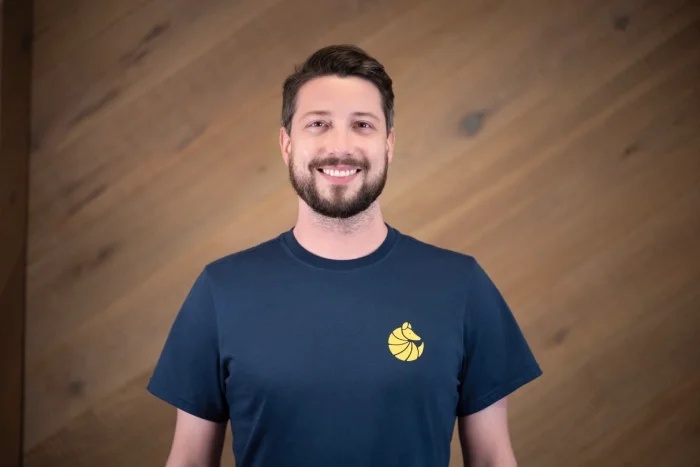
Philip Skov brought experience from Maersk. Birner brought experience building technology companies. Their partnership joined an understanding of how containers moved with an interest in how a customer might buy one more easily. Company materials date Boxhub to 2017; Birner’s accounts place his involvement in 2019.
The distinction matters in a founder’s story. Companies begin in stages: an idea, an initial operation, a partnership, a business with customers. A single founding date can compress several separate arrivals. Birner’s own recent farewell credits Skov with bringing him into the venture when it was still near the beginning.
By 2020, Birner had been named to Forbes’ European 30 Under 30 list for social entrepreneurs. The business described in that recognition sold containers for uses including housing and retail, with predictive sourcing contributing to its economics. The container’s usefulness after shipping was already central to the proposition.
There is a practical attraction to starting with a standardized object. Buyers can imagine an office, a shop or storage inside a recognizable outline. Each project still has its own demands. Boxhub’s part is to make acquiring the underlying object less mysterious, so the buyer can get on with whatever comes next.
An illustrative view of the marketplace’s work.
The button and the truck
Boxhub describes an industry accustomed to ledgers, spreadsheets, emails and phone calls. Its online proposition puts available containers, prices and checkout in one place, with delivery coordination attached. For a buyer, a familiar shopping process replaces a purchase that might otherwise begin with figuring out whom to telephone.
Behind that simplicity sits the physical work. Containers occupy space. Condition matters. So does location. A pleasing checkout page cannot deliver several tons of steel by itself. Every easy purchase hands a set of responsibilities to the business promising to fulfill it.
In discussing the industry, Birner has emphasized dealing directly with shipping lines and reducing unnecessary moves. The logic connects the cost of repositioning an empty container with the possibility of finding a buyer where it already is. The next customer can give the box another job without requiring it to retrace its earlier journey.
That also makes the environmental argument specific. Reuse and fewer unnecessary movements are the intended benefits. They depend on what happens to real equipment. The interesting unit of progress is a container matched with a suitable next use, followed by a delivery that actually works.
A cap table with maritime experience
In April 2022, Boxhub announced a US$2.7 million seed round led by Delivery Hero founder Niklas Östberg. Investors included Uber founding engineer Conrad Whelan, Unity founder David Helgason, Esther Dyson and Charlie Songhurst. Innoport, the Schulte Group’s venture arm, also invested, adding a connection to a long-established maritime business.
The announced uses of the money were American expansion and product development. By then, Boxhub said its customers included NASA, General Electric, Hobby Lobby and the New York City Housing Authority. Those names describe a broad purchasing audience. A container can be useful to an institution without ever becoming a tiny home.
Amounts as reported in the respective announcements. The Series A report does not specify currency.
The following year brought a $12.4 million Series A led by AlleyCorp, with Solasta Ventures, Interplay VC, FJ Labs and Hum Capital participating. AlleyCorp partner Susannah Shipton joined the board. Product development and international expansion again featured among the stated purposes.
Birner’s message about that round focused on what the team had learned from customers and supply-chain partners. He described plans to increase operational capacity, broaden the product range and grow geographically. His invitation to prospective colleagues emphasized ambition and learning quickly. The agenda had moved from establishing a marketplace to making its operations support more activity.
What the box might become
At Toronto’s Collision conference in 2022, Birner took the Growth Summit stage to discuss sustainability and social value in supply chains. It was a setting full of technology companies, though the object behind his argument remained exceptionally tangible. Corrugated steel has a way of keeping a digital proposition grounded.
His January 2025 appearance on Inside Modular returned to the builders and businesses using containers. He discussed the market’s fragmentation, the importance of sourcing and a widening range of applications. He also outlined ambitions for European expansion and additional products, including refrigerated and specialty containers. Those were plans expressed at the time.
The breadth is part of the appeal. A person buying one container and a business sourcing them regularly need different kinds of help. One is trying to complete a purchase; the other may be planning a sequence of projects. Serving both makes the relationship extend beyond the moment someone clicks a button.
Seven years, then a handover
In a recent public announcement, Birner said he had decided to step down as Boxhub CEO after seven years. He named Mark Casaletto as the incoming chief executive and thanked Skov, the team and the people who had supported the company. Casaletto separately announced that he had joined as CEO.
Birner’s farewell acknowledged difficult periods alongside the achievements. It was also generous about ownership of the result: the team, rather than the founder alone, occupied the center of his thanks. He described Boxhub as a defining experience of his life and said he would be supporting its next leadership from the sidelines.
A title changes more quickly than a career can be explained. Birner’s route into the container business began with an unexpected invitation at university and passed through work on giving. It ended this chapter with a handover. Along the way, he helped make a case for looking again at something whose original task was finished. An empty box still leaves room for another idea.