Itamar Zur paid for a meal kit and received a business problem. The food never arrived. He was a student at Harvard Business School, trying a subscription service whose promise depended on dinner reaching his door. When the delivery failed, he canceled the subscription before trying the product. Somewhere between the brand's good intentions and his apartment, an entire customer relationship had gone missing.
The interesting part was whom he blamed. A carrier had failed to deliver, but the brand lost his business. That distinction would become the premise of Veho, the company Zur began building in 2016: the person waiting at home experiences the purchase as one continuous transaction. The retailer may see several vendors and contracts. The customer sees an empty doorstep.
A missing dinner is an unusually modest foundation for a company. It also gives the founder a useful test. Before speaking about networks, software or growth, he can ask whether anyone has made receiving the box less irritating. Zur has spent the years since learning how difficult it is to make that apparently small improvement repeatable.
Before the door, a control tower
Born in Jerusalem, Zur lived in Tel Aviv before moving to Boston. His route into entrepreneurship passed through law and consumer marketing. In an early interview, he described wanting to build a company in the market he intended to serve. The United States offered that opportunity, although being an immigrant also meant thinking about whether his ability to stay could affect the business he was trying to start.
His earlier work had supplied several different ways of looking at a problem. He served as an air traffic controller, studied law at Tel Aviv University, clerked for a Supreme Court justice, and worked at Procter & Gamble and monday.com. Later, he would connect those experiences to keeping the larger operation in view, exercising judgment, understanding consumers, and moving quickly enough to learn.
At Procter & Gamble, consumer understanding meant getting out among the people buying the products. At monday.com, his first startup experience, he encountered a pace that challenged his own methodical habits. He could see the value of trying something, seeing what happened, and adjusting. The future delivery founder was collecting an education in both precision and impatience.
There was another apprenticeship: asking other founders questions. Zur co-produced Startup Camel, a podcast interviewing Israeli entrepreneurs. While at Harvard, he also co-interviewed Dropbox founder Drew Houston. Away from work, he described himself as a dog enthusiast and NBA follower. Entrepreneurship, conversation and basketball would make a fairly serviceable account of how he chose to spend his attention.
A free ticket, then a prize
In 2016, Zur visited Parcel Forum in Dallas. The organizers gave the cash-strapped student a free ticket. He arrived expecting a look at the delivery business and found an opening: while technology circles discussed drones and autonomous vehicles, the conference conversation seemed to him heavily occupied with negotiating rates with UPS and FedEx.
That was his assessment, and it was a useful provocation. An industry can be very good at negotiating the price of its existing arrangements while leaving the customer experience largely untouched. Zur saw room to approach delivery from the shopper's end. There was no requirement that the next entrant begin with a truck fleet resembling the incumbents'.
Veho's early proposition was concrete: people could deliver packages in their own cars, coordinated through a platform. In April 2017, the venture won Harvard Business School's $75,000 New Venture Competition business-track grand prize. The named team was Zur, Matt Graham and Keith Cheong. A student project had acquired institutional encouragement and money with which to test its premise.
A competition stage is a pleasing place to explain an operating model. A doorstep is less accommodating. The box has to be there. The distinction matters in Zur's story because the early recognition did not spare the company a much more awkward test after graduation.
New Venture Competition
The company had to begin twice
In the Boston days, Zur drove delivery routes before dawn and hurried to class afterward. The rest of the day went into the technology, the business case and investor pitches. Some investors suggested getting a regular job. Others backed the experiment. Then the original team failed to work out, and he shut the business down.
After business school, he left Boston. Unable to afford rent, he moved in with his uncle. He then met Fred Cook, whom he would describe as the most influential person in his career. Together, they relaunched Veho in Colorado. The familiar founding date, 2016, contains this less tidy sequence: start, stop, find a different partner, start again.
Zur's writing from 2018 offers an unusually specific account of what he had learned about working with others. He described early disagreements over the company's direction and the cost of leaving decisions unresolved. His remedy was clearer ownership of decisions and partners who understood the risks they were agreeing to take. Consensus had proved expensive.
He also remembered an investor who had told him to find a job, then wanted another meeting once Veho had delivered thousands of packages. The anecdote has a dry little commercial lesson. An opinion about a business can change surprisingly quickly when the business starts doing business. Zur's response was to keep producing evidence.
The shoe that stayed in the shop
Another of Zur's shopping experiences explains the company almost as well as the missing meal kit. He found a pair of shoes online that he liked, a welcome discovery for someone wearing size 14. Then he considered the delivery, the possibility of theft from the stoop, and the effort of returning them if they did not fit. He decided against buying.
He described a buyer and seller who both wanted a transaction, yet came away with nothing. The sale had been lost before any carrier touched a parcel. Delivery had entered the customer's calculation at checkout. For a former brand manager, this is a particularly pointed observation: a persuasive product can lose to the anticipated nuisance of receiving it.
Veho's answer has included letting recipients provide delivery instructions, communicate about an order, and change delivery arrangements. The purpose is to reduce the uncertainty that comes after payment. These are ordinary concerns, which may be why they make a useful starting point. A customer generally has quite enough projects without becoming the coordinator of a parcel rescue.
Zur applies a similar product lens to drivers. In a March 2026 interview, he described routes posted the previous night, allowing independent drivers to consider location and pay before choosing work. He also acknowledged that routes could not be guaranteed every day. His argument was that flexibility becomes more useful when people can plan around it.
“I wanted to buy and the company wanted to sell.”
Itamar Zur, on the shoes he decided against buying
“But nobody won.”
Growing the map, learning the job
With Cook, Veho became a network large enough to attract institutional investors including General Catalyst and SoftBank. Recognition followed too: in 2024, Goldman Sachs selected Zur for its Builders and Innovators entrepreneurship honors. That October, Veho announced an Austin flagship office and said its CEO had relocated there. His working geography had shifted again.
The map kept widening. In February 2026, Veho announced 66 markets and coverage of 44% of the United States population. In June, expansion into Oakland, San Francisco, Sacramento and San Jose took its reported footprint to 78 markets and 52%. Those figures describe access to the network, rather than the share of Americans already using it.
A larger map creates a different leadership assignment. The founder who once drove before class now has to make an experience consistent across many locations. His own language has changed accordingly. In an October 2025 statement of priorities, Zur described becoming a primary shipping partner for brands, broadening delivery options and building more coordinated operating practices.
He has also had to explain the business in economic terms. His return-on-shipping approach asks retailers to look beyond the quoted shipping rate to complaints, lost packages, late arrivals and repeat purchasing. It makes the argument testable: run a pilot, compare the results, and decide whether the experience earns its cost. The brand manager and the operator are sharing the same spreadsheet.
From 66 markets to 78
Back at a Boston doorstep
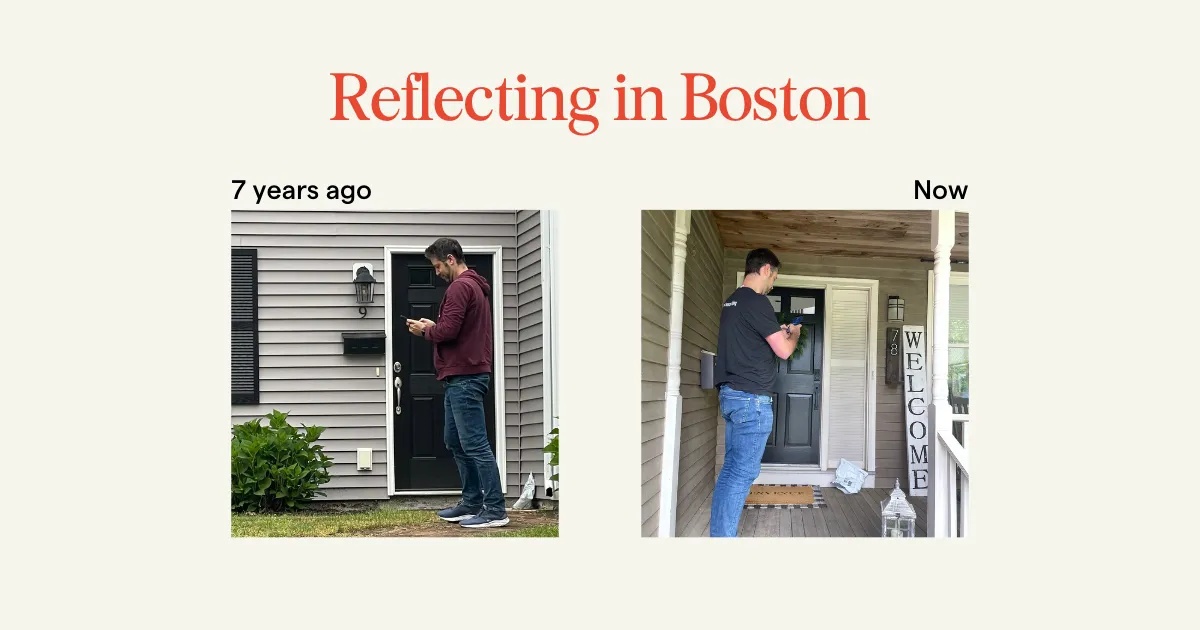
In June 2023, Zur returned to delivering packages in Boston as Veho expanded in New England. He published two pictures, one from the first experiments and one from the return. The doors were different; the task was recognizable. After the shutdown and the Colorado restart, being back on a Boston route carried a significance that a new market announcement alone could not.
The customer-facing work has continued to evolve. In August 2026, Veho announced that its tracking events would flow directly into Shopify, bringing delivery status alongside the order rather than sending shoppers elsewhere to follow the box. It is a small interface change with a familiar ambition: make the period between paying and receiving feel connected.
There is a pleasing symmetry to Zur's career so far. He entered the business because a company could persuade him to buy something and still fail him at the door. He stayed through a failed first version of his own company. His ambition now is to become a routine part of how brands keep that promise, at a scale that makes personal intervention impossible.
The early-morning delivery run remains a useful image because its standard is so plain. No one at home needs to know about the pitch competition, the co-founder search or the market count. They ordered something. It should arrive. Zur has built a career around the distance between how simple that sounds and how much work it takes.