At a Las Vegas computer show in 1990, Tony Davis’s side project began causing trouble for the main attraction. Delrina had come to COMDEX to sell its electronic forms software. Davis had made something that let a computer send a fax. It occupied a small table. The visitors kept choosing the table.
Davis had joined the product team the previous year and worked on the fax idea in his spare time. Delrina co-founder Mark Skapinker initially wanted the team to concentrate on the forms product. By the second day, crowds were gathering around WinFax; by the third, it needed another table. Eventually, the booth was given over to it. Customers had rearranged the company’s priorities without attending a single strategy meeting.
The episode offers an early glimpse of a career spent shortening the distance between an intention and its execution. A document needed to reach someone. Why should the sender have to leave the computer? Years later, a shopper would want a name on a necklace. Why should imagining the result be part of the purchase price?
The customer’s vote was visible in the traffic across the booth. Davis’s prototype answered a task people could immediately recognize. It required little explanation once someone saw it work. The contrast with a carefully planned sales presentation is part of the anecdote’s appeal: the team had brought its priorities to Las Vegas, and the visitors brought their own.
Davis would eventually become Jewlr’s founder and original CEO. His path there ran through software development, company building and venture investing. The thread connecting those jobs is easier to see in the things he made than in the titles: take a familiar task, inspect its awkward steps, and see which ones a customer might happily surrender.
- 1990WinFaxA document leaves the PC.
- 2009JewlrA personal choice reaches a workshop.
- 2026NectAirA regional trip fits the day.
An engineer walks into a jewelry business
The early résumé belongs to the software industry. Davis studied at the University of the Witwatersrand, with a master’s degree in electrical engineering listed in his professional biography. In 1996 he founded Lanacom, later acquired by BackWeb Technologies. In 1998 he co-founded Delano Technology. He also helped establish Brightspark, moving into the business of building and backing companies.
Jewlr arrived in 2009. There was no apprenticeship at a jeweler’s bench behind the venture. Davis and his colleagues began with an experiment in online selling. Personalized jewelry seemed promising, but software experience was an incomplete toolkit for a business that also needed to produce physical objects.
“I didn’t know anything about jewelry four years ago. Nothing.” Davis’s admission, made in 2014, is wonderfully economical. The extra word closes off any temptation to imagine a hidden family tradition involving gemstones.
The practical response was to learn. The team studied design and investigated three-dimensional modeling and printing. They brought manufacturing in-house. An online business had acquired workshop problems: materials, production methods and the question of how a picture becomes an object. For a programmer, a ring makes a rather demanding output format.
“I didn’t know anything about jewelry four years ago. Nothing.”
Tony Davis · 2014
A keepsake, with fewer leaps of faith
Personalization makes the customer’s choice unusually intimate. A birthstone, an initial or an engraved phrase carries meaning that a generic product photograph cannot fully convey. Jewlr’s offer put those choices into the shopping process, allowing people to configure a piece before it was made.
By 2019, its catalog offered more than 4,000 styles, including rings, name necklaces and bracelets. Buyers could select metals, stones and engravings, with visualization helping them understand the combination. The finished piece followed the order. This reverses the familiar retail encounter in which a customer chooses among objects already waiting in a case.
There is a quiet courtesy in letting someone see a decision before committing to it. A name necklace is both lettering and jewelry; the arrangement of letters matters as much as the metal. A preview gives that choice a visible shape. The technical work serves a very ordinary wish: please let this look the way I mean it.
Jewlr’s progress earned the Most Innovative (Large) Retailer award at the 2013 Canada Post E-commerce Innovation Awards. In 2018, it won the Large category’s Pure Play of the Year award, with $100,000 in free shipping among the prizes. For a business shipping small, personally significant parcels, that is a pleasingly practical trophy.
Consider the difference between ordering a standard item and commissioning a personal one. The second purchase asks the buyer to make more decisions and the seller to handle more variation. Keeping those decisions understandable becomes part of the service. For Davis, the engineering challenge reached into the customer’s confidence as well as the company’s production process.
The awards recognized a buying experience as well as a product. That distinction suits Davis’s career. The stone and setting must satisfy the wearer, of course. But a shopper also has to choose, understand, pay and wait. Every step can make a thoughtful gift feel either reassuringly possible or unnecessarily difficult.
Royal appearances, measurable consequences
A workshop capable of responding quickly can follow changes in taste. In early 2018, Jewlr reported an 85 percent increase in searches for pink sapphires after Princess Eugenie’s engagement. The company introduced a ring inspired by hers, following its earlier response to Meghan Markle’s engagement ring.
Davis discussed those royal influences as evidence of how fast customers’ interests could move. Public appearances became signals that could be answered with a design. The company’s technology and production methods allowed it to respond while the image was still fresh in a shopper’s mind.
The royals soon had competition from a rather different source of public fascination. In July 2018, Jewlr reported a 500 percent month-on-month rise in sales of men’s necklaces as Love Island contestants wore chains and pendants on screen. Davis identified the male contestants as the unexpected influence on customers in the United Kingdom.
The contrast is amusing: palace announcements and reality television arriving at the same manufacturing system. It is also commercially revealing. Customers do not organize their desires according to a retailer’s neat categories. An operation has to be ready when an interest appears, whether the inspiration comes with a tiara or a microphone pack.
The less glamorous work behind the click
Even a well-designed product page can lose a customer while loading. In 2020, more than 80 percent of Jewlr’s website traffic came from mobile users. Work with Google on its mobile experience produced a reported 40 percent improvement in load times and a 45 percent improvement in mobile conversion rates.
For Davis, that meant looking beyond the parts of the shopping journey a designer could point to on a screen. Page speed affects whether someone ever reaches the pleasing photograph, the configuration controls or the checkout. A beautiful shop is of limited use if its door takes too long to open.
The same attention extended behind the storefront. Jewlr developed software connecting commerce, service, manufacturing and logistics. By February 2022, the business had passed one million customers and sold 1.3 million products across two brands. Those totals describe the company at that moment; they are useful milestones rather than a running counter.
That year brought investment from Kensington Private Equity. Brightspark sold a substantial portion of its stake and reported a 35-fold return. The company had grown without further capital beyond Brightspark’s initial investment. Its investor also described helping in shipping and quality assurance during the holiday rush. Sentiment, it turns out, still needs packing.
Jewlr milestones · February 2022
The next queue is at the airport
Davis’s interest in flying predates the jewelry business. After immigrating from South Africa to Canada, he earned his private pilot’s licence in 1990. He has owned several aircraft, including a two-seat Van’s RV-14 he built from a kit. The desire to understand how something works evidently survives contact with a much longer parts list.
That enthusiasm now has a business attached. Davis is chairman and co-founder of NectAir, which offers regional private flights using turboprop aircraft. Its service focuses on journeys within Ontario and Quebec and across the United States border. Electric aircraft remain a future ambition, dependent on certification, rather than the equipment carrying today’s passengers.
In announcing the venture, Davis named Daniel Stoppel, Marg Vaillancourt and Schuyler Jager among the people starting it with him. His stated aim was to make same-day regional travel easier while preparing for a possible electric air taxi market. An experienced founder was back at the stage of assembling a team.
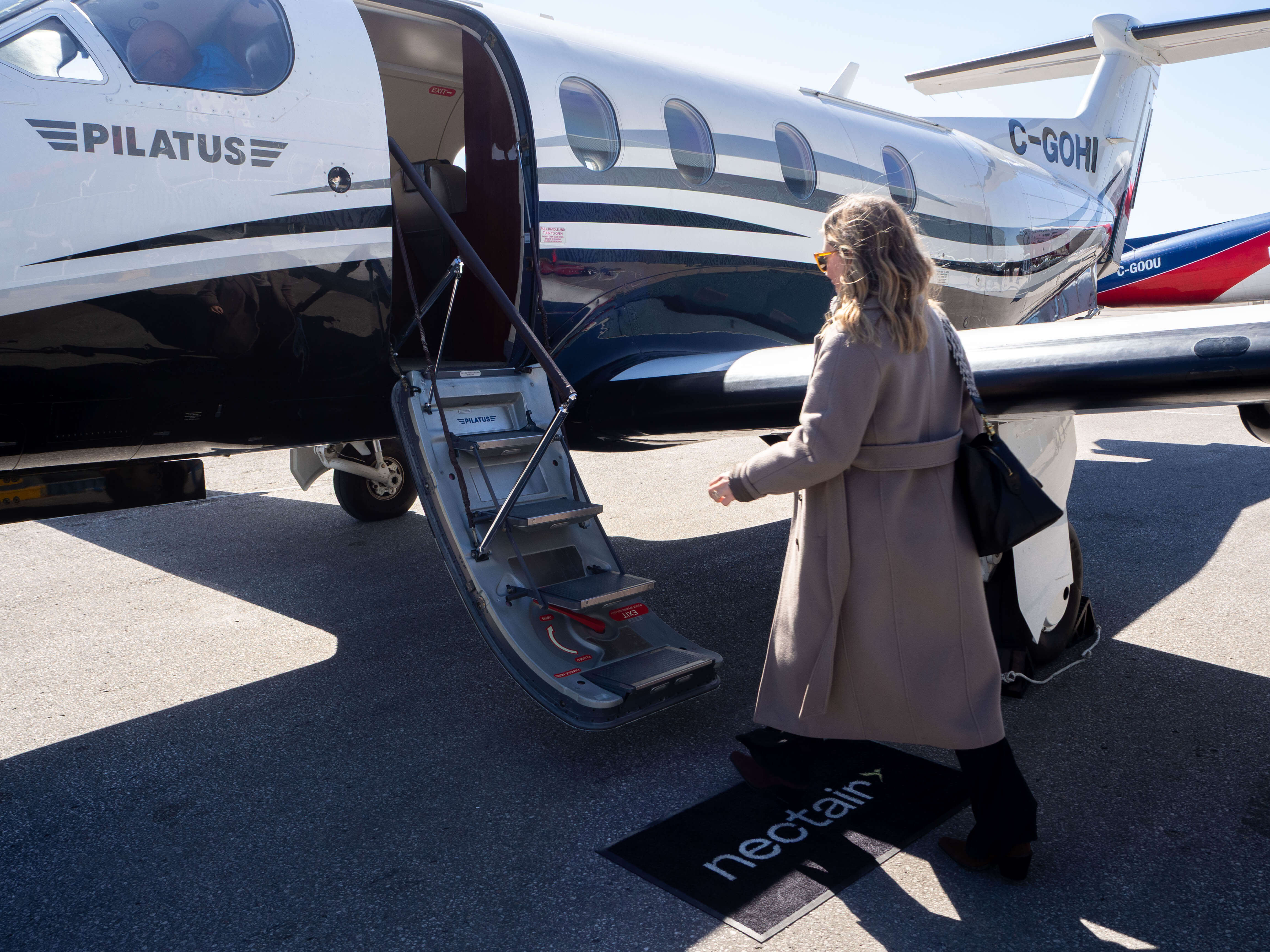
One concrete example came in June 2026: NectAir announced same-day return trips from Toronto to the EAA AirVenture gathering in Oshkosh. The plan used a Pilatus PC-12NG and required at least five booked seats for a flight to proceed. The attraction was straightforward: spend the day around aircraft, then sleep in your own bed.
There is a recurring constraint in these ventures: a customer’s saved time has to be supported by work elsewhere. A workshop must interpret an order. A flight needs an aircraft and crew. Removing visible effort from a purchase puts more responsibility on the business to coordinate the details. Davis’s career keeps returning to that responsibility.
It is a fitting next chapter for someone whose products have repeatedly asked customers to spend less time negotiating a system. The ambitions have changed in scale. The practical question remains recognizable. How much of the day belongs to the thing you want to do, and how much disappears into getting ready to do it?
Davis also describes weekend flights with friends to small airports, lunch at a nearby diner, then the return home. Pilots have a name for this excursion: the hundred-dollar hamburger. After decades of making transactions more efficient, he still leaves room for a journey whose purpose can comfortably fit between two halves of a bun.