Maura Smith has a useful way of explaining affiliate marketing to civilians. She begins with the safer phrase, marketing technology. If the listener is digitally fluent or unusually curious, she proceeds to the mechanics: a consumer encounters a recommendation on a publisher or partner site, follows it, and buys. At some point the listener may ask whether she is responsible for those advertisements that pop up all over the internet. She is not.
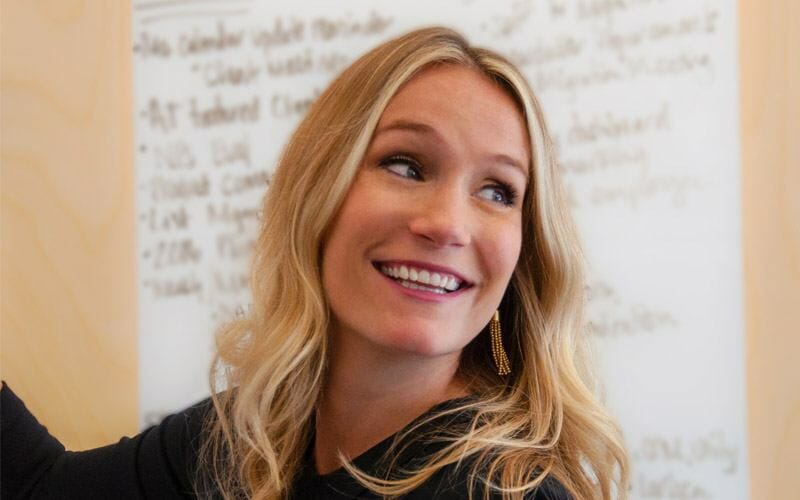
The misunderstanding is funny because it contains the problem that has occupied much of Smith's career. Affiliate marketing is close enough to the rest of digital advertising to be confused with it, yet separate enough to be misunderstood by the executives who decide where money goes. For almost 20 years, Smith has worked inside that gap. As CMO and SVP of Marketing at Partnerize, she now oversees the global brand, go-to-market messaging, demand generation, content, creative development, and marketing operations. Her larger job has been translation.
She translates a specialist trade into the language of enterprise growth. She translates relationships into data. She translates the invisible work of publishers into an argument for payment. And lately, as generative AI compresses research and recommendation into answers that may produce no referral click at all, she is trying to translate influence into economic proof.
The long apprenticeship
Smith came to Pepperjam after finishing her undergraduate studies and looking for a career in marketing. She had earned a business degree with a marketing concentration from the University of Delaware, and later completed an MBA in Marketing at the University of Scranton. A friend told her about the company. What followed was less a job than a long apprenticeship in how a category changes while you are standing inside it.
By 2020, she had spent 14 years at Pepperjam, moving through customer success, operations, marketing, and communications. Those early operating roles mattered. Smith describes her leadership style as leading from the trenches, and customer success gave her a close view of what modern marketers actually needed, rather than what a platform hoped they needed. She took pride in helping redefine the Pepperjam brand and set the tone for its story.
Then the corporate name changed around her. Partnerize acquired Pepperjam in 2020, joining a global partnership automation business with a Pennsylvania company whose roots reached back to the improbable commerce problem of selling jars of jam online. Smith continued into the combined organization and ultimately into its C-suite. Her tenure is a study in staying put without standing still.
The regional and the global coexist neatly in her story. Smith is based in the Kingston area of Northeastern Pennsylvania while leading marketing for a company with operations around the world. She has served on the Wilkes-Barre Chamber of Commerce board and, from 2020 through 2024, on the board of the Victims Resource Center. She also spent multiple terms on the Performance Marketing Association board and co-chaired an Interactive Advertising Bureau working group. The résumé moves from community institutions to industry infrastructure and back again.
“We can't fight over a fixed pie. We have to build a bigger table.”Maura Smith
Escape the echo chamber
Smith's central complaint about affiliate marketing is not that it lacks value. It is that the value remains too easy for outsiders to miss. A channel can produce revenue and still be treated as a tactical afterthought if its data lives in a separate network, its reports arrive as spreadsheets, and its experts spend most of their time talking to one another.
Her phrase for the social version of this problem is the echo chamber. Affiliate veterans know the vocabulary, the publishers, the economics, and the recurring objections. That fluency can become a wall. Smith argues that growth requires new participants, particularly senior brand marketers who control budgets but may retain old ideas about what affiliates do.
The scale comparison makes her impatience understandable. In a 2023 discussion, she set roughly $9 billion in United States affiliate ad spend beside $65 billion in paid social and $99 billion in paid search, using then-current industry estimates. The point was not to make affiliate look small. It was to show how much room remained if marketers could see partnerships as a complement to their expensive primary channels.
The budget room
The practical move is to put partnership data beside the rest of the company's marketing data, then appoint someone with enough standing to keep explaining it. Smith calls for an internal champion who can build consensus across functions and show senior leadership what the channel contributes. This is less glamorous than a rebrand and more consequential. A budget follows what an organization can understand.
She also wants marketers to widen the time horizon. Return on ad spend, cost per acquisition, and conversion rates answer useful questions about efficiency today. They do not reveal whether a partner introduced customers who return, spend more, or remain valuable. Smith asks teams to pair the short-term dashboard with longer-term customer value. The best partner may not merely close the sale. It may bring the customer who stays.
Find the signal
Put partnership data beside the rest of the marketing mix.
Build the bridge
Give an internal champion the evidence and authority to explain it.
Follow the customer
Measure repeat purchases, basket size, retention, and long-term value.
Influence without a receipt
Generative AI has made the measurement argument sharper. For two decades, the click served as digital media's receipt: a visible handoff from publisher to merchant, followed by attribution and payment. Answer engines can now absorb publisher content, shape a recommendation, and influence a purchase while producing no conventional referral at all. The customer arrives informed; the measurement system sees an orphaned conversion.
Smith's recent writing at Partnerize concentrates on this zero-click gap. The vocabulary has shifted from channel efficiency to economic truth. Who influenced the outcome? How can that contribution be verified? How should publishers be compensated when the machine consumes their work but the customer never follows their link?
Her answer is not to abandon measurement for vague brand sentiment. It is to improve the measurement. Smith has championed full-funnel attribution and Partnerize's work on connecting AI-surfaced content to commercial outcomes. Her neat formulation is that relationships build trust, while measurement creates scale. Trust without accounting remains fragile. Accounting without a faithful model rewards whatever happens to be easiest to count.
“Relationships build trust, but scale comes from measurement.”Maura Smith
This is the adult version of marketing's oldest temptation. The dashboard offers a number, and the number looks objective, so the organization mistakes visibility for importance. Smith keeps asking what happened outside the frame. Earlier in her career, that meant lapsed customers, wholesale partners, and conversions hidden in siloed reports. Now it means the publisher article summarized by an AI model before a customer buys. The technology changed. The habit of undercounting did not.
The list, the coffee, the chicken wrap
Smith's operating style is reassuringly free of executive incense. Every week begins with personal and professional to-do lists. She blocks time in her calendar not only for meetings and appointments but for ideation and organization. No day is typical, she has said, though coffee is a constant. She collects candid market feedback because it exposes blind spots. When she develops an idea, she works across verbal, written, and visual forms, aware that different people need different doors into the same thought.
She does not pretend to adore the blank slate. Give her a thought, a constraint, or a scrap of content and she can start turning it. It is a useful corrective to the mythology of effortless creativity. Smith's method is closer to editing reality than summoning lightning.
Her best miniature case study may be lunch. Smith's family owns Flaherty's Irish Pub in Kingston. She persuaded them to convert a Nashville hot chicken sandwich into a wrap, then helped build the restaurant's website and set up DoorDash and Grubhub. Product adaptation, digital presence, distribution: an entire go-to-market plan folded into a tortilla.
She has also confessed that she does not eat many sandwiches, prefers honey Dijon on a turkey club when she does, and believes airports should have gyms for stranded travelers. These details matter because careers can become too polished in summary. Smith's actual working philosophy is tactile. Make the list. Ask the customer. Change the format. Fix the distribution. Learn from the failure. Keep enough humor to propose a treadmill beside Gate B17.
Gateway, not gatekeeper
The same preference for practical action appears in Smith's advocacy for women. She has written about women paying opportunity forward after breaking the glass ceiling, served community organizations, and spoken about the invisible pressures that can accompany senior roles. Her advice to women entering leadership is disarmingly modest: seek trusted counsel and accept that no one has all the answers.
Recognition followed. She was selected as a Times Leader Distinctive Woman in 2020, named among the Northeastern Pennsylvania Business Journal's Top 25 Women in Business in 2022, and included in Affilifest's Top Women in Affiliate list in 2026. She treated the latest honor as validation for restructuring the category, then returned attention to what comes next.
Her clearest line about leadership is also an instruction: “Influence only matters if you spend it.” Smith describes spending it by bringing women into strategic forums, co-authorship projects, and leadership platforms. The image she prefers is a gateway, not a gatekeeper. It matches her professional campaign. In both cases, valuable contribution is already present. The task is to make sure the system notices, credits, and extends it.
That is why the disappearance of the click suits Smith's story so well. Her career has unfolded around evidence that institutions overlook because it arrives in the wrong format. Customer success taught her to listen below the dashboard. Operations taught her where systems break. Marketing gave her the language to carry those lessons upward. AI has now turned a specialist's complaint into a broad commercial question.
A click was convenient. Influence is complicated. Smith seems perfectly content with complicated, provided someone makes a list.