There is a moment in every marketing meeting when a reassuring number stops being reassuring. A link has been clicked. Perhaps thousands of times. Someone asks how many of those people became customers. The room discovers that a click is a beginning with an unusually good publicist. Dub has built its business around what happens next.
- Make it yours: branded links and QR codes for campaigns.
- Follow the money: connect clicks to signups and purchases.
- Pay the people: run affiliate rewards and payouts in the same system.
The first problem was a preview
In 2022, Steven Tey was solving an internal problem at Vercel: sharing links on social platforms with better Open Graph images. The preview card, that small rectangle under a post, was the starting point. Dub began as an open-source side project with analytics and custom domains. A link could look like the company sending it, rather than an anonymous forwarding address.
Tey’s account of the following year is unusually spare: growth came mostly through word of mouth, without paid marketing spending. In January 2024 he announced a company around the project. The ambition had expanded from presentation to attribution. Behind the attractive preview lay a question about whether the work of sharing things was producing anything worth paying for.

Clicks grow up
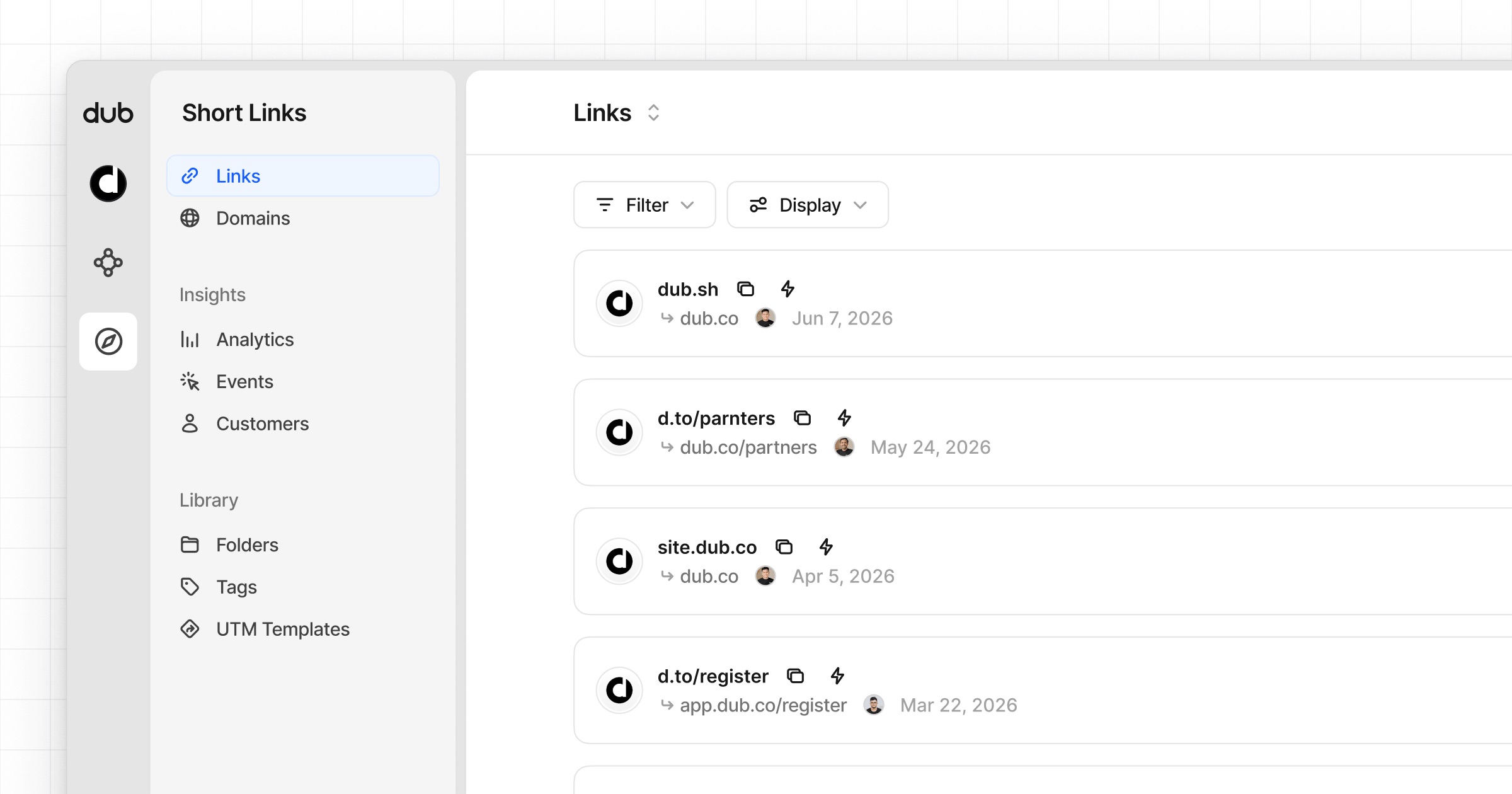
Dub now sells two connected products. Dub Links handles short URLs, custom domains, QR codes and link management. Dub Partners handles affiliate and referral programs: who gets rewarded, for which action, and how the money reaches them. Conversion analytics supplies the connective tissue. A marketer can follow a campaign beyond the initial visit to a signup or sale.
The machinery became more explicit with the January 2025 launch of Dub Conversions. Its model has three events: click, lead, sale. A QR scan can be the click; a mailing-list signup can be the lead; a paid subscription can be the sale. Integrations with payment and authentication tools, including Stripe, Shopify, Clerk and Supabase, help teams record the later steps.
Dub Partners → apply the reward → pay the partner
That puts Dub between two familiar software purchases. Bitly, Rebrandly and Short.io are alternatives for managing links. Rewardful, FirstPromoter, Tolt and PartnerStack are alternatives for running affiliates. Dub’s proposition is to keep the link, the measurement and the reward together. Its APIs also let developers put those functions inside another product, where customers already spend their time.
The public GitHub repository adds another route in. Developers can inspect the software instead of treating every operation as a sealed service. That fits a company whose customers may want their own screens and workflows. Running software yourself, however, means taking responsibility for its operation. The hosted subscription buys a managed service; access to code does not eliminate the work behind one.
The spreadsheet was the warning
The practical case becomes clearer at Tella, the screen-recording company. Dub’s published case study describes problems with Tella’s previous Rewardful setup: duplicate lead and sale events that sometimes double-paid affiliates, more than 40 hours a month spent processing payouts and troubleshooting PayPal, and a separate account requirement for referral partners. These are mundane failures. They are also expensive ones.
Tella moved to server-side attribution, built-in payouts and a referral dashboard embedded in its application. Users could get a referral link within the product. The case study reports 300-plus active partners, a 38% increase in partner-driven revenue over two months and twice as many affiliates onboarded. Those are customer results reported by Dub, rather than a controlled comparison. The useful detail is the workflow that changed.
“Integrating with Dub was effortless”Michiel Westerbeek, Tella co-founder
Framer illustrates the same idea at a different scale. Its Dub case study describes an earlier split between FirstPromoter for tracking and Contra for payouts. Framer wanted referral tools inside its Creator Dashboard. Dub’s links, analytics and partner APIs made that possible; event webhooks also helped inform template rankings. The company reports managing more than 9,000 active partners and roughly $900,000 in monthly payouts through Dub.
Do the small calculation
The entry point is inexpensive. Dub Links has a free plan with 25 new links and 1,000 tracked events per month, plus three custom domains. Links Pro lists at $30 a month. But a team buying conversion tracking or an affiliate program is buying more than a shortener. Partners Business lists at $90 monthly; Advanced at $300. Enterprise pricing is negotiated.
There is also a payout fee: the published comparison lists 5% for Business and Advanced, and 3% for Enterprise. Business includes up to $2,500 in monthly partner payouts; Advanced includes $15,000. As an illustration, $2,000 of commissions on Business adds a $100 listed payout fee to the $90 subscription. The commissions themselves remain a separate expense. Funding methods and withdrawals may add costs, so the subscription headline is only the beginning of the calculation.
A link still needs a business
There is a sensible way to copy the method. Choose the action that matters before choosing the reward. Give campaigns distinct links. Test a real journey through signup and purchase. Then show partners enough information to improve their work. A popular post and a profitable recommendation can look identical until the sale event arrives.
There are limits. Conversion tracking requires integration with the systems that record leads and sales. An unconnected short link cannot report a purchase it never sees. Attribution assigns credit under configured rules; it does not, by itself, prove that a sale would never have happened otherwise. A business with little referral demand still needs people willing to recommend it.

Dub describes a culture of ownership, security and frequent shipping. Its published values give employees room to make decisions without redundant meetings. That is the company’s stated operating approach, rather than a verdict on daily life there. The fully remote team keeps widening the product. March 2026 brought USDC payouts; May brought an MCP server for agents to work with partner applications and commissions. October’s changelog added applications to switch partner groups. Each addition reaches further into the administration behind a recommendation. The enduring idea is modest enough to be useful: when someone sends a customer your way, the link should help both of you understand what happened.