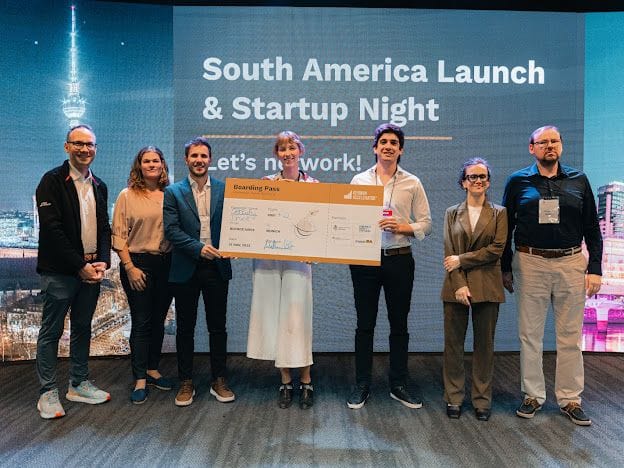
There is an oversized boarding pass in the photograph. Matthias Notz stands at the left of a group in Buenos Aires, smiling beside founders and fellow judges. Behind them, the screen announces a South America launch and startup night. International expansion, an activity normally expressed in arrows on a presentation, has acquired a rather literal prop.
The occasion was German Accelerator’s November 2023 launch in Argentina. Local startups pitched for the chance to spend a week in Germany. Drixit and Sensify won. German startups were there too, looking for partners in the other direction. Notz thanked the team, mentors, public officials and founders. The important unit of achievement, in his telling, was the group.
That photograph is a useful way into his career. Notz is co-founder and Global CEO of Start2 Group and managing director of German Accelerator. His working subject is the distance between having something promising and knowing the people who can help it travel. A boarding pass gets you onto a plane. The rest requires rather more introductions.
The money behind the meeting
Notz’s route into this work began at Ludwig Maximilian University of Munich. He studied business administration from 1997 to 2002, then worked as a research assistant and lecturer. His academic interests included the systems used to manage universities. He also completed the university’s Master of Business Research program.
Those are useful beginnings for someone who would spend years moving between academic institutions and commercial ambitions. Universities produce knowledge; turning that knowledge into a company involves a different set of obligations. Someone must arrange support, persuade partners and keep the institution involved after the enthusiastic opening speech.
By 2008, Notz was working in development at the LMU Entrepreneurship Center. In December 2009 he appeared at an alumni-management conference as its head of development. The questions at that gathering concerned lasting relationships: how universities could connect alumni work with institutional leadership and make it part of their operations.
Fundraising is an education in other people’s motives. A good project still needs someone willing to support it. At the LMU center, Notz spent more than a decade responsible for entrepreneurial financing. The same questions returned at a 2025 HOCHSPRUNG workshop he led: how to attract backers, build sponsorship and distinguish it from philanthropy. Startup support needs its own means of support. Even the people helping founders must occasionally pass the hat.
From university research to international markets
- 1997-2002Business administration at LMU Munich
- 2008Development work at the LMU Entrepreneurship Center
- 2013CEO of German Entrepreneurship
- 2024German Entrepreneurship takes the Start2 Group name
- 2026Rise & Scale brings European hub leaders together
What he brought home from California
Around 2013, a first visit to Silicon Valley changed the scale of Notz’s thinking. He later described understanding what the instruction to think big meant both for German startups and for himself. This was a personal shift, remembered a decade later while he was teaching in Lower Bavaria.
By then, he had helped build German Entrepreneurship from 2013 onward. He also held a part-time professorship at Deggendorf Institute of Technology, teaching “Ecosystem of Scale” at its Bavarian Innovation Transformation Center in Oberschneiding. His teaching and company work could feed each other: practical experience supplied the classroom, while the classroom asked him to explain what experience had taught.
His motto, “Mission possible!”, is cheerful enough to belong on a conference badge. His teaching principle is more revealing. “Nicht der Vortrag vor Studierenden steht im Vordergrund, sondern der ‘Wegtrag’.” The German wordplay shifts attention from delivering a lecture to what students carry away.
It is a demanding standard. An audience can enjoy a talk and leave with nothing it can use. For Notz, the useful question begins at the classroom door: what goes home with the student? That attention to the recipient also helps explain why his work keeps returning to mentoring.
“Mission possible!”
Matthias Notz’s personal motto
An introduction with a job to do
Consider the partnership between German Entrepreneurship and RWTH Innovation in Aachen. Notz signed the agreement alongside Malte Brettel, RWTH’s vice-rector for industry and business relations and a managing director of RWTH Innovation. Its design connected research expertise with experience in helping companies grow internationally.
The proposed work was specific: joint programs for young companies, participation in the RWTH Incubation Program and an international network of business and research specialists. Founders would gain access to experienced entrepreneurs, scientists and industry experts. Each connection had a reason to exist beyond appearing on a partner slide.
The distinction matters for understanding Notz’s place in startup life. His work concerns the arrangements around founders: who can offer technical judgment, who understands a market and which institution can make that expertise accessible. The promise of a network lies in what its members can actually do for one another.
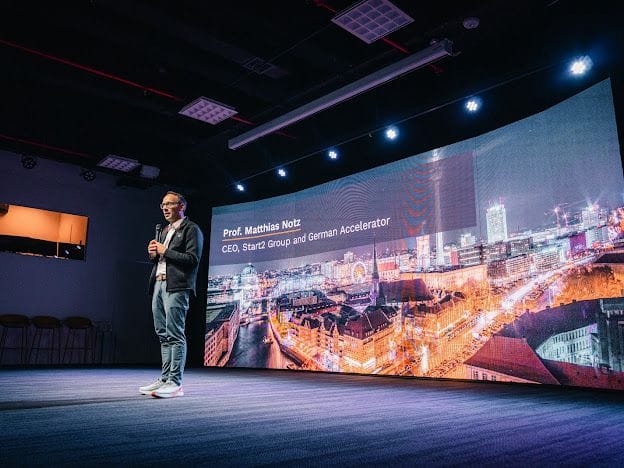
The university connection has remained visible in his public conversations. In a 42-minute episode of 360 Founders Talk, released in September 2024 and hosted by Theresa Köck, he discussed networks and international connections. When sharing the interview, he described networking as the work he most enjoyed. He highlighted collaboration among universities, startups and regional hubs. This was a recognizable continuation of the development work he had begun in Munich.
Success should come back around
Notz’s view of growth includes a return journey. In an interview about German scale-ups, he argued that successful founders help the next group by becoming mentors and investors. Experience and capital can circulate. A company’s success can therefore leave something useful behind for people who were never on its payroll.
His diagnosis also drew a distinction between helping companies start and helping them grow. The latter requires experienced managers, appropriate financing advice and access to capital for later rounds. He saw particular opportunity in business-to-business companies and called for startups to receive greater consideration in public procurement.
These are institutional questions with very personal consequences for a founder. A new management appointment changes who makes decisions. A later funding round introduces unfamiliar negotiations. Finding a first buyer asks something different of a team than developing a product. Treating each stage as an extension of the previous one misses what has changed.
Notz also participates in Scale-up.NRW, where he is listed as deputy program director and CEO. Start2 and digihub Düsseldorf/Rheinland implement the program together. Its remit includes international expansion, management-team growth and organizational change. Here his argument about the needs of growing companies becomes a set of practical responsibilities. Geography remains local enough to know the firms, while the intended market reaches beyond the region.
How Notz describes a network renewing itself
The next group of founders gains from the last group’s experience. Conceptual diagram, not a measured growth model.
A different direction on the departure board
Start2’s institutional journey has widened the map around him. The organization began in Munich in 2008 as German Entrepreneurship, supporting early startups associated with LMU. Its history records a government-backed initiative and US market access in 2011, followed by a Singapore office in 2017. The Start2 Group brand arrived in 2024, as its work extended across more regions.
Notz has urged German founders to consider Latin America alongside the more familiar US and Asian destinations. In a June 2025 essay, he described a Buenos Aires hub opened in 2023 and a second in São Paulo by the end of 2024. More than 50 German startups had explored the region through the organization’s programs, he wrote.
He offered a useful qualification to his own invitation. Entering a new market takes time, local understanding, cultural empathy and execution. He described three visits to the region and emphasized listening to people already building there. His enthusiasm rested partly on what German founders might learn from them.
That makes internationalization a two-way exchange. A founder arrives with a product and assumptions about how it should be sold. The new market supplies its own expectations. Being introduced to people who understand those expectations creates the possibility of changing course before a team commits too much to its original plan. In Notz’s account, curiosity belongs beside ambition.
Now connect the connectors
By 2026, Notz was applying the same logic to the organizations that support startups. Start2’s Rise & Scale workshop at Deep Tech Momentum in Berlin was scheduled for May 21. Its audience included innovation hubs, investors, public-sector participants and corporate leaders. The people who normally make introductions were being invited to meet one another.
The program’s interests reached beyond exchanging business cards. It addressed shared European programs, industry networks and how startup hubs could develop sustainable income through equity, infrastructure, consulting and corporate partnerships. The old fundraising question had returned with a larger map: how do you pay for useful support long enough for it to matter?
There is a pleasing circularity here. Early in his career, Notz worked on the backing that a university entrepreneurship center needed. Later, he helped connect founders to international expertise. Now the agenda includes connecting the institutions that perform that work, and discussing how they sustain themselves.
His public diary also has room for smaller-scale meetings. A private Slush dinner planned for November 2026 in Helsinki lists him as host, with around 20 invited guests and no stage or formal agenda. The same executive who addresses startup gatherings is making room for a conversation over dinner. An ecosystem has to fit around a table occasionally.
Across these settings, the person remains recognizable: a teacher interested in what people take away, a fundraiser attentive to backing and a CEO working across borders. The ambition is substantial. The acts that serve it are often modest: asking a question, arranging a meeting, listening carefully, making an introduction. Notz has made a career of taking those acts seriously. The oversized boarding pass is the amusing part. Getting people somewhere useful is the work.