Kauana Yrina went looking for forty professionals to help people start businesses. She found fifty. For a project built around sharing experience, this was a promising numerical inconvenience: more people willing to give advice than she had initially planned to recruit. The useful introduction was already proving a useful idea.
The project was Jovem Empresário, developed with Daiane Pereira in Curitiba. Experienced businesspeople would help newcomers work through the decisions that separate an attractive idea from an operating company. Years later, Yrina would become known as the CEO of Condor Connect, an accelerator with an unusually practical address: a supermarket. Between those two settings lies the story of someone whose work depends on getting people into the same conversation.
Forty invitations, fifty answers
At the launch of Projeto Jovem Empresário, Yrina was identified as Kauana Vissotto, director of Melhore Consultoria & Marketing. The gathering took place at Restaurante Mediterrâneo in Curitiba’s Shopping Crystal. Centro Europeu was a co-organizer, supplying the educational support for a program intended to help forty businesses, startups and innovative ideas over a year.
The arrangements went beyond matching names on a list. Participating businesses included Grupo Babilônia and Saint Germain Confeitaria e Panificadora. They would give entrepreneurs practical contact with customers, suppliers and the media. There was even a proposed book collecting the experiences. The design treated other people’s mistakes as something with a second use.
Yrina’s recruitment anecdote captures the scale: she wanted forty professional partners and already had fifty. The appeal was local and concrete. Someone starting out could speak to someone who had already dealt with the unfamiliar problem in front of them. An established entrepreneur could make accumulated experience available to a new business.
“Meu desafio inicial era conseguir parceria com 40 profissionais e já tenho 50.”
Kauana Yrina, at the Projeto Jovem Empresário launchHer initial target was 40 professional partners. She already had 50.
A working education in business
Yrina brought an operating background to that effort. Her earlier roles included financial analysis at HSBC, coordinating market logistics and marketing for Editora Abril in Curitiba, its metropolitan area and the coast, and reader-market coordination at Grupo RIC. Her education included business administration at UniCuritiba and a marketing specialization at FAE Business School.
Those jobs placed her around the less decorative parts of commerce: money, distribution and the work of reaching an audience. Her teaching also included financial education through the Federal University of Paraná, or UFPR. By 2017, she had coauthored Abrindo o Próprio Negócio - Minibook with Heitor Côrtes Netto. Published that June, the book came in at 114 pages.
Its contents move through familiar entrepreneurial decisions: planning finances, choosing partners, understanding costs, assembling a sales team and managing stock. A business dream gets a fairly brisk appointment with the accounts. The book belongs to the same practical territory as the mentorship project: helping someone think through the obligations that arrive with independence.
The introductions acquire an address
By April 2018, Projeto Jovem Empresário described a yearlong mentoring program in which more than fifty businesspeople supported forty early-stage ideas. A wider community allowed members to share what they had learned. In May, a collective mentoring session brought participants to Grupo Barigui’s Ford Center, hosted by businessman Ângelo Zagonel.
In January 2019, another visit took participants to Fomento Paraná. There they learned about the state development institution’s financing model, credit lines and partners supporting smaller businesses. The sequence is revealing. The network introduced entrepreneurs to advice, operating businesses and the institutions through which money might become available.
Then came Condor Connect. Opened on July 30, 2019, at Condor Pinheirinho in Curitiba, it joined the Condor supermarket business with Projeto Jovem Empresário. Universities, research laboratories, companies and entrepreneurs were invited into an effort to improve retail processes, efficiency and productivity. Yrina was the project originator, responsible for startup development, mentoring and communication with the retail business.
Condor founder Pedro Joanir Zonta had seen Brazilian entrepreneurs building abroad and wanted opportunities closer to home. Yrina’s part was to help connect new businesses with corporate needs. A supermarket supplied a setting where an idea could encounter the demands of an existing operation. It also supplied people who could say whether the proposed improvement was useful.
and an entrepreneurship network
at Condor Pinheirinho
with advertising students
The pitch meets the purchase order
The accelerator’s early activity soon produced something more specific than a launch announcement. During 2019, Condor Connect heard more than two hundred pitches and selected twenty-two startups with potential for retail acceleration. Seven projects begun that year were already serving different areas when the next selection round was announced.
The examples included Eye Vision’s trade campaign for Nestlé, online-commerce projects involving meucompras.com and Self Sale, and a customer relationship club from Ciklus. Partnerships with colleges and universities encouraged final-year projects directed toward innovation and startups. The work linked the educational end of the pipeline to commercial applications.
By June 2024, more than forty companies had passed through the accelerator and six had received investment. Its search extended to businesses that could serve Grupo Zonta’s suppliers as well as the group itself. Applicants needed a validated minimum viable product. Condor Connect helped develop proofs of concept and test ideas in practice.
That wider supplier network gave Yrina’s work another set of possible introductions. A solution could be relevant somewhere in the commercial relationships surrounding the retailer. The founder’s task was to establish where it belonged. Mentoring, preparation for investors and corporate testing offered different ways of examining that question.
- 01Validated productA startup arrives with an MVP.
- 02Practical testingA proof of concept meets an operating need.
- 03A possible marketThe group and its suppliers offer potential connections.
A microphone, then a theatre
Yrina’s public work developed alongside the accelerator. In 2021, she presented InovaRIC, a series of live conversations about entrepreneurship and innovation. The format used different themes and invited guests to make them accessible to a wider audience. It brought the conversation out of the mentoring session and onto a screen.
One discussion featured Dennis Nakamura and the professional skills that help people work in innovation. Another scheduled conversation, with lawyer Rhodrigo Deda, examined legal technology. Those subjects show the breadth of the role: she could move between what a company might build and what people needed to understand to operate in a changing business environment.
In October 2024, Condor Connect’s fifth anniversary brought a more theatrical setting. Yrina and Charmoniks Heuer, Condor’s human resources manager, conceived Inovação Humana: Transformando o Futuro at Teatro Regina Vogue. The event combined talks with music and theatrical scenes about artificial intelligence. An accelerator birthday had acquired stage directions.
Olympic volleyball medalist Tande spoke about leadership and performance. Yrina addressed AI’s effect on the corporate world. The event placed technological change beside the work of developing people and leading teams. It was a larger room for a concern already present in the mentoring project: how someone learns to make useful decisions when the conditions around them change.
Back to the classroom
The university keeps reappearing in Yrina’s working life. UFPR’s 2019 science, culture and innovation festival listed her as the facilitator of a startup workshop, using the name Kauana Vissotto. Academic extension work also connects her with entrepreneurship education beyond the accelerator’s immediate corporate setting.
In May 2025, she met seventh-semester advertising students at UniBrasil. The discussion covered startups, acceleration and the possibilities of entrepreneurship. Students asked questions and shared their views. Yrina emphasized collaboration between fields such as advertising and marketing, and the part a new generation could play in encouraging innovation.
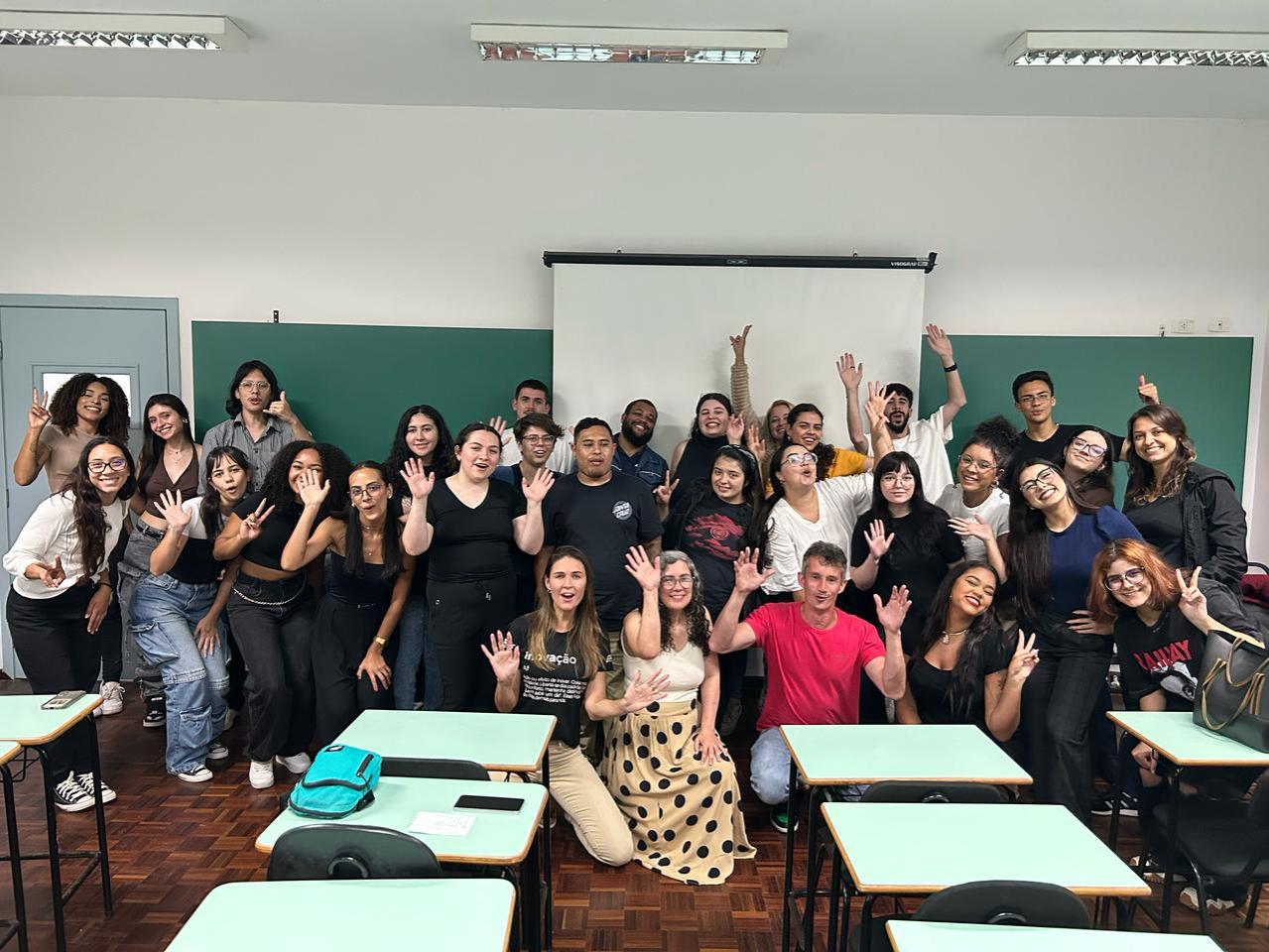
“O papel das novas gerações é fomentar a inovação,” she told the students: the role of new generations is to encourage innovation. In that room, entrepreneurship crossed into a degree concerned with audiences, communication and markets. Those are subjects with a direct bearing on whether anyone understands what a new business is offering.
UFPR extension proceedings also list Yrina among the authors of work on the Laboratório de Inovação em Educação Empreendedora. A later abstract describes twelve innovation-management course cohorts between 2021 and 2024, reaching participants in twenty-six Brazilian states and seven countries. Those are results of a collaborative educational program, a broader setting for her work with founders and leaders.
The question before the next tool
Her more recent public work includes speaking about applied AI and digital awareness, alongside her HojePR column. Her speaker biography also lists books, consulting and the podcast Quebrando a Cuca. The subject matter has expanded, while the practical problem of helping people use knowledge remains close at hand.
Her 2026 column titles repeatedly return to learning and execution. In August, she asked readers to consider what they were doing with what they already knew. In September, she posed a question about whether a company needed more technology or a better problem. It is a useful question for someone working where new tools meet established businesses.
Read across her career, it also brings the story back to the original introductions. A mentor needs to understand the difficulty before offering advice. A startup needs to understand a customer before proposing a solution. A leader considering AI has decisions to make before choosing a tool. Yrina’s work has repeatedly placed people at those junctions.
The early arithmetic remains a pleasing place to leave her: forty professionals sought, fifty willing to help. An idea about shared experience had found more participants than expected. There would still be products to test, businesses to build and difficult decisions to make. At least someone had arranged for the right people to meet.