The website was working. That was the trouble. At Canal+, Nacho de Pinedo had helped turn a web presence into a way of selling subscriptions. When he wanted to expand the operation, he ran into a problem that a larger recruitment budget could not easily solve: finding people who understood the whole digital business.
He could see the connections between attracting an audience, converting visitors into customers and managing the relationship afterwards. He needed colleagues who could see them too. The missing hire became a question about education. If companies needed this combination of skills, who was teaching it?
By 2009, de Pinedo and his fellow founders had begun answering with ISDI and its Master in Internet Business. The television executive was becoming an education entrepreneur. It was a substantial career turn, prompted by a remarkably ordinary management frustration. Many businesses complain about the candidates. He helped build somewhere to teach them.
A television career, interrupted on purpose
De Pinedo had learned business inside established organisations. His early career at Procter & Gamble involved marketing and sales. At Sogecable, his responsibilities extended across Canal+ and Digital+, including marketing, customers and pay-television strategy. He had worked on the commercial combination of Canal Satélite Digital and Vía Digital and the launch of the resulting Digital+ brand.
These were assignments involving existing customers, recognisable brands and complicated transitions. The work offered an education in how organisations change while continuing to trade. Customers do not suspend their expectations just because an executive team has decided to reorganise.
His departure was announced in April 2010. ISDI already existed, and he belonged to its founding team. Now he was leaving Sogecable to become its CEO. The first MIB cohort had started in the 2009/2010 academic year. He was stepping into an experiment that had already admitted its students.
He has described a more personal calculation behind entrepreneurship: wanting greater control over the direction of his working life. The corporate career was going well, yet he could imagine its limits. In his account, ambition included being able to choose the next professional challenge, even when that choice involved giving things up.
A company for homework
The business school grew around people whose knowledge came from doing the work. Javier Rodríguez Zapatero brought experience from Google. Víctor Molero brought academic expertise. De Pinedo’s own background was commercial. Their different experiences mattered to a project intended to connect subjects that employers needed to use together.
The current ISDI methodology still makes that connection explicit. Students work on a central real project, with sprints, deliverables and practical problems. They prototype, test and try again. The school also places generative AI within its teaching through an AI Hub, alongside critical thinking and judgement.
The attraction of this arrangement is easy to understand. A real project has a habit of spoiling a tidy answer. The customer wants something slightly different. The data answers only half the question. A decision in one part of the business creates work in another. An assignment becomes useful precisely where it becomes awkward.
“La transformación siempre ha sido más difícil que la creación.”
Nacho de Pinedo, 2019
“Transformation has always been harder than creation.”
De Pinedo once compared the experience to Ender’s Game: students gradually discover how real their task is. The reference gives a glimpse of his teaching temperament. He likes the moment when an abstract lesson acquires consequences. The classroom has a door leading directly into someone else’s business.
That door also led towards entrepreneurship. As students developed ventures, the activity around the school widened into mentoring, investment and acceleration. IMPACT became part of this broader undertaking. Learning could lead to a company, and a company could need help beyond the final presentation. The institution’s work followed that sequence.

His November 2021 conversation on Hablando con líderes gives the range of questions this creates. The discussion moves from ISDI’s beginnings to accelerator models, continuing education, the changing stages of a founder’s job and retaining talent. Education sits among the other problems of running a business, rather than floating above them.
One school becomes a group
In September 2020, ISDI’s founders and Magnum joined forces to develop a larger educational project. DIGITALENT’s subsequent history includes Skylab Coders in December 2020, ISDE in February 2021, ESERP in May, IEBS in October and DIGITECH in January 2022. Formadores IT joined in August 2025.
The list matters because it describes an expansion beyond one kind of classroom. Business education, law, coding, vocational training and online learning bring different students and professional requirements into the same group. De Pinedo became responsible for an enterprise whose educational reach extended beyond the original master’s programme.
There is a practical management problem inside that growth. Institutions need their own expertise and identities, while a group needs reasons for bringing them together. DIGITALENT describes shared academic, digital and market resources as part of its approach. The organisational task is to make those connections useful in the learning itself.
De Pinedo’s public biographies now place several roles alongside the chief executive title: entrepreneur, angel investor, mentor and independent board member. His education includes ICADE and a doctorate in digital marketing at the Complutense University of Madrid, as well as executive programmes at IESE and Harvard. His professional life has kept him on both sides of the classroom.
In a 2022 interview, he located many obstacles to digitalisation in the habits and assumptions of business owners. He described unfamiliarity with technology and the inertia of established routines as barriers. It is a useful detail in understanding his choice of profession. If the difficulty includes how people think about their work, teaching has a role that installing new software cannot complete. Someone has to make space for questions that a busy organisation might prefer to postpone.
The optimist has homework too
He calls himself a digital optimist. The phrase has survived enough technological fashions to become a recognisable part of his public identity. In a June 2026 essay, he described technological disruption as an invitation to play, discover and experiment. His account leaves room for trial and error, with curiosity doing much of the work.
There is humour in the smaller details. His ISDI CRM biography describes a family with three children and two dogs, then announces a preference for boxing with a joke about why anyone would run when fighting is an option. An executive biography can usually be relied upon to name several committees. This one gives the dogs a place too.
He also has a technology enthusiast’s pleasure in meeting the people behind the machines. In a 2024 podcast conversation, he spoke about having met Steve Wozniak. The encounter fits a public persona that is interested in the people who make things, as well as the companies and institutions built around them.
Some of those connections have a different purpose. In March 2025, UNICEF Spain recognised ISDI’s collaboration through its foundation and IMPACT Accelerator at the Futur&ia event in Madrid. The relationship had included seven acceleration cohorts since 2014. It put the school’s entrepreneurial methods to work in projects concerned with children.
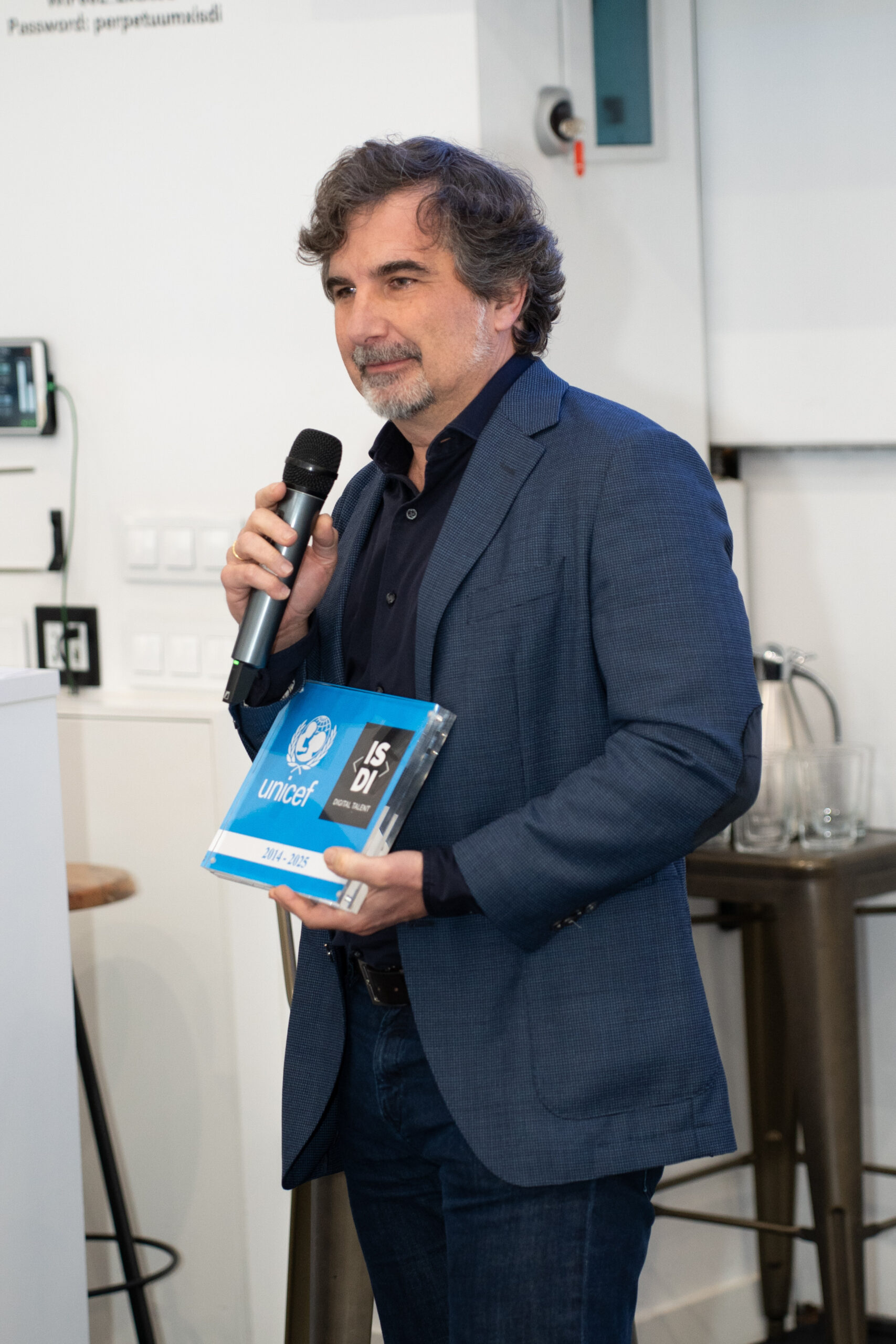
Asked what he wanted to leave behind, de Pinedo spoke about helping people navigate the digital transition. His personal wish was more modest in language: to be remembered as a good person, empathetic and consistent. It is an ambition with fewer convenient metrics than an acquisition programme.
His involvement also extends to the wider digital economy. Adigital listed him as its vice-president and the presenter of its sixth Digital Economy Report in May 2026. The programme brought together a national economic measure and discussions about competitiveness, regulation and AI. It placed him in another kind of classroom: an industry gathering where employers and public institutions were considering the conditions in which digital businesses operate. The practical questions had grown in scale since the Canal+ website.
The next vacancy has AI in the description
By 2026, the professional skills question had acquired another urgency. DIGITALENT launched its Digital Talent Observatory, with de Pinedo directing the initiative. Its programme combined conversations with business leaders, a national talent barometer and an annual summit. The proposed interview subjects included executives from Microsoft, LinkedIn, Telefónica, L’Oréal and other employers.
At the September Digital Talent Summit, he presented the first barometer. Reporting published later that month highlighted a mismatch: 77.8% of companies reported medium, high or very high AI adoption, while 79.2% described employee preparation as uneven or insufficient. These are separate survey measures, rather than opposing portions of one total.
The tools are arriving.
The learning is uneven.
His argument about adoption focuses on what happens inside the organisation. Early adopters can help colleagues identify uses and build confidence. Training can start with situations the company actually encounters. A shared base of capability matters if the technology is to become part of ordinary professional work.
He has also questioned a narrow emphasis on cost reduction, arguing for attention to new customers, services and business value. That gives the learning a destination. The point of a course becomes clearer when people can connect it with something useful they are trying to accomplish together.
His interest in AI includes the possibility of freeing time for ideas, further learning and family. There is a familiar human wish beneath the professional vocabulary: to spend less time on tasks that consume attention and more on the activities one would choose.
The question that helped start ISDI remains recognisable. What happens when a business needs capabilities its people have not yet had the chance to learn? De Pinedo has built much of his working life around answering it. The vacancy changes. The classroom stays busy.