Consider a shipment too small to fill a container, bound for Alaska. It needs company for the voyage, somewhere to be sorted, and someone who knows what happens after the dock. The container is the easy thing to picture. The sequence of decisions is harder. In August 2016, Matson Logistics paid $197.6 million for Span Alaska, a business organized around precisely that sequence. An apparently modest problem had acquired a rather substantial price.
- Matson Logistics connects rail, trucks, warehouses, and international supply chains.
- Span Alaska turns smaller shipments into consolidated freight headed north.
- More freight revenue does not automatically mean a fatter margin.
The small load worth $197.6 million
Matson Logistics began in 1987 as Matson Intermodal System, arranging rail and truck transportation across North America. Its parent’s ocean business needed inland connections. By 2003, the name had become Matson Integrated Logistics; in 2011, it became Matson Logistics. The changing names reflected a growing collection of jobs: freight brokerage, forwarding, storage, distribution, and supply chain management. A voyage increasingly came with a sequel.
Span Alaska made that sequel tangible. At the time of the acquisition announcement, it was already Matson’s largest northbound freight customer. The deal presentation described a customer relationship with Horizon and Matson stretching back more than 30 years. Matson was buying a business it could observe through freight already moving across its network. Familiarity, in this case, had commercial advantages.
Span consolidated freight in Auburn, Washington, for shipment to Alaska, then distributed it through a network of terminals. Less-than-container-load freight lets multiple customers share capacity rather than each finding enough cargo to fill a box. The acquisition joined that aggregation and distribution work to Matson’s existing Alaska transportation presence. The logic was continuity: more of the journey under related management.
The price was $197.6 million in cash, on a debt- and cash-free basis. Matson announced plans to use its revolving credit facility and a commitment for $200 million of 15-year senior unsecured notes at 3.14%. This was a corporate acquisition financed through the parent, with expected earnings benefits. Those numbers describe the deal, however; a shipper’s invoice depends on its own cargo and route.
The cash price of adding consolidation and Alaska forwarding to the logistics business.
A warehouse is a place where the plan changes
The company’s customers include importers, exporters, manufacturers, retailers, and ecommerce businesses. Its published service descriptions mention electronics, specialty foods, premium beverages, household goods, and agricultural exports. These products have different demands, but share an awkward characteristic: arriving in a container does not necessarily make them ready for the customer.
A retailer might need a club-store pallet display. An ecommerce seller might need individual orders picked and packed. An importer might need labels changed or several items bundled together. Matson Logistics offers those jobs alongside transportation. It can assemble gift boxes, apply barcode labels, repackage merchandise, and handle returns. The freight company may be the last pair of hands to dress the product before its public appearance.
Location gives that work its usefulness. Matson advertises 1.1 million square feet of warehousing about 20 minutes from the Port of Savannah, and nearly 600,000 square feet about 15 minutes from the Port of Oakland. Nearby transloading can help turn containers back toward the port sooner, reducing exposure to demurrage. Storage, packaging, and the next inland move can happen without another distant detour.
The human details matter too. Its value-added services page emphasizes permanent, long-term workers and managers with 10 to 12 years overseeing projects. That is a company description, not an independent workplace audit. Still, it identifies the expertise being sold: people who can reconcile warehouse instructions, retail requirements, and a deadline. Software tracks the inventory; somebody must make the right display.
- 01 Port arrival
- 02 Transload + prepare
- 03 Rail or truck
- 04 Store or doorstep
The margin is in the choreography
Matson Logistics occupies the space between a carrier and a shipper’s complete operating problem. Its brokerage business arranges transport using outside capacity; its warehouses and forwarding services add other revenue streams. BNSF lists it as a provider with coast-to-coast and cross-border coverage, offering door-to-door and ramp-to-ramp service. Customers can buy different portions of the journey.
There are alternatives. BNSF’s directory also lists J.B. Hunt, Odyssey Logistics, and IMC with overlapping services. Matson’s combination of port warehouses, international supply chain work, and Alaska forwarding provides a particular configuration to compare. A buyer still needs to evaluate the actual lane, equipment, handling requirements, and deadline. A corporate family tree is useful context; it does not settle a routing decision.
The latest quarterly numbers supply a corrective to easy enthusiasm. In the second quarter of 2026, Logistics revenue reached $202.0 million, up 30.4% from a year earlier. Operating income reached $14.9 million, up 3.5%. Operating costs rose 33.2%, and the margin fell from 9.3% to 7.4%. Transportation brokerage drove the revenue increase; a lower warehousing contribution partly offset gains elsewhere.
Same business, different growth rates. Bars use a common linear scale.
The point is elementary but useful: more business can arrive with more expense. For the first half of 2026, revenue increased while operating income declined. The company attributed the income decline primarily to warehousing. A logistics network can expand activity while one of its components earns less. The handoffs must work economically as well as physically.
The next move is the business
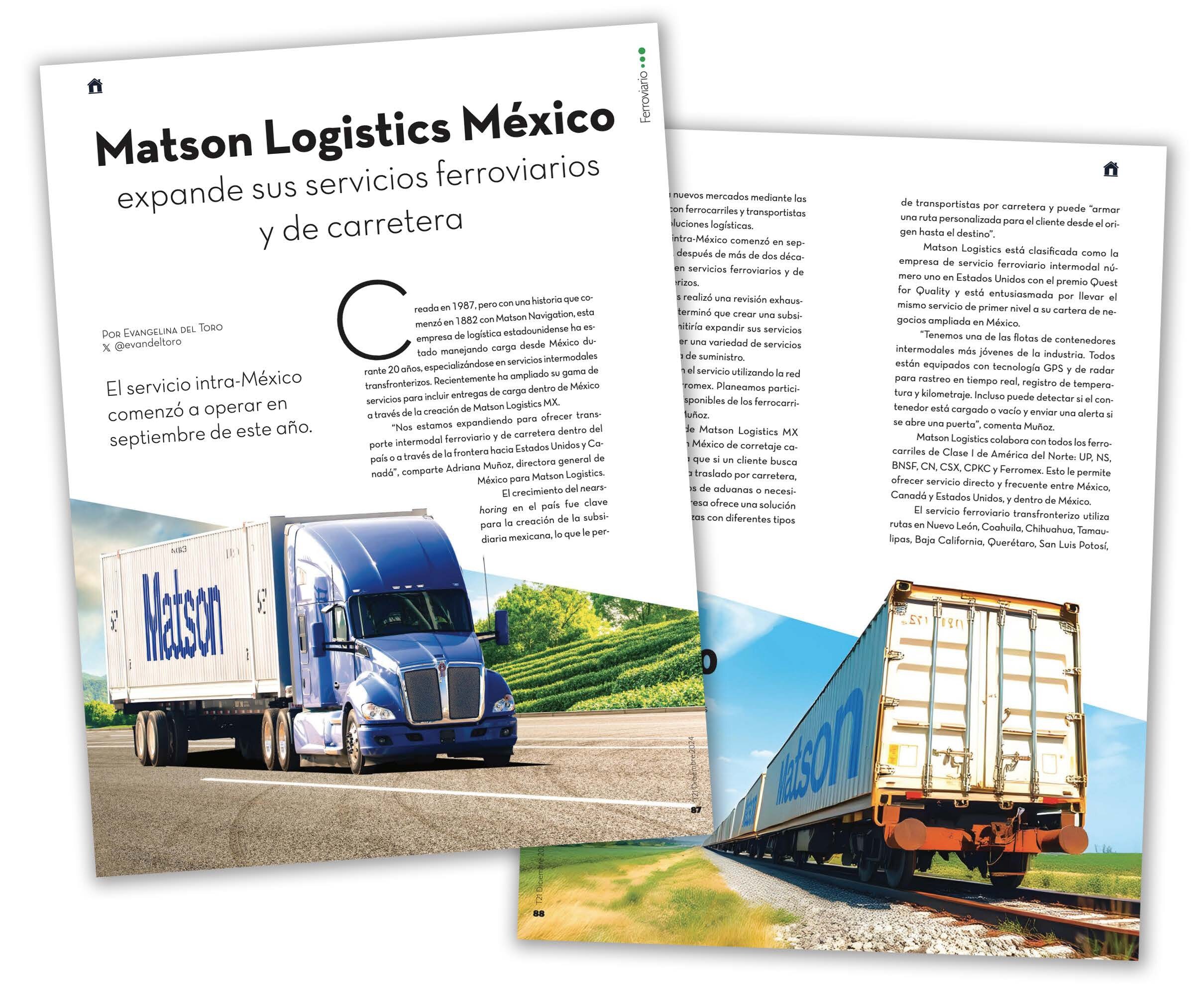
Geography keeps changing the assignment. Matson Logistics MX began domestic Mexico operations in September 2024, adding highway and intermodal brokerage to existing cross-border work. It launched using Ferromex’s Interpacific network. The company connected the expansion to nearshoring demand: production moving closer to North American markets creates a different set of journeys to organize.

“Rigid processes fail when conditions change overnight.”
Michael Johnson, VP, International Supply Chain · January 2026
For a shipper, the copyable lesson is to map the troublesome connections before buying transport. Compare the total route, including storage, packaging, handling, and delay exposure. Ask which jobs one provider can coordinate, and whether that arrangement improves your particular deadline. A simple move already served well by a direct carrier may need little additional orchestration. Rail requires suitable lanes and timing; consolidation requires compatible freight. Matson Logistics is most interesting where the journey has unfinished business.