At Brown Trucking’s 2025 Million Mile Hall of Fame celebration, Tyrone Sanders stood beside a luminous “2M” sign. There were balloons, a leather jacket and the rather unusual spectacle of a logistics business celebrating someone for doing an ordinary thing extraordinarily many times. Sanders, based in Raleigh, was the company’s two-million-mile honoree. Five colleagues joined the one-million-mile class.
- Four divisions connect freight, storage, brokerage and airline provisioning.
- Owned capacity and partner carriers serve different shipping needs.
- Dedicated operations suit recurring demand; flexible services cover changing volumes.
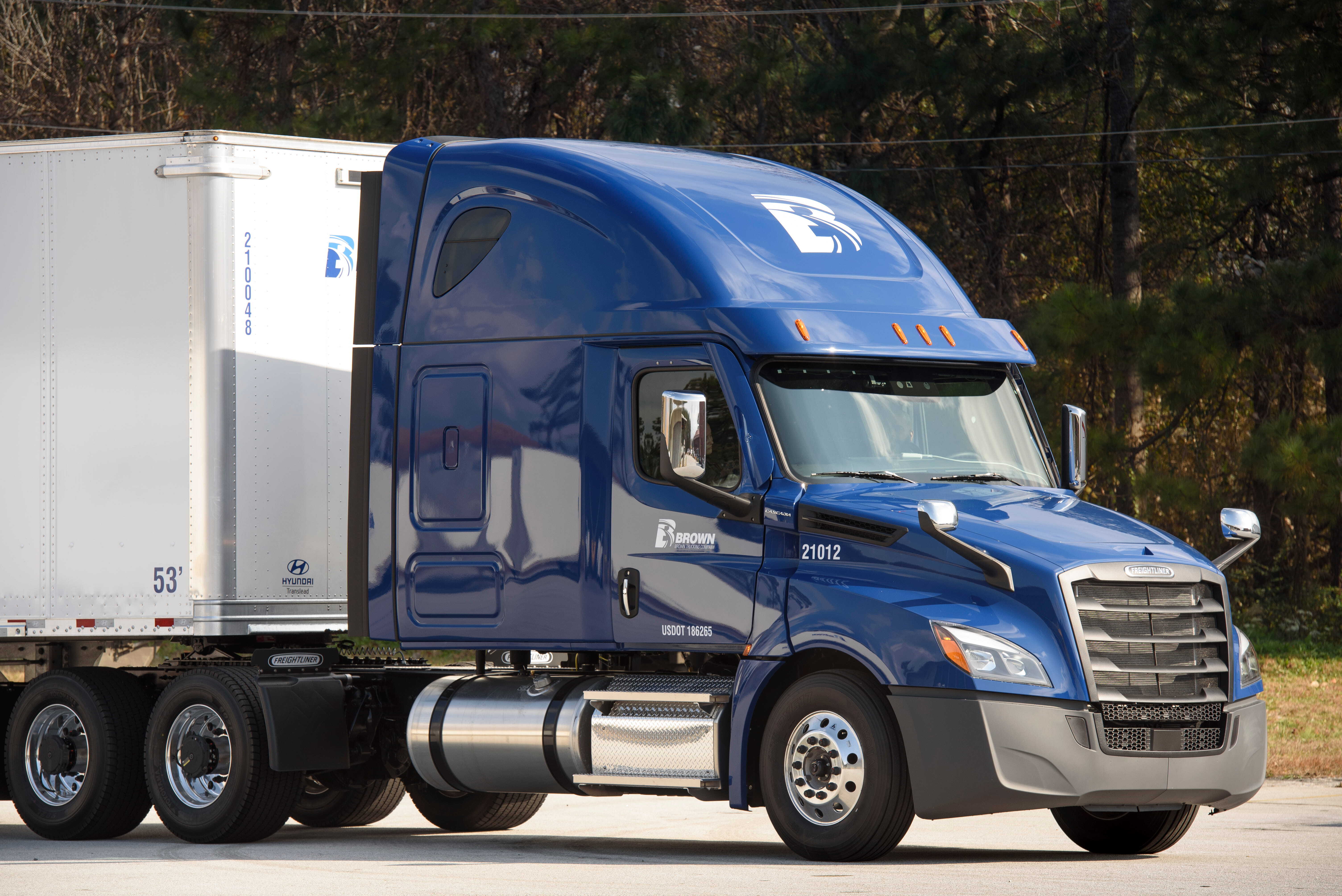
Freight is often described through equipment: tractors, trailers, warehouses. This photograph offers another unit of measurement. A person returns to the road, makes decisions, delivers, and does it again. Brown calls its drivers Commercial Vehicle Operators, or CVOs. The title has a certain ceremony. The work deserves some.
Brown Integrated Logistics has built its pitch around connecting that work to everything before and after it. Its four principal divisions cover trucking, freight brokerage, warehousing and airline provisioning. The proposition is simple enough to fit on a dispatch slip: fewer handoffs, clearer responsibility.

Four businesses, one awkward question
Consider a familiar shipping problem. Inventory is ready, a trailer is late, and the customer wants an answer. A warehouse operator can explain the dock schedule. A carrier can explain the traffic. A broker can explain the replacement truck. These explanations may all be accurate. They still leave the shipper managing the consequences. This is an illustrative situation, but it captures the coordination problem Brown markets itself against.
Brown Trucking supplies the asset-based transportation. Brown West Logistics handles warehouse operations. Brown Logistics Services arranges outside freight capacity. Brown Aviation Logistics manages provisioning inventory for commercial airlines. Brown describes the combined relationship as “one contract, one invoice, one point of contact.” That is a purchasing promise as much as an operational one.
The distinction from a standalone carrier or a brokerage-only provider is the combination of owned transport capacity, warehouse operations and a carrier network. Other integrated 3PLs, including Ryder and Kenco, occupy overlapping territory. Brown’s case rests on how well its divisions work together, rather than on inventing a new category.
The dump truck became a buying strategy
James W. Brown began with a dump truck in West Virginia in the mid-1960s. He moved to the Atlanta area in the early 1970s, started James Brown Trucking with four trucks, and incorporated James Brown Contracting in 1976. The current business uses 1965 as its founding year. The origin is agreeably concrete: one vehicle, then four, then an organization.
Brown retired and sold the business to Navigation Capital Partners in May 2008. Two years later, acquisitions widened the menu. Schrader Trucking added Tennessee capacity. The purchase of West Brothers’ companies brought transportation, brokerage, truck leasing and maintenance, and contract warehousing into the portfolio.
This matters because integration here was assembled through businesses already doing adjacent jobs. The useful managerial question is whether buying the next link in a supply chain makes the whole chain easier to operate. An acquisition can provide the capability; shared execution has to provide the benefit.
A warehouse bill has more than one floor
Brown serves manufacturers and shippers in paper and packaging, food and beverage, consumer goods, automotive, heavy equipment, healthcare and aviation. Publicly reported customers include Georgia-Pacific and United Airlines. Their requirements help explain the service mix: recurring freight lanes, inventory accuracy, specialized handling and delivery schedules that cannot simply wait for a convenient truck.
Dedicated contract carriage reserves equipment and assigns Brown employees to a customer’s operation. It suits consistent lanes and demanding schedules. Brokerage adds access to more than 15,000 partner carriers when geography or volume extends beyond the core fleet. That network is a pool of partner businesses, not 15,000 Brown-owned trucks.
Warehousing offers another choice. Contract operations provide dedicated space and teams, with barcode inventory tracking, business-system connections, lot controls, kitting and fulfillment. Public warehousing in Charlotte accommodates overflow and changing volumes. A shipper can buy individual services or combine them.
Brown’s published pricing example is revealing. For 150 pallets and 500 monthly orders, it illustrates $2,700 in storage, $750 in inbound handling, $750 in pick-and-pack, $500 in optional labeling and $250 in administration: $4,950 altogether. This is a hypothetical calculation, not a Brown rate card. Storage represents about 55% of the bill. Asking only about pallet rent would miss nearly half the example’s expense.
- Storage
- $2,700
- Inbound handling
- $750
- Pick & pack
- $750
- Optional labeling
- $500
- Administration
- $250
The airline blanket needs a barcode
Aviation gives the coordination argument a smaller, more peculiar object: the cabin item. Brown Aviation Logistics receives, tracks and kits passenger comfort items, safety supplies and service materials. Its provisioning facilities include Newark and Denver. This is the inventory behind the flight, a world far removed from selling airline tickets.
Barcode scans follow materials through receipt, storage, picking and outbound handoff. Rotation and expiration controls help determine what should leave first. Brown coordinates with planeside delivery partners; provisioning support should not be mistaken for operating an airline or owning the final airport delivery step.
The underlying expertise travels across industries. Whether the item is a cabin supply or a food product, someone must know what exists, where it is and when it can move. A warehouse management system gives that knowledge structure. People still have to act on it.
“one contract, one invoice, one point of contact”Brown Integrated Logistics · its stated customer proposition
Even the website had a handoff problem
Brown’s coordination challenge reached its own marketing. Farmers Marketing describes two disconnected company websites with different platforms and identities, weak lead generation and limited editing control. An earlier content effort had produced a warehousing account worth roughly $1 million in annual revenue, according to the agency’s case study. That result helped make the argument for broader investment.
The response was to consolidate the sites on HubSpot, organize pages around services and industries, preserve old links through redirects, and connect forms to lead tracking. Farmers reports organic clicks rising 42% and impressions 80% in the first 28 days. The reported ten-plus daily inquiries included job applications and general contacts as well as sales leads. They are not ten daily customers.
The practical lesson is refreshingly unglamorous: make the whole offering understandable, keep useful old content reachable, and track which inquiries become business. A transport company had to move its information into one place, too.
Buy the fit, then measure the promise
In June 2026, Brown appointed Ron Drogan chief executive, named Mike Stevens president of Brown Trucking, and promoted Kevin Slaughter to executive vice president of commercial operations. Slaughter joined in 1998, when the company operated fewer than 100 trucks. The appointments emphasize closer commercial and operational alignment.
For a prospective customer, the copyable move is to describe lanes, volumes, handling requirements and service windows before requesting a proposal. Brown’s own procurement guidance warns against vague requirements and incomplete cost comparisons. Agree on responsibility for exceptions, then measure delivery performance, inventory accuracy and damage.
Dedicated capacity makes sense when recurring demand can use it. Occasional loads or unpredictable storage may favor brokerage and public warehousing. Combining providers also concentrates responsibility, making performance reporting essential. Brown finished ninth in Inbound Logistics’ 2023 readers’ choice 3PL awards. Useful recognition; the decisive test remains the next shipment.