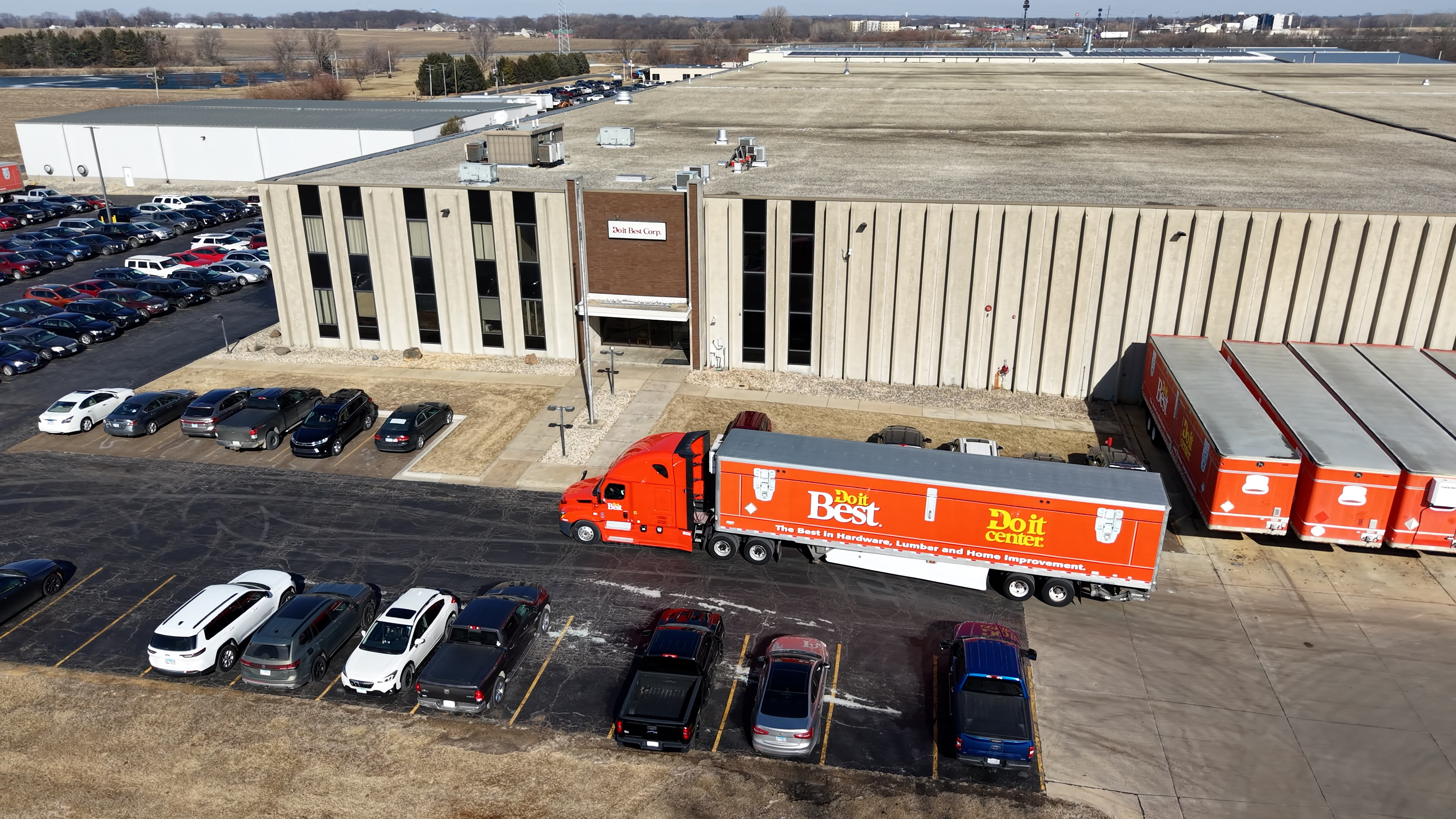
The revealing detail in Ruan’s partnership with Do it Best is the paint. The tractors and trailers carry the hardware cooperative’s colors and logos. A retailer watching a delivery arrive may never know that another company runs the fleet. For Ruan, this disappearance is part of the service. The customer keeps its public identity; somebody else gets the dispatch problems.
- Dedicated fleets let customers hand over drivers, equipment, and daily operations.
- Ruan also manages freight, warehouses, brokerage, and U.S.-Mexico customs clearance.
- At Dixon, Illinois, Ruan says every existing driver stayed through a carrier change.
- The useful lesson: protect local knowledge while improving the system around it.
That arrangement raises an interesting question. When a business outsources transportation, what exactly is it buying? Trucks are easy to count. A driver’s knowledge of a particular delivery route is harder to put on a balance sheet. Ruan’s business sits between those two kinds of value.
01 The people inside the painted trucks
Do it Best’s relationship with Ruan began with a 2023 transportation bidding process for Milbank, South Dakota. It expanded into Dixon, Illinois, and grew further following Do it Best’s acquisition of True Value. The cooperative’s priorities included keeping drivers, protecting service, and maintaining continuity for member retailers.
At Dixon, Ruan reports retaining 100 percent of the previous carrier’s drivers. That preserved people who already understood the routes and individual deliveries. It also made a substantial operational change less visible to the stores receiving goods.
“We are trying to solve problems - together.”
Ty Sordelet, VP of Logistics, Do it Best
The result suggests a practical rule for buyers: ask which people and routines must survive the transition before discussing what should change. A new provider can bring different software and equipment. The experienced driver may still know something the implementation plan has missed.
02 First, sell the family car
Ruan’s own beginning involved a considerably smaller fleet decision. On July 4, 1932, John Ruan hauled his first load of gravel. The truck was bought with money from selling his family’s car. During the Depression, transportation was both the business opportunity and the means of supporting the family.
Within months, one truck became three. The company survived trucking deregulation in the 1980s and later added non-asset logistics services as customers asked for them. Its evolution followed a useful progression: own the equipment, understand the work, then take responsibility for more of the customer’s operation.
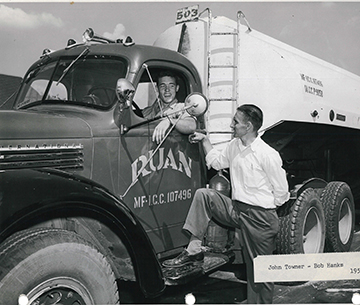
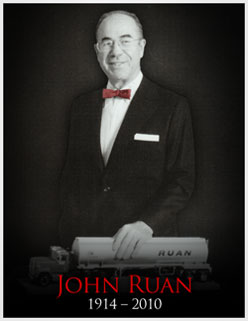
Family ownership continues, with chairman John Ruan IV and CEO Ben McLean leading the business. McLean became CEO in 2015; his background includes computer engineering, enterprise software, law, and finance. It is an unusually appropriate résumé for a company whose work joins physical assets to complicated information.
03 Buying the operation, not just the journey
Dedicated Contract Transportation is Ruan’s answer to running a private fleet. Long-term agreements provide shipper-specific drivers, equipment, and operating support. Ruan takes on recruiting, fleet management, and the daily demands that accompany keeping trucks available.
Managed Transportation addresses a different layer: choosing modes and carriers, planning freight, optimizing networks, and auditing and paying freight bills. Contract Distribution and Fulfillment adds warehouse operations and inventory systems. Freight Brokerage finds capacity through Ruan’s equipment and partner carriers, including opportunities to fill a truck’s return journey.
Network design → fulfillment → fleet or carrier → customs
Customers include Target, Daikin, Vital Farms, and industrial shippers. Daikin’s public account describes seeking logistics help after the pandemic disrupted its business. Ruan manages inbound raw materials and outbound HVAC shipments. The appeal is coordination across a network, rather than simply procuring another truck.
J.B. Hunt, Ryder, and Penske are alternatives in dedicated carriage. Ruan’s case rests on combining its own assets with outside capacity and local operating teams. That combination deserves scrutiny at the level of a particular customer’s routes, service requirements, and economics.
Safety supplies another piece of the operating discipline. Ruan traces its formal program to the 1940s. Today, Megasafe combines driving and workplace rules with education and loss prevention. For customers handing over a fleet, those practices belong in the evaluation alongside capacity and delivery performance.
04 A backlog is a rather honest starting point
Ruan’s newer 2026 fact sheet gives an unusually concrete example. A warehouse customer began with a 203,000-case backlog, 23-day lead times, and 75 percent fulfillment. Within seven months, Ruan says the backlog was eliminated, next-day delivery was achieved, and fulfillment reached 93 percent. The sheet reports a subsequent level of 99.53 percent.
A customer’s starting problem and reported recovery; the later measurement date is unspecified.
These figures describe a customer operation, not a company-wide guarantee. They nevertheless show how to judge the service: establish the starting conditions, then measure whether the work improved. Ruan also reports saving an unnamed dedicated customer $25 million over five years. That is a reported outcome, not a price list.
For a prospective buyer, the useful comparison is the full cost of serving the network: equipment, labor, maintenance, management, and service performance. A low freight quote can be an expensive way to ignore the rest.
Ruan’s engineering guidance also looks beyond individual loads. A new distribution center changes transportation, labor, and warehouse costs together. An acquisition can create overlapping routes. Seasonal promotions change delivery needs. Studying those relationships helps expose resources sitting idle while another part of the network needs them.
05 Idaho before everywhere
Technology follows the same operational logic. Ruan announced a partnership and investment in Mastery Logistics in 2021. Its first live fleet deployment of MasterMind arrived in Nampa, Idaho, in October 2025. Nampa was chosen for its manageable size and legacy dispatch system.
The deployment connected orders and dispatch with electronic logging and Ruan’s driver workflow application. Dispatchers gained visibility into tractor locations and drivers’ available working hours. Ruan planned to refine the system there before extending it to other fleets. The transferable idea is modest: pick a place where a change can be understood before making it everybody’s problem.
06 The next handoff is the border
In July 2026, Ruan launched Customs Brokerage through licensed entities in the United States and Mexico, connecting clearance and compliance with transportation and distribution. It extends the same proposition to another handoff where disconnected responsibilities can delay freight.
None of this makes a dedicated fleet the automatic choice for every shipper. Irregular demand may favor brokerage; improvement requires usable information and a customer willing to participate. Ruan itself emphasizes trust, resources, and tolerance for experiments that fail. The buyer’s work continues after the contract is signed. Ideally, the delivery looks entirely ordinary.
Readers can borrow that discipline without outsourcing anything. Record the baseline, identify the constraint, change a process, and measure again. Ruan’s continuous-improvement account explicitly starts with performance measures and supply-chain data. The persuasive evidence is what happens after the change, rather than how attractively the proposal describes it.
Follow the freight
Explore Ruan’s services, customer stories, and conversations on the road.